Travel eSIM Overtakes Carrier Roaming Among Korean Travelers: What the 2026 Survey Shows
For the first time, more Korean travelers used a travel eSIM than their carrier's roaming. The survey numbers, why travelers switched, and what it tells anyone planning a trip.
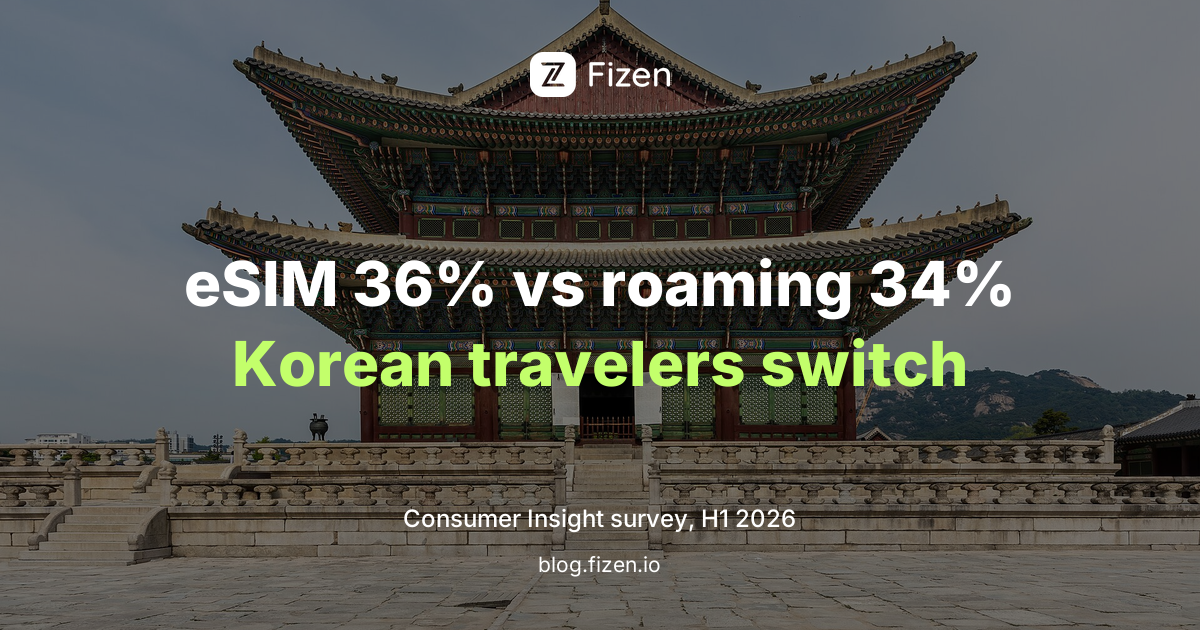
Quick answer: In a survey of 1,497 Korean overseas travelers in the first half of 2026, 36% used a travel eSIM and 34% used carrier roaming, the first time eSIM came out on top. Travelers cited low prices, more data for the money and easy activation, and gave eSIM the highest satisfaction score at 79%. Korea's big three carriers responded by adding data to roaming plans and launching new perks.
Key takeaways
- Travel eSIM use rose to 36% of Korean overseas travelers in H1 2026, up 8 points year on year, overtaking carrier roaming at 34%.
- Local SIM cards fell to 16% and portable Wi-Fi routers to 9%.
- Top reasons for choosing eSIM: low prices (64%), more data for the price (43%) and simple activation (41%).
- eSIM had the highest satisfaction at 79%, ahead of local SIM cards (64%) and roaming or Wi-Fi routers (58% each).
- KT, LG Uplus and SK Telecom are answering with bigger roaming data allowances, travel partner perks and calling apps.
South Korea is one of the most connected travel markets in the world, and its carriers have long sold convenient roaming packs. That is why this data point matters: in the first half of 2026, more Korean travelers bought a travel eSIM than switched on their carrier's roaming. Here is what the survey found and what it means for anyone deciding how to stay online abroad.
What did the 2026 survey find?
The numbers come from Consumer Insight's 43rd Mobile Telecommunications Survey of 1,497 overseas travelers, reported by the Seoul Economic Daily on 2 September 2026.
| How travelers got data abroad | H1 2026 | Year earlier |
|---|---|---|
| Travel eSIM | 36% | 28% |
| Carrier roaming | 34% | 32% |
| Local SIM card | 16% | 20% |
| Portable Wi-Fi router | 9% | 12% |
| Free Wi-Fi only | 6% | n/a |
The shift is mostly away from physical options. Local SIM cards and pocket Wi-Fi both lost share, while eSIM gained 8 points and roaming grew slightly.
Why are travelers choosing eSIM over roaming?
- Price. 64% of eSIM users named low prices as the reason.
- Data for the money. 43% said they get more data relative to the price.
- Easy setup. 41% cited simple application and activation.
- Satisfaction. eSIM scored 79%, the highest of all options, compared with 64% for local SIM cards and 58% for both roaming and Wi-Fi routers.
The pattern matches what travelers everywhere report: a travel eSIM is bought before the trip, installed at home, and works on landing, without a kiosk queue or a device to carry and charge.
How are Korean carriers responding?
| Carrier | Response reported |
|---|---|
| KT | Bigger data and longer validity on Shared Roaming plans from 1 September, plus a new larger plan |
| LG Uplus | Joined the Wonderjoy Travel Alliance after a Japan pilot, adding partner benefits in Japan, Singapore and Taiwan |
| SK Telecom | Launched the A. (A dot) Phone app for free calls to Korea or local numbers while abroad |
Competition is good news for travelers in any country: roaming plans are getting better precisely because eSIMs made the comparison easy.
Roaming or travel eSIM: how to choose for your trip
| Your situation | Usually the better fit | Why |
|---|---|---|
| Short trip, light use, need your number for calls | Carrier roaming | Nothing to install, number works as usual |
| Heavy data use: maps, video, hotspot | Travel eSIM | Fixed data price shown before you pay |
| Multi-country trip | Regional travel eSIM | One plan across several countries |
| Long stay with a local phone number needed | Local SIM or local carrier eSIM | Local number for deliveries and bookings |
| eSIM-only phone | Travel eSIM or local eSIM | No SIM tray for physical cards |
Many travelers combine the two: keep the home line on for calls and SMS codes with data roaming off, and use a travel eSIM for data.
How much data do you actually need abroad?
The reason eSIM wins on value is that most people know roughly how much data they use. A rough guide helps you avoid paying for either too little or far too much.
| Trip style | What uses data | Rough daily need |
|---|---|---|
| City break, maps and messaging | Navigation, ride-hailing, chat, photos | Light: under 1 GB a day |
| Busy sightseeing with social media | Maps, video stories, uploads | Moderate: around 1 to 2 GB a day |
| Working trip or hotspot for a laptop | Video calls, cloud files, tethering | Heavy: several GB a day or an unlimited plan where offered |
These are estimates, not rules. Streaming video and hotspot use are the biggest variables. Our data guide goes deeper.
Before you rely on roaming, check these five things
- Daily or per-GB price in your destination, not just the headline plan name.
- Speed caps after a data allowance is used, which can make maps and video painfully slow.
- Automatic daily passes that start charging when your phone touches a network abroad.
- Validity of roaming packs, which may be shorter than your trip.
- Hotspot rules if you plan to share data with a laptop or companion.
If any of these look unclear or expensive, a travel eSIM with the price shown before you pay is usually the simpler choice. You can still keep roaming on standby for calls.
How to set up a travel eSIM before your trip
- Check that your phone supports eSIM and is carrier-unlocked.
- Choose a plan for your destination and trip length, for example on fizen.io/esim.
- Install the eSIM at home over Wi-Fi.
- After landing, turn on the eSIM line, enable data roaming for it and set it as your cellular data line.
- Keep your home SIM on for calls and bank codes, with its data roaming switched off to avoid charges.
Popular destinations for travelers from Korea
Korean travelers' favourite short-haul destinations include Japan, Vietnam, Thailand, the Philippines and Taiwan. Each has its own quirks for connectivity: in Japan, maps and train transfers need live data; in Vietnam, Grab and QR payments need data from the moment you leave the terminal.
- Best travel eSIM for Japan
- Best travel eSIM for Vietnam
- Best travel eSIM for Thailand
- Best travel eSIM for Taiwan
What this means beyond Korea
Korea is often an early signal for mobile habits. When travelers in a market with strong carrier roaming products move to eSIM, it suggests the same shift will keep spreading as more phones ship eSIM-first. For travelers, the practical lesson is simple: compare before you fly. Land connected, skip the roaming bill: Fizen travel eSIMs cover 150+ destinations with plans from $4 and can be paid in USDT. Pick your destination.
Frequently asked questions
Do more Korean travelers use eSIM than roaming now?
Yes. In Consumer Insight's survey of 1,497 overseas travelers in H1 2026, 36% used a travel eSIM and 34% used carrier roaming, the first time eSIM led.
Why do travelers prefer eSIM?
In the survey, 64% cited low prices, 43% said more data for the price and 41% named simple activation. eSIM also had the highest satisfaction at 79%.
Is carrier roaming still worth it?
It can be for short trips with light data use, or when you need your usual number for calls. For heavier data use, a travel eSIM usually gives a clearer fixed price.
How are KT, LG Uplus and SK Telecom responding?
KT increased data and validity on Shared Roaming plans from 1 September 2026, LG Uplus added travel partner benefits in Japan, Singapore and Taiwan, and SK Telecom launched a calling app for travelers.
Can I use a travel eSIM and keep my Korean number?
Yes. Travel eSIMs are usually data-only, so your Korean line stays active for calls and SMS codes while the eSIM handles data.
When should I install a travel eSIM?
At home over Wi-Fi before you fly. Switch it on after landing. For most plans validity starts on first connection, but check the plan details.
Land connected, skip the roaming bill
Travel eSIM for 150+ destinations, plans from $4, one-tap install on supported iPhones, pay in USDT. Trip-long warranty with free 1-for-1 replacement if an eSIM fails.
Terms and conditions
- Information only. This article summarises public reporting of a third-party survey and is general information, not advice.
- For readers in the United States. This article provides information only. It is not an offer, solicitation or sale of any product or service, and it is not financial, investment, legal or tax advice. Fizen is not offered to US Persons.
- Survey data. Figures are as reported by the Seoul Economic Daily from Consumer Insight's survey and may be revised by the source.
- Plans vary. eSIM prices, data, hotspot support and validity depend on the plan and are shown at checkout, which takes precedence over this article. Your phone must support eSIM and be carrier-unlocked. Travel eSIMs are data-only.
- No affiliation. Fizen is not affiliated with Consumer Insight, KT, LG Uplus, SK Telecom or any carrier named here.
- Availability. Fizen is not offered to US Persons. Product availability varies by country.
- Full terms. Master Terms of Use, Privacy Policy and Disclaimer on the Fizen site.
Sources
Information as of 15 September 2026.