eSIM vs Pocket WiFi vs Local SIM: Which Is Best for Travel (2026)
eSIM, pocket WiFi or a local SIM? The honest comparison for 2026: what each costs, what is convenient, and which fits your trip.
Key takeaways
- An eSIM is usually the simplest for one traveler: install before you fly, no queue, no extra device.
- Pocket WiFi makes sense when several people or many devices share one connection, but it is a gadget to carry and charge.
- A local physical SIM can be cheap but means a shop queue, swapping out your home SIM, and sometimes ID registration.
- With Fizen the eSIM is bought in USDT with no bank card, and one balance also pays by Visa and QR.
There are three common ways to get online abroad: a travel eSIM, a pocket WiFi device, or a local SIM card. Each wins in different situations. Here is the honest comparison for 2026 so you pick the right one for your trip.
New to Fizen? Open the eSIM tab in the Fizen app and $10 of eSIM credit is added automatically. New accounts only, while the campaign runs. Claim it here →
Quick comparison
When an eSIM is the best choice
For one traveler on a short or medium trip, an eSIM is usually the easiest option. You buy and install it before you leave, keep your home number active on its own line, and land already connected. There is no shop queue, no tiny SIM to swap and lose, and nothing extra to carry or charge.
When pocket WiFi or a local SIM still makes sense
Pocket WiFi is worth it when a family or a group wants several devices on one connection, or when you carry a laptop and phone and tablet all day. A local physical SIM can be the cheapest raw data for a long stay, if you are happy to queue, register ID where required, and swap out your home SIM. If your phone cannot run an eSIM, a local SIM is your route.
If an eSIM fits, you can compare plans on Fizen eSIM pricing and pay in USDT with no bank card. See the full Fizen eSIM page.
Get the Fizen eSIM and set it up
Frequently asked questions
Is an eSIM better than pocket WiFi?
For one traveler, usually yes: an eSIM needs no extra device to carry or charge, and you install it before you fly. Pocket WiFi wins when several people or many devices share one connection.
Is an eSIM cheaper than a local SIM?
A local SIM can be cheaper for raw data on a long stay, but an eSIM saves the shop queue, ID registration and swapping out your home SIM. For short trips the convenience usually wins.
Can I keep my home number with an eSIM?
Yes. On a dual-SIM phone the eSIM handles data while your physical SIM keeps your home number active for calls and texts.
Do I need to return an eSIM like pocket WiFi?
No. An eSIM is software, so there is nothing to collect or return. If a Fizen eSIM fails, a real person swaps it one to one.
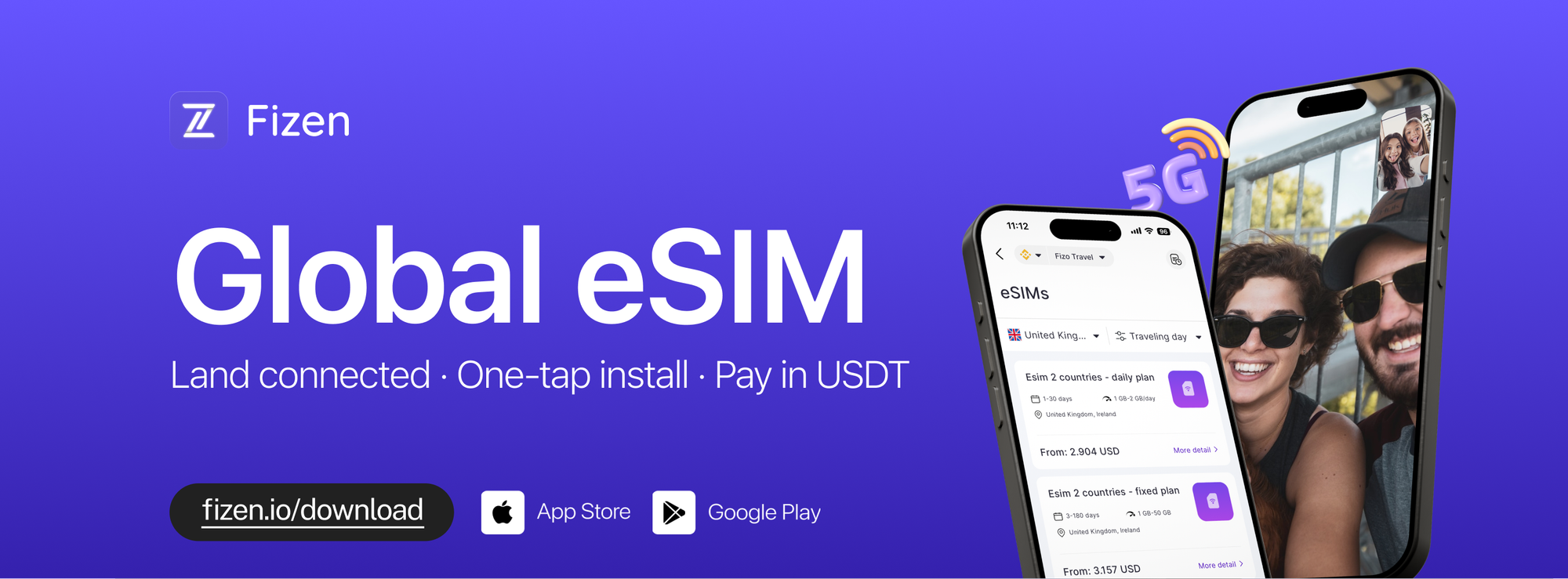
Land already online, from $4.
No midnight SIM queue, no roaming bill that eats your budget. A Fizen eSIM covers 150+ countries, with daily 1GB, 3GB and 5GB plans or unlimited data. Pay with USDT, or by card via Stripe, Apple Pay or Google Pay. And on the rare day one fails, you get a one-to-one replacement and a person who actually answers, not a ticket that replies next week.
Fizen eSIM works across 150+ countries; you pay in USDT with no bank card, and if a Fizen eSIM ever fails a real person swaps it one to one. See the Fizen eSIM page and eSIM pricing. Fizen is a self-custody app, backed by an investment from Tether.
Fizen eSIM docs
Terms and conditions
- Information only. Fizen publishes this article to inform, not to sell. Nothing here is an offer or solicitation, and it is not financial, investment, legal or tax advice. Prices, rules and availability change; check official sources.
- For readers in the United States. This article provides information only. It is not an offer, solicitation or sale of any product or service, and it is not financial, investment, legal or tax advice. Fizen is not offered to US Persons.
- Full terms. Master Terms of Use, Privacy Policy and Disclaimer on the Fizen site.