$1.2 Billion in Remittances Went Missing in Vietnam. Crypto Was Only One Reason.
Roughly $1.2 billion that used to reach Ho Chi Minh City through banks did not this year. Six forces pulled at the same number in the same six months, and only one of them was crypto.
Key takeaways
- Remittances through Ho Chi Minh City's licensed channels fell to $4.04 billion in the first half of 2026, down 22.8% year on year. That is roughly $1.2 billion that used to arrive through banks and did not.
- The State Bank of Vietnam names the causes plainly: a slow global recovery, high inflation and living costs abroad, prolonged tight monetary policy, Middle East conflict, a strong dollar, and tightened immigration policy.
- A sixth force arrived on 1 January 2026: the new US 1% excise tax on cash-funded remittance transfers. US outbound remittances fell 5.5% over January to September, with California down 9%.
- Payment rails moving outside the official series are a real factor too, but only one among several. Nobody has published the split, so treat any single-cause explanation with suspicion.
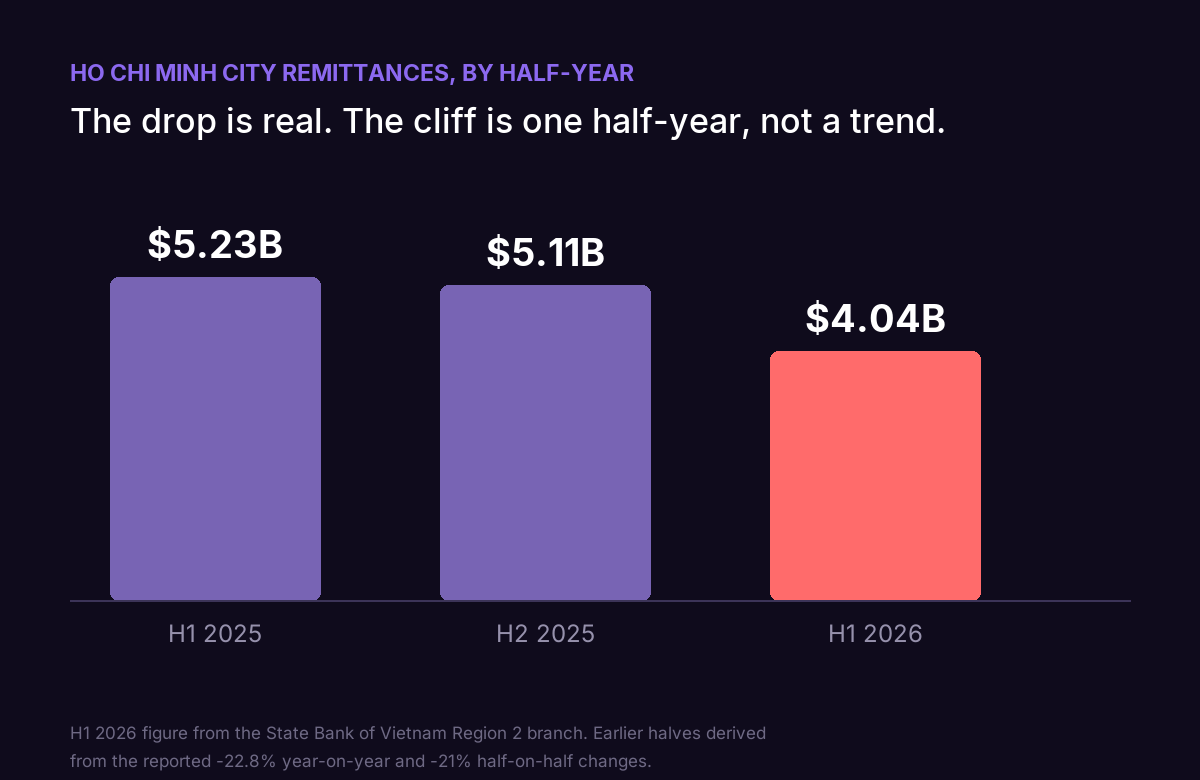
- The trend inside the year is steadier than the headline: Q2 was $2.03 billion, up 1.4% on Q1, and the full-year forecast is still $8.6 to $8.9 billion.
Remittances into Ho Chi Minh City, the largest receiving hub in Vietnam, came to $4.04 billion in the first half of 2026, down 22.8% year on year and 21% below the second half of 2025, according to the State Bank of Vietnam's Region 2 branch. That is roughly $1.2 billion that used to arrive through banks and licensed operators, and did not.
It is tempting to reach for one dramatic explanation. The data does not support one. At least six separate forces pulled at this number in the same six months, and they are worth separating.
Six reasons remittances to Vietnam fell
1. Incomes abroad got squeezed
The regulator's own explanation leads here: a slow global recovery, with high inflation and rising living costs in the countries where Vietnamese workers live. Remittances come out of what is left after rent and groceries, and that residual shrank. Prolonged tight monetary policy in major economies added to it by pressuring the businesses that employ those workers (Dien dan Doanh nghiep).
2. A new 1% US tax on cash-funded transfers
From 1 January 2026 the One Big Beautiful Bill Act applies a 1% federal excise tax to remittance transfers funded with cash, money orders or cashier's cheques. Transfers funded from a bank account, debit or credit card, or a digital wallet are exempt. The effect showed up quickly: US outbound remittances fell 5.5% from January to September, California down 9%, Texas down 3%. The Americas send roughly 34% of Ho Chi Minh City's inflow, so a US-specific shock lands squarely on this dataset.


3. Immigration policy tightened
Fewer people working abroad, or working under more precarious status, means fewer and smaller transfers. The State Bank names tightened immigration policy directly as a driver. It affects both the number of senders and how confident they feel about parting with savings.
4. A strong dollar changed the timing
When the dollar is strong against the dong, each dollar sent buys more. That sounds like it should raise the numbers, and sometimes it does. It also encourages families to hold and send later, or to send less to achieve the same result at home. Exchange-rate movement changes the timing of remittances as much as the amount, which is one reason quarterly figures swing this hard.
5. Geopolitics feeding into energy and inflation
Middle East conflict pushed energy price volatility and global inflation pressure through the same channel as everything above: less disposable income in the sending countries, particularly for workers in the Gulf, where a meaningful number of Vietnamese labourers work.
6. Some of it moved to rails nobody counts
This is the factor that gets the headlines, and it deserves its place, in proportion. The official figure counts money passing through credit institutions and licensed economic organizations. Vietnamese families have used informal hand-carry channels for decades, long before anyone held a stablecoin. What is new is a digital version of the same thing: global stablecoin payment flows grew roughly 60% year on year, Asia originates about 60% of that volume, and Western Union and MoneyGram have both launched their own USDC settlement corridors (Forbes). But no one has published how much of Vietnam's missing volume moved that way. Anyone quoting a precise crypto share is guessing.
The honest read
Put simply: the official series measures one pipe, and several unrelated forces reduced what goes into it. Incomes abroad fell, a new tax made the cheapest cash-funded route slightly more expensive, immigration policy shrank the sender pool, and a portion of the flow shifted to channels that were never in the dataset. Attributing the whole drop to any one of those, crypto included, is the kind of story that reads well and ages badly.
Worth keeping in view: Q2 was up 1.4% on Q1, and the regulator still expects $8.6 to $8.9 billion for the year. This looks more like a hard reset than a collapse.
If you are the one sending
None of the six forces above are things a sender can do anything about. The one variable still in your hands is the route, and the route is where most of the quiet cost sits. Not the advertised fee: the exchange rate you get, the days the money spends in transit, and what the receiving side pays to turn it into dong.
That last part is the one worth pricing. Fizen moves money as USDT across 64 countries and more than 30 chains, arriving in minutes rather than days, with payout in Vietnam to a bank transfer or a Visa card. The balance sits in a self-custody wallet, so no company in the middle decides when it is released. It is backed by a strategic investment from Tether. One thing to know up front: Fizen is not offered to US Persons, so this is a route for senders in Japan, Korea, Taiwan, Australia, Canada and the rest of the 64, which between them supply most of Vietnam's inflow anyway.
Two smaller details, filed here without comment. Eligibility inside the app follows the documents on the account, not where the money ends up, which is why the in-app QR payments are built for people holding foreign papers in Vietnam. And in Vietnam a VietQR code is not only a shop's till: every bank account has one too.
Corridor-by-corridor comparisons are in how to send money to Vietnam with USDT and USDT vs Wise vs Western Union. Compare the landed amount in dong, not the advertised fee.
Ways to send money to Vietnam in 2026, compared
If the six forces above are outside your control, the route is not. These are the ways money actually reaches Vietnam, and where each one quietly takes its cut. The World Bank puts the global average cost of sending $200 at 6.36%, while the cheapest quartile of providers averages 3.29% (Remittance Prices Worldwide). The gap between those two numbers is the whole game.
| Route | How fast | Where the cost hides | Suits |
|---|---|---|---|
| Bank wire (SWIFT) | 1 to 5 business days | Sending fee, correspondent bank fee, receiving bank fee, plus the exchange-rate spread | Large one-off transfers where a paper trail matters |
| Cash at an agent counter | Minutes | Usually the highest headline fee band, plus the spread. From the US, add the 1% excise tax | Recipients without a bank account |
| Online remittance apps | Same day to 2 days | Mostly the exchange-rate markup, and promotional first-transfer rates that do not repeat | Regular monthly transfers to a bank account |
| Bank app or e-wallet partner payout | Minutes to hours | Spread plus a partner payout fee, and caps on how much can land per day | Smaller, frequent amounts |
| Stablecoin (USDT) with payout to bank or card | Minutes | Blockchain network fee plus the on-ramp and off-ramp spread at each end | Senders who want speed and a rate visible before confirming |
One rule cuts through all of it: compare the dong that lands, not the fee on the front page. A route advertising zero fees can still deliver less than one charging $5, because the exchange rate is doing the charging. Send the same amount two ways once, write down both numbers, and you will not have to wonder again.
Sending to Vietnam from the biggest corridors
Asia supplies about 47.5% of Ho Chi Minh City's inflow and the Americas about 34.1%, so most of this money starts in Japan, Korea, Taiwan, the United States, Australia and Canada. The practical differences are corridor-specific: Japan and Korea have deep bank-transfer competition but slow cut-off times, Australia and Canada tend to have the widest exchange-rate spreads on small amounts, and the United States is the only corridor where the new 1% excise tax applies at all, and only when the transfer is funded with cash.
Frequently asked questions
Did remittances to Vietnam go up or down in 2026?
Down through formal channels. Ho Chi Minh City, the largest receiving hub, took in $4.04 billion in the first half of 2026, a 22.8% drop year on year and 21% below the second half of 2025. Within the year the slide is flattening: Q2 came in at $2.03 billion, up 1.4% on Q1, and the State Bank of Vietnam's Region 2 branch still forecasts $8.6 to $8.9 billion for the full year.
Why did remittances to Vietnam drop so much in H1 2026?
There is no single cause. The regulator cites a slow global recovery with high inflation and living costs eating into what overseas workers can spare, prolonged tight monetary policy in major economies squeezing the businesses that employ them, Middle East conflict pushing energy prices and inflation, a strong US dollar, and tightened immigration policy. On top of that, a new 1% US excise tax on cash-funded remittances took effect on 1 January 2026, and some money now moves on rails the official series does not count.
What is the new US 1% remittance tax?
Under the One Big Beautiful Bill Act, a 1% federal excise tax applies from 1 January 2026 to remittance transfers funded with cash, money orders or cashier's cheques. Transfers funded from a bank account, a debit or credit card, or a digital wallet are not covered. US outbound remittances fell 5.5% between January and September, with California down 9% and Texas down 3%. The Americas send about 34% of Ho Chi Minh City's remittances, so this matters for Vietnam.
Is crypto the reason remittances to Vietnam fell?
It is one factor, not the explanation. Global stablecoin payment flows did grow at roughly 60% a year, and Western Union and MoneyGram both launched USDC settlement corridors. But nobody has published how much of Vietnam's missing volume moved that way, and the economic pressures above are enough to explain a large part of the drop on their own. Anyone quoting an exact crypto share is guessing.
What is the cheapest way to send money to Vietnam in 2026?
It depends on how you fund the transfer and what happens to the money on arrival. Compare the landed amount in dong rather than the advertised fee, because exchange-rate markup usually costs more than the visible charge. If you fund from cash in the US, add the new 1% excise tax. And check what the receiving side pays to convert or withdraw, since that is where a good rate often gets given back.
How much money do Vietnamese overseas send home each year?
Ho Chi Minh City alone, which receives the largest share, is forecast at $8.6 to $8.9 billion for 2026. Asia supplies about 47.5% of the city's inflow and the Americas about 34.1%, so the biggest single corridors run from Japan, Korea, Taiwan and Australia as well as from the United States.
How long does it take to send money to Vietnam?
It depends entirely on the route. A SWIFT bank wire typically takes one to five business days. Online remittance apps usually land the same day or within two days. Cash at an agent counter is available in minutes for pickup. Stablecoin transfers settle in minutes on-chain, with the payout to a Vietnamese bank account or card depending on the provider's off-ramp.
Can I send money to Vietnam without a bank account?
Yes, but the options narrow. Cash-to-cash pickup through an agent network works without either side holding an account, and it is usually the most expensive route. If the sender has no account but the recipient does, wallet and stablecoin routes can work. If you are sending from the United States and funding with cash, the 1% excise tax applies to that transfer.
Send it once. It lands in minutes.
Fizen sends USDT across 64 countries and 30+ chains, with payout in Vietnam to a bank transfer or a Visa card. Self-custody, so nobody in the middle holds the money. Backed by a strategic investment from Tether. Not available to US Persons.
Terms and conditions
- Availability. Fizen is not offered to US Persons. Supported corridors, payout methods and limits vary by country and can change without notice. Check what is available for your route in the app before you rely on it.
- For readers in the United States. This article provides information only. It is not an offer, solicitation or sale of any product or service, and it is not financial, investment, legal or tax advice. Fizen is not offered to US Persons.
- Not advice. This article is news and analysis. It is not investment, tax, legal or financial advice, and nothing here is a recommendation to buy, sell or hold any asset. Tax treatment of transfers depends on your own circumstances and country.
- Figures. All data is as reported on 26 August 2026 by the sources linked in this article. Official statistics are revised; check the source before quoting.
- Transfers. On-chain transfers are irreversible once confirmed. Blockchain network fees and third-party on-ramp and off-ramp spreads apply and are not set by Fizen. Confirm the network and send a small test amount first.
- Self-custody. You hold your own keys. No one, Fizen included, can restore your wallet if you lose your recovery phrase.
- Rates and comparisons. Any comparison of ways to send money to Vietnam is general and illustrative. Costs change daily and by provider, amount, funding method and corridor. Always compare the amount that actually lands.
- Full terms. Master Terms of Use, Privacy Policy and Disclaimer.
- QR Pay funding. Fizen QR Pay is funded only with USDT on Solana or BNB Chain: no bank account link, no card, no VND or PHP deposit, and no other token or network. USDT on another network, or another token, cannot be deposited. QR Pay is for cross-border use by travellers and foreigners and is governed by the Fizen QR Pay Terms.
Figures as of 26 August 2026 from the State Bank of Vietnam Region 2 branch via VIR and Thanh Nien, the IRS on the remittance transfer tax, Border Report on its early effect, and Deutsche Bank's 2026 digital assets outlook. News coverage, not investment or tax advice.
Sending to Vietnam, corridor by corridor
- How to send money to Vietnam with USDT
- Philippines: a record half, the slowest growth in four years
- Japan to Vietnam
- Korea to Vietnam
- Australia to Vietnam
- Canada to Vietnam
- Wise alternative in Vietnam
- Sending money to parents and family overseas
Remittances in 2026, country by country
- Philippines: a record half, and the slowest growth in four years
- India: $144.8 billion, the largest inflow any country has ever recorded
- Bangladesh: a record $35.56 billion after the hundi crackdown
- Pakistan: $41.6 billion, with one record month of $4.25 billion
- Nepal: Rs7 billion a day, worth a third of the economy
- Indonesia: $4.5 billion a quarter from 4.2 million workers
- Nigeria: official inflows up 45% after the exchange-rate reforms
- Kenya: the boom has stopped, and 2026 may be the first fall since 2009
- Egypt: up 31% in a year on one exchange-rate decision
- Mexico: growing again, still $3 billion below the peak