Nigeria's Official Remittances Jumped 45%. The Money Did Not Change. The Route Did.
Nigeria's official remittance numbers jumped 45% in a single quarter. Nigerians abroad did not suddenly become 45% more generous. The money changed channel, which is exactly what the reforms were designed to do.
Key takeaways
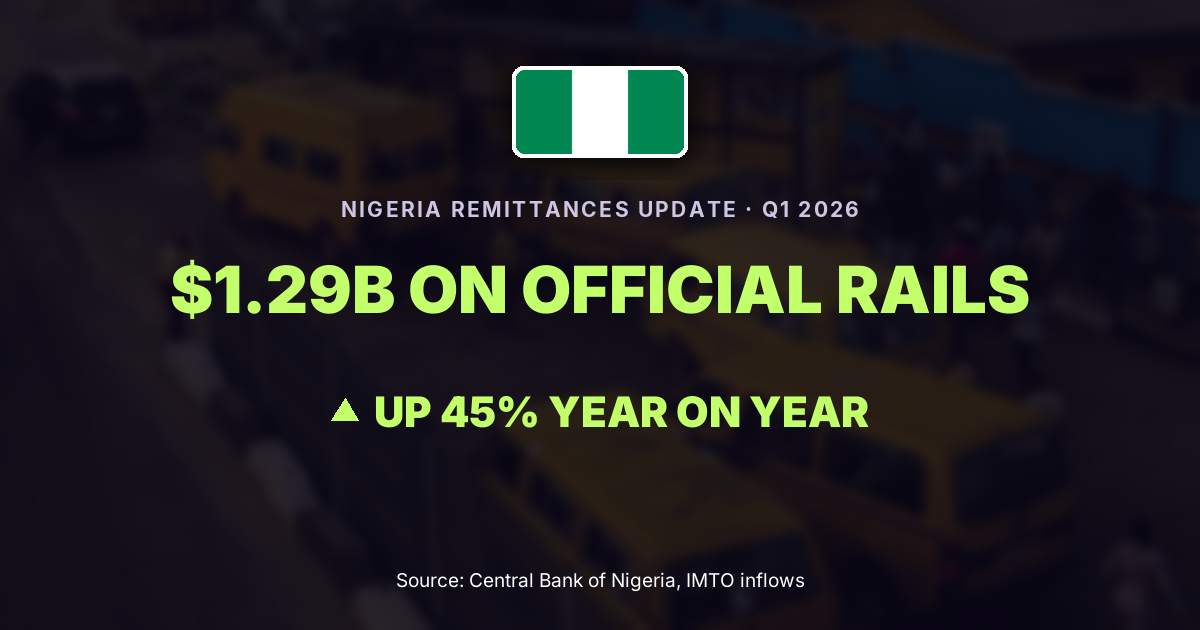
- Inflows through licensed International Money Transfer Operators reached a record $1.29 billion in Q1 2026, up 45% million in Q1 2025.
- The Central Bank of Nigeria is targeting about $1 billion a month in official diaspora remittances by the end of 2026, up from more than $600 million currently.
- From 1 May 2026 all licensed IMTOs must pay recipients exclusively in naira, at the prevailing market rate reflected through Bloomberg BMatch.
- The rise is mostly a channel shift. Nigeria's true diaspora flow has always been far larger than the official series, with much of it moving through informal networks.
- Whether the trend holds depends on one thing: how close the official payout rate stays to the parallel-market rate.
Inflows through licensed International Money Transfer Operators hit a record $1.29 billion in the first quarter of 2026, up 45% million in the same quarter of 2025, according to Central Bank of Nigeria data (reported here).
Nigerians abroad did not become 45% more generous in twelve months. The money moved channel. That distinction is the whole story, and it is also the reason the number is fragile.
The numbers, in one place
- $1.29 billion through IMTOs in Q1 2026, a record.
- $888.47 million in Q1 2025, so a rise of 45%.
- >$600 million a month currently, against a CBN target of about $1 billion a month by end-2026.
- Naira-only payout from 1 May 2026, at the market rate reflected through Bloomberg BMatch.
- Foreign exchange reserves are the policy motive: remittances are the cheapest hard currency Nigeria can attract.
What the reforms actually did
1. They made the official rate worth using
For years the gap between the official exchange rate and the parallel-market rate meant that anyone sending money to Nigeria through a bank was donating the difference. Families used informal operators instead, who paid the street rate. Once the official rate was allowed to move closer to the market, that penalty shrank, and volume followed. This is the entire mechanism behind the 45%.
2. The naira-only payout rule
From 1 May 2026 the CBN requires all licensed IMTOs to pay out exclusively in naira, at the prevailing market price reflected through Bloomberg BMatch (Technext). The stated aim is transparency and traceability of foreign exchange flows. The practical effect is that recipients can no longer take dollars, which removes a store-of-value option many families relied on during periods of high inflation.
3. Remittances as reserve policy
The CBN's $1 billion a month target is not really about families. It is about foreign exchange reserves. Remittances are the cheapest hard currency any developing economy can attract: no interest, no repayment, no conditionality. That is why so much policy attention has landed on a flow that governments historically ignored.
The honest read
Two cautions belong on this number. First, a channel shift can only happen once. The 45% measures migration from informal to formal rails, not growth in what Nigerians abroad actually send, and the second year of that migration is always smaller than the first.
Second, the whole gain rests on the exchange rate staying honest. If the official payout rate drifts away from the parallel rate again, families will go straight back to the operators who pay more, and the recorded inflow will fall while the real inflow does not change at all. The naira-only rule makes that risk sharper, not softer, because it removes the option to simply hold dollars.
Ways to send money to Nigeria in 2026, compared
The World Bank puts the global average cost of sending $200 at 6.36%, while the cheapest quartile of providers averages 3.29% (Remittance Prices Worldwide). Every point of that gap is a choice, not a fact of life. These are the routes money actually takes, and where each one quietly takes its cut.
| Route | How fast | Where the cost hides | Suits |
|---|---|---|---|
| Bank wire (SWIFT) | 1 to 5 business days | Sending fee, correspondent bank fee, receiving bank fee, plus the exchange-rate spread | Large one-off transfers where a paper trail matters |
| Cash at an agent counter | Minutes | Usually the highest headline fee band, plus the spread. Note that licensed operators must now pay out in naira | Recipients without a bank account |
| Online remittance apps | Same day to 2 days | Mostly the exchange-rate markup, and promotional first-transfer rates that do not repeat | Regular monthly transfers to a bank account |
| Bank account or wallet payout in naira | Minutes to hours | The payout exchange rate, plus any bank charge on the receiving end | Regular household support |
| Stablecoin (USDT) with payout to bank or card | Minutes | Blockchain network fee plus the on-ramp and off-ramp spread at each end | Senders who want speed and a rate visible before confirming |
Sending to Nigeria, corridor by corridor
The United Kingdom, the United States, Canada, the UAE, South Africa and the EU carry most of Nigeria's diaspora flow. UK and Canadian corridors are the most competitive and the most digitised. What matters more than the corridor, though, is the payout rate: since May 2026 licensed operators must settle in naira at the market rate, so compare the naira that actually land in the account rather than the dollar fee quoted at the front end.
If you are the one sending
The forces above are macroeconomics. The route is the one part of this that sits with the sender, and it is where a surprising share of the cost hides: not in the advertised fee, but in the exchange rate, the days in transit, and what the receiving side pays to turn the money into local currency.
If you send from the UK, Canada, the UAE, South Africa or the EU, it is worth pricing. Fizen moves money as USDT across 64 countries and more than 30 chains, arriving in minutes rather than days, with payout to a bank transfer or a Visa card where the corridor is supported. The balance sits in a self-custody wallet, so no company in the middle decides when it is released, and it is backed by a strategic investment from Tether. One thing to know up front: Fizen is not offered to US Persons.
Whatever you choose, compare the naira that lands, not the fee on the front page. A route advertising zero fees can still deliver less than one charging a visible fee, because the exchange rate is doing the charging quietly.
Frequently asked questions
How much money do Nigerians abroad send home?
Inflows through licensed International Money Transfer Operators reached a record $1.29 billion in Q1 2026, up 45% year on year, and currently run above $600 million a month. The Central Bank of Nigeria is targeting about $1 billion a month by the end of 2026. The true diaspora flow, including informal channels, is considerably larger.
Why did Nigeria's official remittances rise 45%?
Mostly a channel shift rather than more money being sent. Central bank reforms narrowed the gap between the official exchange rate and the parallel-market rate, which removed the penalty for using formal channels. Money that was already flowing through informal operators started arriving through licensed ones, where it gets counted.
Can I still receive dollars from abroad in Nigeria?
Not through a licensed International Money Transfer Operator. From 1 May 2026 the CBN requires all licensed IMTOs to pay recipients exclusively in naira, at the prevailing market price reflected through Bloomberg BMatch. Domiciliary account arrangements are a separate matter and depend on your bank.
What is the cheapest way to send money to Nigeria?
Compare the naira that land in the recipient's account, not the fee quoted at the sending end. Since payouts are now naira-only at market rates, the payout rate is where the real difference sits. The World Bank puts the global average cost of sending $200 at 6.36%, against 3.29% for the cheapest quartile of providers.
How long does it take to send money to Nigeria?
A SWIFT bank wire typically takes one to five business days. Online remittance apps usually land the same day or within two. Payouts to a Nigerian bank account through a licensed operator are usually minutes to hours. Stablecoin transfers settle on-chain in minutes, with payout speed depending on the provider's off-ramp.
Send it once. It lands in minutes.
Fizen sends USDT across 64 countries and 30+ chains, with payout to a bank transfer or a Visa card where the corridor is supported. Self-custody, so nobody in the middle holds the money. Backed by a strategic investment from Tether. Not available to US Persons.
Terms and conditions
- Availability. Fizen is not offered to US Persons. Supported corridors, payout methods and limits vary by country and can change without notice. Check what is available for your route in the app before you rely on it.
- For readers in the United States. This article provides information only. It is not an offer, solicitation or sale of any product or service, and it is not financial, investment, legal or tax advice. Fizen is not offered to US Persons.
- Not advice. This article is news and analysis. It is not investment, tax, legal or financial advice, and nothing here is a recommendation to buy, sell or hold any asset. Tax treatment of transfers depends on your own circumstances and country.
- Figures. All data is as reported on 26 August 2026 by the sources linked in this article. Official statistics are revised; check the source before quoting.
- Transfers. On-chain transfers are irreversible once confirmed. Blockchain network fees and third-party on-ramp and off-ramp spreads apply and are not set by Fizen. Confirm the network and send a small test amount first.
- Self-custody. You hold your own keys. No one, Fizen included, can restore your wallet if you lose your recovery phrase.
- Rates and comparisons. Any comparison of ways to send money to Nigeria is general and illustrative. Costs change daily and by provider, amount, funding method and corridor. Always compare the amount that actually lands.
- Full terms. Master Terms of Use, Privacy Policy and Disclaimer.
Figures as of 26 August 2026 from Central Bank of Nigeria data via Nigeria Housing Market, Nairametrics and Technext. News coverage, not investment or tax advice.
Remittances in 2026, country by country
- Vietnam: $1.2 billion went missing, and only one reason was crypto
- Philippines: a record half, and the slowest growth in four years
- India: $144.8 billion, the largest inflow any country has ever recorded
- Bangladesh: a record $35.56 billion after the hundi crackdown
- Pakistan: $41.6 billion, with one record month of $4.25 billion
- Nepal: Rs7 billion a day, worth a third of the economy
- Indonesia: $4.5 billion a quarter from 4.2 million workers
- Kenya: the boom has stopped, and 2026 may be the first fall since 2009
- Egypt: up 31% in a year on one exchange-rate decision
- Mexico: growing again, still $3 billion below the peak