Nepal Now Takes In Rs7 Billion a Day From Abroad. That Is a Third of Its Economy.
Nepal takes in about Rs7 billion a day from its people abroad. Remittances are now worth roughly a third of the entire economy, which is a remarkable achievement and a serious exposure at the same time.
Key takeaways
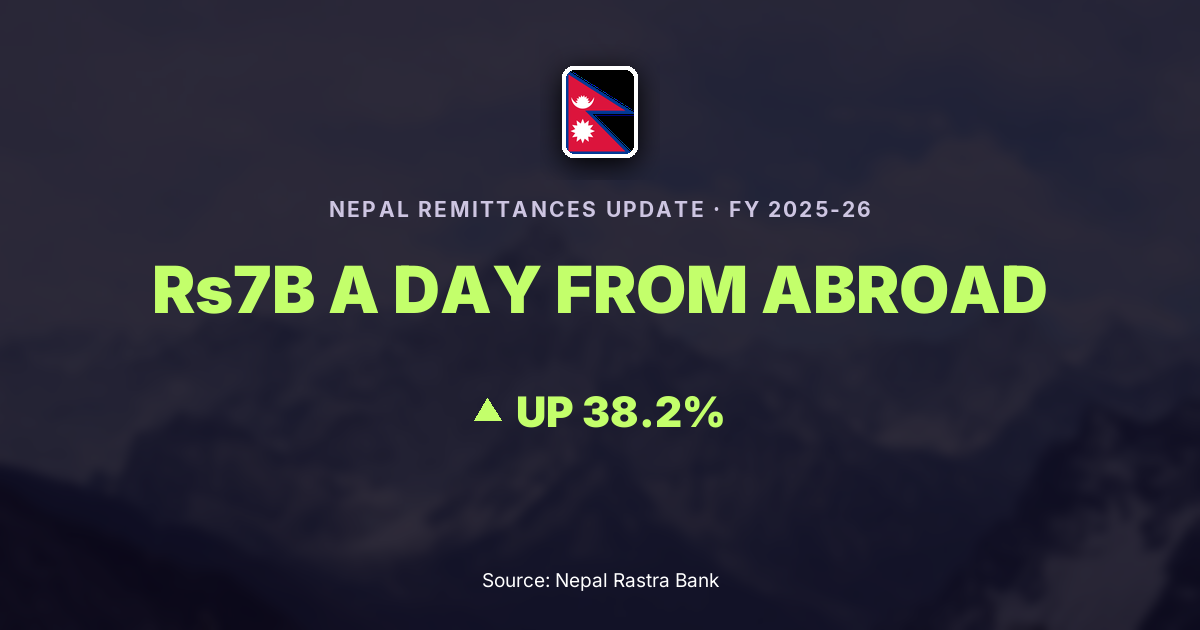
- Nepal's remittance inflow rose 38.2% year on year to Rs2.1208 trillion in the first eleven months of FY2025-26, according to Nepal Rastra Bank.
- In the first nine months alone the inflow was Rs1.65 trillion, up 39.1%, worth $11.55 billion, a rise of 31.9% in dollar terms.
- That works out at roughly Rs7 billion arriving every single day.
- Remittances are projected at about 33% of GDP this fiscal year, up sharply from 27.8% last year.
- Foreign exchange reserves rose 30.5% to Rs3.49 trillion by mid-April 2026, almost entirely on the back of this flow.
Nepal's remittance inflow rose 38.2% year on year to Rs2.1208 trillion in the first eleven months of the fiscal year, according to Nepal Rastra Bank (People's Review). That is about Rs7 billion arriving every day, every day of the year (Kathmandu Post).
Remittances are now worth roughly a third of Nepal's entire economy. That is an extraordinary number, and it should make anyone reading it slightly uneasy.
The numbers, in one place
- Rs2.1208 trillion in eleven months, up 38.2% year on year.
- Rs1.65 trillion in nine months, up 39.1%, or $11.55 billion, up 31.9% in dollar terms.
- ~Rs7 billion a day arriving from abroad.
- ~33% of GDP this fiscal year, up from 27.8% last year.
- Rs3.49 trillion in foreign exchange reserves by mid-April 2026, up 30.5%.
What is behind the surge
1. More people leaving, and going further
Nepal's outward migration has kept climbing, and the destination mix has shifted. Malaysia and the Gulf still take the largest numbers, but Korea, Japan, Croatia, Romania and Portugal have grown fast, and those corridors pay considerably better. A worker in Korea sends multiples of what the same worker would send from a Gulf construction site.
2. The dollar-to-rupee arithmetic flatters it
Note the gap between the two growth figures: 39.1% in rupees against 31.9% in dollars over the same nine months. A weaker Nepali rupee inflates the local-currency headline. Both numbers are large, but the rupee figure is the one that gets quoted, and it is the one that overstates how much more money actually arrived.
3. Formal channels are winning
As in Bangladesh, part of the increase is money moving from informal networks into banks and licensed remittance companies, where it gets counted. Better digital access on both ends and closer alignment between official and street exchange rates have made the legal route the convenient one.
The honest read
At roughly a third of GDP, remittances are no longer a supplement to Nepal's economy. They are the economy's foundation, and that is a fragile position. The inflow depends on labour demand in a handful of foreign countries, on their visa policies, and on the health of construction and manufacturing sectors Nepal has no influence over. Reserves at record levels are genuinely good news; a growth model that requires exporting a third of your working-age population is not the same as a growth model.
The near-term watch item is destination policy. Any tightening in Korea, Japan, Malaysia or the Gulf shows up in this series roughly a year later, and there is no domestic policy lever that can offset it quickly.
Ways to send money to Nepal in 2026, compared
The World Bank puts the global average cost of sending $200 at 6.36%, while the cheapest quartile of providers averages 3.29% (Remittance Prices Worldwide). Every point of that gap is a choice, not a fact of life. These are the routes money actually takes, and where each one quietly takes its cut.
| Route | How fast | Where the cost hides | Suits |
|---|---|---|---|
| Bank wire (SWIFT) | 1 to 5 business days | Sending fee, correspondent bank fee, receiving bank fee, plus the exchange-rate spread | Large one-off transfers where a paper trail matters |
| Cash at an agent counter | Minutes | Usually the highest headline fee band, plus the spread. Widely used in districts far from a bank branch | Recipients without a bank account |
| Online remittance apps | Same day to 2 days | Mostly the exchange-rate markup, and promotional first-transfer rates that do not repeat | Regular monthly transfers to a bank account |
| Wallet or bank payout inside Nepal | Minutes to hours | Spread plus a payout or cash-out fee, and per-transaction caps | Smaller, frequent household amounts |
| Stablecoin (USDT) with payout to bank or card | Minutes | Blockchain network fee plus the on-ramp and off-ramp spread at each end | Senders who want speed and a rate visible before confirming |
Sending to Nepal, corridor by corridor
Malaysia, Qatar, Saudi Arabia and the UAE carry the largest numbers of Nepali workers, while Korea, Japan and parts of Europe send larger amounts per person. Gulf and Malaysian corridors are competitive on fees and settle quickly. Korea and Japan pay far better but tend to carry wider exchange-rate spreads, so the route choice matters more there, not less.
If you are the one sending
The forces above are macroeconomics. The route is the one part of this that sits with the sender, and it is where a surprising share of the cost hides: not in the advertised fee, but in the exchange rate, the days in transit, and what the receiving side pays to turn the money into local currency.
If you send from Malaysia, Qatar, Saudi Arabia, the UAE, Korea or Japan, it is worth pricing. Fizen moves money as USDT across 64 countries and more than 30 chains, arriving in minutes rather than days, with payout to a bank transfer or a Visa card where the corridor is supported. The balance sits in a self-custody wallet, so no company in the middle decides when it is released, and it is backed by a strategic investment from Tether. One thing to know up front: Fizen is not offered to US Persons.
Whatever you choose, compare the rupees that lands, not the fee on the front page. A route advertising zero fees can still deliver less than one charging a visible fee, because the exchange rate is doing the charging quietly.
Frequently asked questions
How much does Nepal receive in remittances?
Nepal Rastra Bank recorded Rs2.1208 trillion in the first eleven months of FY2025-26, up 38.2% year on year, which works out at roughly Rs7 billion a day. In the first nine months the figure was Rs1.65 trillion, or $11.55 billion.
What percentage of Nepal's GDP is remittances?
Around 33% this fiscal year, up sharply from 27.8% last year. That is one of the highest ratios in the world and makes Nepal unusually exposed to labour demand and visa policy in the countries where its workers go.
Why did remittances to Nepal grow so fast in 2026?
Three things at once: more Nepalis working abroad and increasingly in better-paying destinations such as Korea, Japan and parts of Europe; a weaker rupee inflating the local-currency figure, which is why rupee growth of 39.1% corresponds to 31.9% in dollars; and a continued shift of money from informal networks into formal channels where it gets counted.
What is the cheapest way to send money to Nepal?
Compare the rupees that land rather than the advertised fee. Gulf and Malaysian corridors are the most competitive. Korea and Japan pay better wages but often carry wider exchange-rate spreads, so comparing providers is worth more there. The World Bank puts the global average cost of sending $200 at 6.36% against 3.29% for the cheapest quartile.
How long does it take to send money to Nepal?
A SWIFT bank wire typically takes one to five business days. Online remittance apps usually land the same day or within two. Cash pickup through an agent network is available in minutes, which is why it remains common outside the main cities. Stablecoin transfers settle on-chain in minutes, with payout speed depending on the provider's off-ramp.
Send it once. It lands in minutes.
Fizen sends USDT across 64 countries and 30+ chains, with payout to a bank transfer or a Visa card where the corridor is supported. Self-custody, so nobody in the middle holds the money. Backed by a strategic investment from Tether. Not available to US Persons.
Terms and conditions
- Availability. Fizen is not offered to US Persons. Supported corridors, payout methods and limits vary by country and can change without notice. Check what is available for your route in the app before you rely on it.
- For readers in the United States. This article provides information only. It is not an offer, solicitation or sale of any product or service, and it is not financial, investment, legal or tax advice. Fizen is not offered to US Persons.
- Not advice. This article is news and analysis. It is not investment, tax, legal or financial advice, and nothing here is a recommendation to buy, sell or hold any asset. Tax treatment of transfers depends on your own circumstances and country.
- Figures. All data is as reported on 26 August 2026 by the sources linked in this article. Official statistics are revised; check the source before quoting.
- Transfers. On-chain transfers are irreversible once confirmed. Blockchain network fees and third-party on-ramp and off-ramp spreads apply and are not set by Fizen. Confirm the network and send a small test amount first.
- Self-custody. You hold your own keys. No one, Fizen included, can restore your wallet if you lose your recovery phrase.
- Rates and comparisons. Any comparison of ways to send money to Nepal is general and illustrative. Costs change daily and by provider, amount, funding method and corridor. Always compare the amount that actually lands.
- Full terms. Master Terms of Use, Privacy Policy and Disclaimer.
Figures as of 26 August 2026 from Nepal Rastra Bank via People's Review, The Kathmandu Post and Nepal News. News coverage, not investment or tax advice.
Remittances in 2026, country by country
- Vietnam: $1.2 billion went missing, and only one reason was crypto
- Philippines: a record half, and the slowest growth in four years
- India: $144.8 billion, the largest inflow any country has ever recorded
- Bangladesh: a record $35.56 billion after the hundi crackdown
- Pakistan: $41.6 billion, with one record month of $4.25 billion
- Indonesia: $4.5 billion a quarter from 4.2 million workers
- Nigeria: official inflows up 45% after the exchange-rate reforms
- Kenya: the boom has stopped, and 2026 may be the first fall since 2009
- Egypt: up 31% in a year on one exchange-rate decision
- Mexico: growing again, still $3 billion below the peak