Kenya's Remittance Boom Has Stopped. 2026 Could Be the First Annual Fall Since 2009.
Kenya's diaspora sent home more money every year for over a decade. That streak is now in danger, and more than half the exposure sits in one country.
Key takeaways
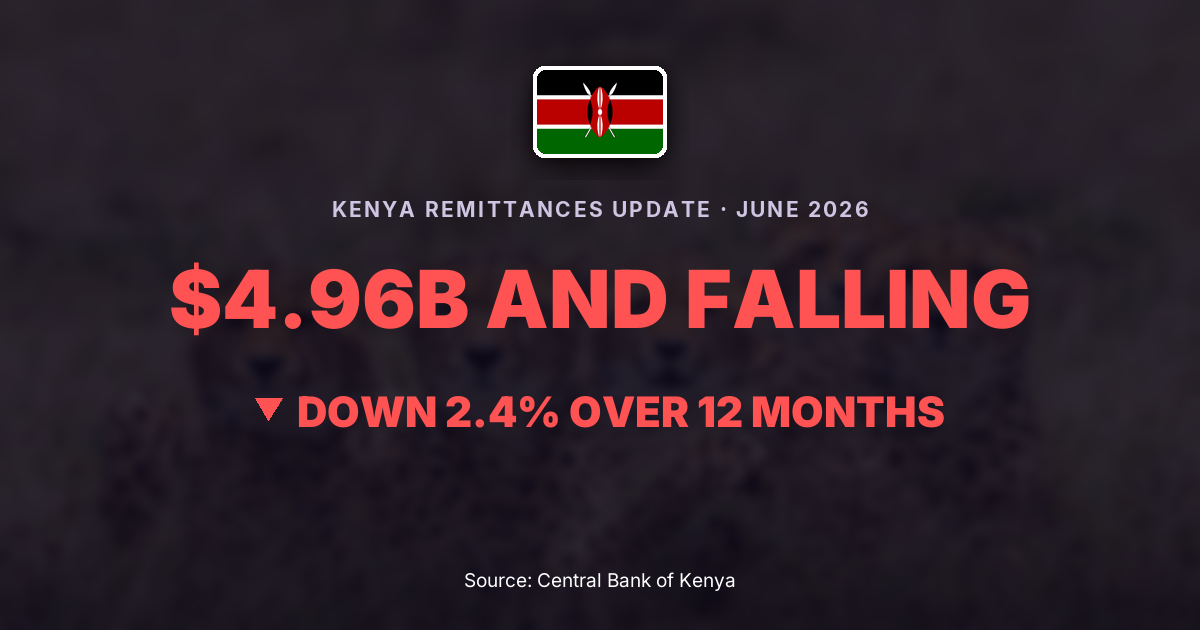
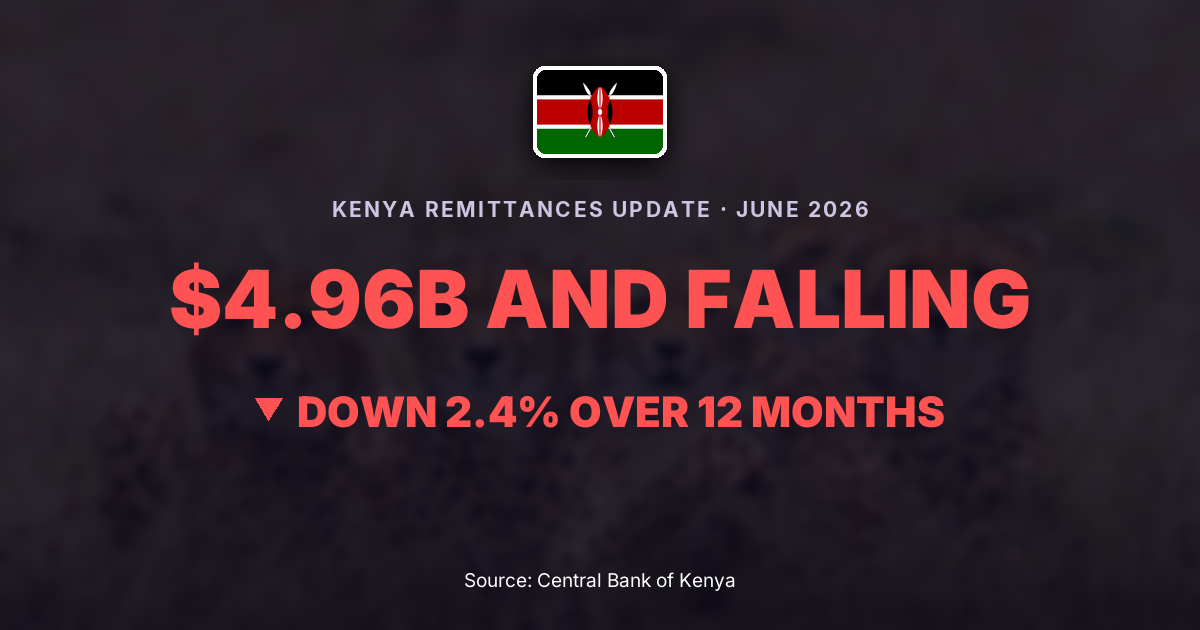
- Remittances to Kenya totalled $375.6 million in June 2026, down 4.7% million in May, a third consecutive monthly fall.
- The 12-month cumulative inflow to June 2026 shrank 2.4% to $4.96 billion billion over the same period a year earlier.
- The Central Bank of Kenya had projected growth of about 4% for 2026, to roughly Sh676 billion. That projection now looks optimistic.
- The United States is the single point of exposure: it supplied 54.2% of Kenya's inflows in 2025, worth $2.73 billion.
- If the trend holds, 2026 would be Kenya's first full-year decline in diaspora remittances since 2009.
Remittances to Kenya came to $375.6 million in June 2026, down 4.7% million in May and the third consecutive monthly fall (People Daily). More telling is the rolling figure: the 12-month cumulative inflow to June shrank 2.4% to $4.96 billion billion a year earlier.
Kenya's diaspora has sent more money home almost every year since 2009. That run is now genuinely at risk, and the reason is concentrated in a single country.
The numbers, in one place
- $375.6 million in June 2026, down 4.7% on May's $394.2 million.
- $4.96 billion over the 12 months to June, down 2.4% billion.
- Three consecutive monthly falls, with the year-to-date comparison now negative.
- United States 54.2% of 2025 inflows, worth $2.73 billion or about Sh352.6 billion.
- Sh676 billion was the CBK's 2026 projection, implying about 4% growth.
Why the flow is slipping
1. One country carries more than half of it
At 54.2% of inflows, the United States is not just Kenya's largest source, it is the majority of the whole flow. That is an unusual level of concentration even by remittance standards, and it means US-specific conditions, hiring, immigration enforcement, cost of living, drive the national number almost on their own. When the US corridor softens, nothing else is large enough to offset it.
2. The new US tax lands on the cash counter
From 1 January 2026 the United States applies a 1% excise tax to remittance transfers funded with cash, money orders or cashier's cheques, while transfers funded from a bank account or a US-issued debit or credit card are exempt (IRS). The rate itself is small. The more relevant effect for Kenya is behavioural: senders reconsidering the route often reconsider the amount at the same time.
3. Cost of living, not generosity
Remittances are the residual after rent, food and transport in the sending country. Elevated living costs across North America and Europe, where most of the Kenyan diaspora lives, have squeezed that residual for two years running. Nobody decided to send less. There is simply less left at the end of the month.
4. A high base to clear
Kenya's inflows grew strongly through 2024 and into early 2025, and March 2026 still produced the largest single month on record. Part of what now reads as decline is measurement against an unusually strong comparison period (Business Daily).
The honest read
A 2.4% fall over twelve months is not a crisis. It is a plateau after a long climb, and Kenya's inflow is still close to $5 billion a year. The uncomfortable part is what it reveals about structure rather than level: a flow where one country supplies more than half the volume is not diversified, and diversification is not something Nairobi can legislate.
The near-term signal to watch is not the monthly headline, which is noisy, but the rolling 12-month figure. It has now turned negative. If it stays there through the end of the year, 2026 becomes the first annual decline since 2009, and the CBK's Sh676 billion projection will need revisiting.
Ways to send money to Kenya in 2026, compared
The World Bank puts the global average cost of sending $200 at 6.36%, while the cheapest quartile of providers averages 3.29% (Remittance Prices Worldwide). Every point of that gap is a choice, not a fact of life. These are the routes money actually takes, and where each one quietly takes its cut.
| Route | How fast | Where the cost hides | Suits |
|---|---|---|---|
| Bank wire (SWIFT) | 1 to 5 business days | Sending fee, correspondent bank fee, receiving bank fee, plus the exchange-rate spread | Large one-off transfers where a paper trail matters |
| Cash at an agent counter | Minutes | Usually the highest headline fee band, plus the spread. From the US, add the 1% excise tax | Recipients without a bank account |
| Online remittance apps | Same day to 2 days | Mostly the exchange-rate markup, and promotional first-transfer rates that do not repeat | Regular monthly transfers to a bank account |
| Mobile money payout (M-Pesa and similar) | Minutes | Spread plus a withdrawal fee at the end, and per-wallet limits | Smaller, frequent household amounts |
| Stablecoin (USDT) with payout to bank or card | Minutes | Blockchain network fee plus the on-ramp and off-ramp spread at each end | Senders who want speed and a rate visible before confirming |
Sending to Kenya, corridor by corridor
The United States dominates at 54.2%, followed by the United Kingdom, Canada, Germany, the UAE, Qatar and Saudi Arabia. Kenya has an advantage most receiving countries do not: mobile money means the last mile is close to free and effectively instant, so nearly all of the cost sits at the sending end. That makes the choice of sending provider unusually decisive here. Compare the shillings that reach the phone, not the fee quoted before you press send.
If you are the one sending
The forces above are macroeconomics. The route is the one part of this that sits with the sender, and it is where a surprising share of the cost hides: not in the advertised fee, but in the exchange rate, the days in transit, and what the receiving side pays to turn the money into local currency.
If you send from the UK, Canada, the UAE, Qatar or Germany, it is worth pricing. Fizen moves money as USDT across 64 countries and more than 30 chains, arriving in minutes rather than days, with payout to a bank transfer or a Visa card where the corridor is supported. The balance sits in a self-custody wallet, so no company in the middle decides when it is released, and it is backed by a strategic investment from Tether. One thing to know up front: Fizen is not offered to US Persons.
Whatever you choose, compare the shillings that lands, not the fee on the front page. A route advertising zero fees can still deliver less than one charging a visible fee, because the exchange rate is doing the charging quietly.
Frequently asked questions
Are remittances to Kenya falling in 2026?
Yes, on the measure that matters. The 12-month cumulative inflow to June 2026 fell 2.4% to $4.96 billion billion a year earlier, and June was the third consecutive monthly decline at $375.6 million. If the trend continues, 2026 would be Kenya's first full-year fall since 2009.
Which country sends the most money to Kenya?
The United States by a wide margin. It supplied 54.2% of inflows in 2025, worth $2.73 billion or about Sh352.6 billion, ahead of the United Kingdom, Canada, Germany and the Gulf states. That concentration means US conditions drive Kenya's national remittance figure almost on their own.
Does the US 1% remittance tax affect Kenyans abroad?
It applies to transfers sent from the United States that are funded with cash, money orders or cashier's cheques, regardless of the sender's nationality. Transfers funded from a US bank account or a US-issued debit or credit card are exempt. Given that the US supplies more than half of Kenya's inflows, even a small effect is visible in the national data.
What is the cheapest way to send money to Kenya?
Compare the shillings that reach the recipient, not the advertised fee. Kenya is unusual in that mobile money makes the receiving end almost costless and instant, so nearly all of the cost sits with the sending provider. The World Bank puts the global average cost of sending $200 at 6.36%, against 3.29% for the cheapest quartile.
How long does it take to send money to Kenya?
A SWIFT bank wire typically takes one to five business days. Online remittance apps usually land the same day or within two. Payouts to M-Pesa or another mobile money wallet are usually minutes. Stablecoin transfers settle on-chain in minutes, with payout speed depending on the provider's off-ramp.
Send it once. It lands in minutes.
Fizen sends USDT across 64 countries and 30+ chains, with payout to a bank transfer or a Visa card where the corridor is supported. Self-custody, so nobody in the middle holds the money. Backed by a strategic investment from Tether. Not available to US Persons.
Terms and conditions
- Availability. Fizen is not offered to US Persons. Supported corridors, payout methods and limits vary by country and can change without notice. Check what is available for your route in the app before you rely on it.
- For readers in the United States. This article provides information only. It is not an offer, solicitation or sale of any product or service, and it is not financial, investment, legal or tax advice. Fizen is not offered to US Persons.
- Not advice. This article is news and analysis. It is not investment, tax, legal or financial advice, and nothing here is a recommendation to buy, sell or hold any asset. Tax treatment of transfers depends on your own circumstances and country.
- Figures. All data is as reported on 26 August 2026 by the sources linked in this article. Official statistics are revised; check the source before quoting.
- Transfers. On-chain transfers are irreversible once confirmed. Blockchain network fees and third-party on-ramp and off-ramp spreads apply and are not set by Fizen. Confirm the network and send a small test amount first.
- Self-custody. You hold your own keys. No one, Fizen included, can restore your wallet if you lose your recovery phrase.
- Rates and comparisons. Any comparison of ways to send money to Kenya is general and illustrative. Costs change daily and by provider, amount, funding method and corridor. Always compare the amount that actually lands.
- Full terms. Master Terms of Use, Privacy Policy and Disclaimer.
Figures as of 17 July 2026 from Central Bank of Kenya data via People Daily, The Kenyan Wall Street and Business Daily, with the IRS on the remittance transfer tax. News coverage, not investment or tax advice.
Remittances in 2026, country by country
- Vietnam: $1.2 billion went missing, and only one reason was crypto
- Philippines: a record half, and the slowest growth in four years
- India: $144.8 billion, the largest inflow any country has ever recorded
- Bangladesh: a record $35.56 billion after the hundi crackdown
- Pakistan: $41.6 billion, with one record month of $4.25 billion
- Nepal: Rs7 billion a day, worth a third of the economy
- Indonesia: $4.5 billion a quarter from 4.2 million workers
- Nigeria: official inflows up 45% after the exchange-rate reforms
- Egypt: up 31% in a year on one exchange-rate decision
- Mexico: growing again, still $3 billion below the peak