Ripple Now Has a US Bank: What It Means for Your USDT and USDC (2026)
Ripple just got a US trust bank for its stablecoin reserves, and Canada launched a bank-issued digital dollar. What it means for the USDT or USDC in your wallet, plus three quick checks.
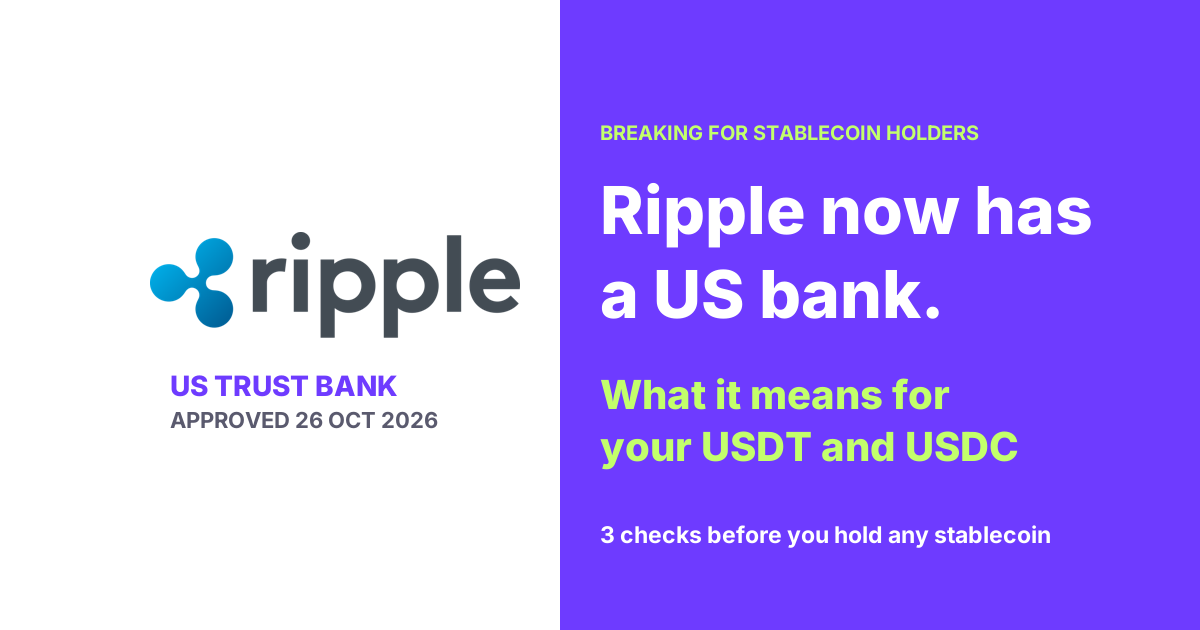
Quick answer: Yes. On 26 October 2026 the US Office of the Comptroller of the Currency gave Ripple final approval for Ripple National Trust Bank, which will hold the reserves behind its RLUSD stablecoin; it is a trust bank, not one you can open an account with. For anyone holding USDT, USDC or any stablecoin, the lesson is three checks: who holds the reserves, how often they are proven, and who can redeem at 1:1.
Key takeaways
- Ripple now has a US trust bank (final OCC approval, 26 October 2026) to hold RLUSD's reserves. It cannot take deposits or lend.
- Canada got a bank-grade digital dollar: CADD from Alberta-regulated Tetra Trust, launched 4 May 2026, backed 1:1 by Canadian dollars.
- Three checks before you hold any stablecoin: who holds the reserves, how often they are proven, and who can redeem.
- Your coins are only yours if you hold the keys. A good issuer protects the dollar; self-custody protects your access to it.
You hold USDT for travel, savings or getting paid, and the headlines say banks are moving into stablecoins: Ripple won a US bank charter and Canada launched a bank-issued digital dollar. Do you need to do anything? Mostly no, but it is a good moment to run three quick checks on whatever stablecoin you hold.
Checked against the issuers' releases, regulators' documents and reporting by The Block, Ledger Insights and Investment Executive, as of 2 November 2026.
What did the OCC approve for Ripple?
A national trust bank charter. Ripple announced on 26 October 2026 that the OCC had granted final approval for Ripple National Trust Bank, ten months after conditional approval in December 2025. Once open, the bank will manage the segregated reserves backing RLUSD, act as collateral trustee of those reserves for RLUSD holders, and offer fiduciary digital asset custody.
Three details matter for holders. RLUSD is still issued by Standard Custody & Trust Company, Ripple's trust company supervised by the New York Department of Financial Services, so the charter adds federal oversight on top. Ripple says BNY is the primary reserve custodian and that it publishes monthly third-party attestations, with RLUSD at about US$2.5 billion in market value. And The Block notes that national trust charters do not permit deposit-taking or lending, so this is not an insured bank deposit. Circle received the same kind of final approval in July 2026, The Block reported.
Why do community banks object?
They say the OCC is stretching the charter. In an August 2025 letter the Independent Community Bankers of America (ICBA) argued Ripple's stablecoin plans fall outside the powers Congress intended for national trust banks. On 2 October 2026 the ICBA sued the OCC to void the March 2026 rule and interpretive letter behind these charters, Ledger Insights reported, counting 21 trust charters approved or conditionally approved under the current administration, at least 13 tied to digital asset firms.
Senator Elizabeth Warren has also criticised the approvals; the Digital Chamber says the charters are limited to trust work. The case is open. For the wider US picture, including the OCC's push for community banks to issue stablecoins, see our US and Canada stablecoin rules explainer.
What is CADD, and how is it different from QCAD?
CADD is a Canadian-dollar stablecoin issued by Tetra Trust Company through its agent CAD Digital Inc., launched on 4 May 2026 after approval from Alberta Treasury Board and Finance. At launch it ran on Base, Ethereum and Tempo, with Solana to follow, and Tetra said all funds used to mint CADD are held in trust and dedicated to redemption. Its backers include Wealthsimple, National Bank of Canada, ATB Financial, Shakepay and Shopify.
QCAD came first on paper: Canadian securities regulators approved the prospectus of the QCAD Digital Trust, an Ontario trust serviced by Stablecorp, law firm Goodmans wrote on 13 January 2026. Investment Executive reported on 20 May 2026 that both are backed 1:1 by Canadian dollar reserves held in Canada. Tetra's launch use cases are institutional: treasury transfers, payouts and fintech settlement.
Canada's draft federal Stablecoin Regulations, published in the Canada Gazette on 24 October 2026, would require registration with the Bank of Canada, reserves at a Canadian custodian, redemption within three business days with no minimum, and redemption fees capped at 1%, from fall 2027.
Why are banks and trust companies getting involved now?
- Reserves need a custodian. A stablecoin is only as good as the money behind it, and banks and trust companies are already licensed to hold assets for others, segregated from their own.
- The law is arriving. Ripple says it will follow the US GENIUS Act framework as it is implemented, and Canada's draft rules require reserves to be segregated and bankruptcy-remote.
- Settlement is the prize. Tetra pitches near-instant settlement in place of batch payment cycles.
3 checks before you hold any stablecoin
- Who holds the reserves? Look for a named custodian or a supervised trust bank, not just "backed 1:1".
- How often are they proven? Monthly attestations or a published proof of reserves beat a yearly statement.
- Who can redeem at 1:1? Usually only large players, so check the token trades near a dollar where you would actually sell it.
How those questions apply to three tokens people searched this week. It describes, it does not rank.
| Question | RLUSD | CADD | USDS |
|---|---|---|---|
| Who issues it? | Standard Custody & Trust Company (NYDFS-supervised) | Tetra Trust Company, via CAD Digital Inc. | Sky Protocol, governed by SKY token holders; no named company |
| Who holds the reserves? | Ripple National Trust Bank once open; BNY primary custodian | Held in trust at Canadian financial institutions | On-chain and off-chain collateral managed by the protocol |
| What backs it? | Cash, US Treasuries and cash equivalents (Ripple) | Canadian dollars 1:1 (Tetra) | Collateral worth more than USDS in circulation; stablecoins were the largest share, 51.46%, on 12 June 2026 (Sky) |
| How can you check? | Monthly third-party attestations | Issuer disclosures | Live dashboard published by Sky |
| Who can redeem 1:1? | Depends on jurisdiction, per Ripple | Not stated for retail at launch | Anyone, via the USDS to USDC swap module, fees set to zero by governance (Sky, June 2026) |
Then check two things yourself: the network, and that the contract address is the issuer's official one. A regulated reserve does not help if you hold a lookalike token.
Who can you actually redeem from?
Usually not the issuer. Tether, for example, lists a minimum redemption of US$100,000, a fee of the greater of US$1,000 or 0.1%, and a US$150 verification fee on its fees page (Tether has invested in Fizen; see the disclosure below). Most people exit a stablecoin through an exchange, a payment app or a swap, so the price they get depends on market depth, and the issuer's redemption keeps that price near 1:1 through the large players who can use it.
That is why Canada's draft rule on retail redemption (no minimum, 1% fee cap) is worth watching, and why a stablecoin whose reserves sit with a supervised trust bank is easier to trust than one whose reserves you cannot see.
What does this mean if you hold stablecoins yourself?
Two separate questions. The issuer and its custodians decide whether a token is worth a dollar. You decide whether the token is really yours, which is what self-custody means: the stablecoin sits at your own address, under keys only you control. Banks are now building custody too, as Google's new MPC service for banks shows, but that is custody for institutions.
Fizen is building the stablecoin neobank for travellers on a self-custody wallet: you hold your own USDT, then use it in the same app for travel eSIMs, investing and more. Tether, the issuer of USDT, has made a strategic investment in Fizen. Read the issuer's reserve reports, keep your recovery phrase offline, and hold your stablecoins somewhere you control. Your money. Your freedom. No borders.
Frequently asked questions
What is Ripple National Trust Bank?
A federally chartered national trust bank that received final OCC approval on 26 October 2026. It will manage the segregated reserves behind RLUSD, act as collateral trustee for holders and offer digital asset custody; it cannot take deposits or lend.
Does Ripple's trust bank issue RLUSD?
No. RLUSD is still issued by Standard Custody & Trust Company, Ripple's New York-regulated trust company. The national trust bank manages the reserves.
What is CADD?
CADD is a Canadian-dollar stablecoin issued by Alberta's Tetra Trust Company and launched on 4 May 2026, backed 1:1 by Canadian dollars held in trust and approved by Alberta Treasury Board and Finance.
Is a stablecoin held by a trust bank FDIC insured?
No. A trust charter does not take deposits, and neither Ripple's announcement nor the reporting describes deposit insurance for RLUSD or its reserves.
What is USDS?
USDS is a dollar stablecoin issued through Sky Protocol and governed by SKY token holders. Sky says it is backed by collateral worth more than USDS in circulation and can be swapped 1:1 with USDC.
Can I redeem a stablecoin directly with the issuer?
Usually only above a large minimum. Tether's redemption minimum is US$100,000, so most people sell through an exchange or app. Canada's draft rules would remove the minimum for regulated CAD stablecoins.
Your keys, your stablecoins
Fizen, the stablecoin neobank for travelers, digital nomads and online workers: you hold the keys to your USDT, and the same app gets you online abroad with a travel eSIM. Your money. Your freedom. No borders.
Terms and conditions
- Information only. This article explains public announcements, regulatory documents and news reports as of 2 November 2026. It is not financial, legal, tax or investment advice, not a recommendation of any stablecoin, and not an offer or sale of any product. Figures and legal proceedings may change.
- For readers in the United States. This is information only, not an offer or sale, and not advice. Fizen products and services are not offered to US Persons.
- Independent, with one disclosure. Fizen is not affiliated with Ripple, Tetra, Stablecorp, Sky, the OCC, the ICBA or any other organisation named here. Tether has made a strategic investment in Fizen. Facts are as stated in the sources listed below.
- Not a deposit. Stablecoins are not bank deposits and are not covered by deposit insurance unless an issuer states otherwise. A stablecoin can lose its peg.
- Image. Banner uses the Ripple logo (Wikimedia Commons, public domain) for news identification. Ripple is a trademark of its owner; Fizen is not affiliated with Ripple.
Sources
- Ripple, Ripple receives final OCC approval to establish national trust bank, 26 October 2026
- The Block, Ripple gains final OCC approval to launch national trust bank, 26 October 2026
- Ledger Insights, Ripple gets final OCC trust bank charter, 27 October 2026
- ICBA, ICBA opposes Ripple's application for a national trust bank charter, 6 August 2025
- Ripple, RLUSD stablecoin page (reserves, attestations, networks)
- Yahoo Finance (CryptoProwl), Tetra launches CADD, 4 May 2026
- Fintech.ca, Canadian stablecoin CADD launches on Base and Ethereum, 4 May 2026
- Investment Executive, Calgary-based fintech launches Canadian dollar-backed stablecoin, 20 May 2026
- Goodmans LLP, QCAD: Canada's first regulator-approved stablecoin, 13 January 2026
- Canada Gazette, Part I, Vol. 160, No. 43, Stablecoin Regulations, 24 October 2026
- Sky, What is USDS?, 12 June 2026
- Tether, Fees
- Tether, strategic investment in Fizen (press release)
Checked against Ripple, The Block, Ledger Insights, Investment Executive, the Canada Gazette, Sky and Tether on 2 November 2026.