Can You Pay by QR at Ben Thanh and Dong Xuan Markets as a Tourist? (2026)
Ben Thanh in Saigon and Dong Xuan in Hanoi are full of stalls with a bank QR code taped to the counter. Your foreign card cannot pay those codes. Here is how a visitor haggles first, scans second, and walks out with the bag and no ATM run.
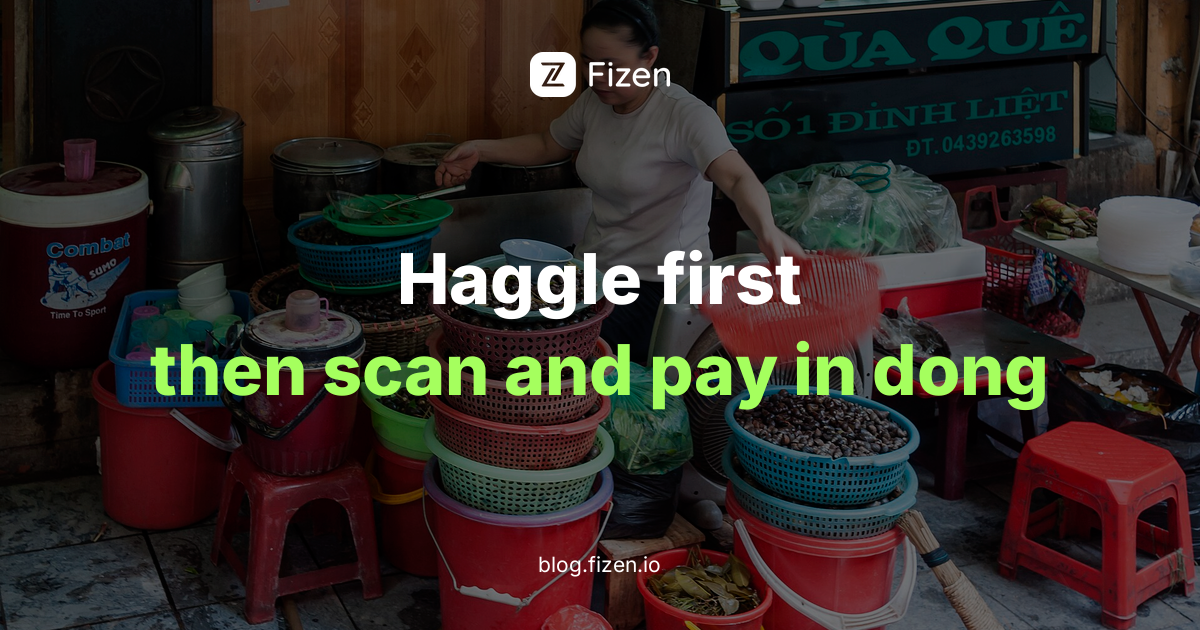
Quick answer: Yes, at many stalls: Ben Thanh vendors have been handed VietQR codes since Ho Chi Minh City's 2023 cashless push, and Hanoi wants every market stall, Dong Xuan included, to have one. The catch is that those codes are bank-to-bank transfers, so a foreign Visa or Mastercard cannot scan them; a visitor pays with cash or with a QR payer such as Fizen QR Pay, funded with USDT on Solana or BNB Chain.
Key takeaways
- The QR on the counter is VietQR, not a card terminal. Your home banking app and your foreign card cannot pay it.
- Haggle first, scan second. Agree the price in dong, then ask to pay by transfer; once you confirm, you cannot bargain back.
- Visitors can pay those codes with Fizen QR Pay. USDT on Solana or BNB Chain only, KYC per wallet and device, US$800 per payment and US$1,000 per week, no daily limit.
- Set it up the night before. You need USDT in the wallet before you reach the stall; moving it from an exchange takes minutes, not seconds.
You have just talked the lady at the Ben Thanh souvenir stall down from 450,000 to 250,000 dong for two lacquer bowls. She smiles, points at a laminated card taped to the shelf, and says the one word every visitor hears in Vietnam's markets now: transfer. Your Visa will not scan it, and your last notes went on the coffee.
This guide is about that moment at Ben Thanh in Saigon and Dong Xuan in Hanoi: what the code is, how to pay it as a visitor, and when cash is still the better call.
What does paying look like at Ben Thanh and Dong Xuan in 2026?
Ben Thanh (District 1, Saigon). In June 2023 the city, NAPAS and Tuoi Tre handed VietQR codes to 90 stalls and said the remaining 1,400 would follow. The market got a fresh coat of paint in January 2026 ahead of Tet, and the codes are now part of the furniture: souvenir, clothing, dried-goods and coffee stalls usually show one. A few bigger stalls have a card machine, often with a surcharge.
Dong Xuan (Old Quarter, Hanoi). Hanoi's biggest wholesale market runs about 6am to 6pm on three floors (the third is closed), with fabrics and ao dai on the second floor, and many vendors take cashless payment (guide updated May 2026). Hanoi's plan to 2030 aims for every market household to have a QR code. Some wholesale stalls still prefer cash, so carry small notes.
| At the stall | Cash (dong) | Foreign card | VietQR code |
|---|---|---|---|
| Ben Thanh souvenirs, clothes, coffee | Always | Some stalls, often with a fee | Most stalls |
| Ben Thanh food court | Always | Rarely | Common |
| Dong Xuan wholesale floors | Always, preferred | Rarely | Many stalls |
| Old Quarter street outside | Always | No | Often |
If you are reading this in Saigon or Hanoi right now: the Fizen app is how a visitor pays that laminated code. You scan the stall's own VietQR, see the shop name and the amount in dong, and swipe to confirm, with no Vietnamese bank account. It needs USDT already sitting in your wallet, so do the setup tonight at the hotel, and tomorrow the bowls, the coffee beans and the ao dai fitting all come out of the same balance.
Why should you haggle before you scan?
Because a QR transfer is final. With cash you can hand over notes, see the change, and argue about the last 20,000. With a transfer, once the money lands in the stall's bank account there is no taking it back if you change your mind, so agree the price out loud first, then say "chuyen khoan" (transfer) and point at the code.
Many market codes are static: the code holds the stall's bank account but not the amount, so you type the agreed number yourself. Type it carefully. Before you swipe, check that the name on screen matches the stall, and that the amount in dong is the one you shook on.
What do people who have done it say?
- Walk the aisles before you buy. Note who sells what at Ben Thanh first; the same bag can start at very different prices three stalls apart.
- Expect to come down a long way. Travellers who bargain at Ben Thanh regularly end up at a third or a quarter of the first price, and walking away often brings the seller back with your number.
- Stay friendly. A smile and a joke at the first price gets further than a hard stare; vendors at both markets bargain all day and respond to good humour.
- Mind your bag space. Dong Xuan sells at wholesale and retail prices, and it is easy to buy more than fits in your luggage.
- Keep small notes anyway. Taxis outside Ben Thanh have refused cards and claimed the machine was broken (forum, June 2025), and some wholesale sellers still want cash.
How does a visitor pay a market VietQR code?
Fizen QR Pay is built for foreign visitors in Vietnam (and the Philippines). People who live in Vietnam cannot use it in Vietnam. It pays VietQR bank codes, VNPay, MoMo and ZaloPay codes, and in Vietnam only codes that belong to Vietnamese account holders, which is what market stalls use. The setup, in order:
- Create or import your Fizen wallet. It is self-custody: you hold the keys.
- Get USDT on Solana or BNB Chain into the wallet. USDT on another network, or another token, cannot be deposited into QR Pay; Swap and Bridge in the app moves it first.
- Deposit from the wallet into QR Pay. On BNB Chain the deposit has no gas fee; on Solana you need a little SOL. KYC applies per wallet and per device, so a new phone means KYC again.
- At the stall: scan, check the name and the dong amount, swipe to confirm.
Already hold USDT on an exchange? In the Fizen app tap Receive, choose USDT and BNB Chain (or Solana) and copy the address. On the exchange, pick Withdraw, USDT, and the matching network (usually labelled BEP20 or BSC for BNB Chain, SOL or Solana for Solana), paste the address, and send a small test first. Some exchanges ask you to confirm it is your own wallet. If you hold no SOL, BNB Chain is the simpler route.
Limits: US$800 per payment and US$1,000 per week, with no daily limit, which covers a market morning comfortably. The Fizen wallet is self-custody; USDT you move into QR Pay is governed by the QR Pay Terms, so only move in what you plan to spend. Step-by-step screens are in the QR Pay getting started guide.
What if the payment fails at the stall?
- It says processing. Do not pay again. Wait for the final status, or you may pay the stall twice.
- The stall's code belongs to a foreigner's account. Rare in these markets, but QR Pay only pays Vietnamese account holders' codes in Vietnam; ask for another code or pay cash.
- The bank is under maintenance. If it shows failed, try again a little later or contact support to check.
- The code carries a message with a hyphen, slash or dot. Many banks reject special characters. Ask the vendor for a plain code; Fizen's in-app message keyboard has none, so you cannot add one by mistake.
- The code is old. Printed static codes rarely expire, but a code generated on a phone for one sale can. Ask for a fresh one.
More on each reason in why a QR payment fails in Vietnam.
So what should you bring to the market?
Small notes for the street outside and the cash-only wholesaler, and a QR payer for everything with a code on the counter. You will need data at the stall too: the same Fizen app sells a data-only travel eSIM for Vietnam, payable with USDT or by card via Stripe, and as a new Fizen programme there is a US$10 eSIM credit waiting in the app's eSIM tab, taken off the bill automatically at checkout (up to 30% of each plan), no code needed.
The picture afterwards: the lacquer bowls, a kilo of Robusta and the silk scarf for your mother, all paid in dong at the price you bargained, and no queue at the ATM on the way back to the hotel.
Frequently asked questions
Does Ben Thanh Market accept credit cards?
Some bigger stalls have a card machine, often with a surcharge, but most small stalls take cash or a VietQR bank transfer. A foreign card cannot pay the VietQR code.
Can I scan a VietQR code with my foreign banking app?
No. VietQR moves money between Vietnamese bank accounts. Visitors can pay those codes with a cross-border QR payer such as Fizen QR Pay, or with cash.
What is the most I can pay with Fizen QR Pay at once?
US$800 per payment and US$1,000 per week per user, with no daily limit.
Can I top up Fizen QR Pay with a card at the market?
No. QR Pay is funded only with USDT on Solana or BNB Chain, moved from your Fizen wallet. Set it up before you go shopping.
Is Dong Xuan Market only for wholesale buyers?
No. It sells at wholesale and retail prices and individual shoppers are welcome, though some wholesale stalls prefer cash and larger quantities.
Pay the stall's QR code in dong
Fizen QR Pay lets foreign visitors in Vietnam pay VietQR, VNPay, MoMo and ZaloPay codes from USDT on Solana or BNB Chain. Set it up at the hotel, then scan, check the name and the amount, and confirm.
Terms and conditions
- Information only. This article is information only, not an offer or sale of any product, and not financial, legal or tax advice. Market practices and vendor payment methods vary and change; check at the stall.
- For readers in the United States. This is information only, not an offer or sale, and not advice. Fizen products and services are not offered to US Persons.
- QR Pay availability. QR Pay is for cross-border use by travellers and foreigners in Vietnam and the Philippines only, and is not available to residents of those countries in their own country. It is funded only with USDT on Solana or BNB Chain; USDT on another network, or another token, cannot be deposited. KYC, KYT, AML and sanctions checks apply. Use of QR Pay is governed by the Fizen QR Pay Terms.
Sources
- Tuoi Tre News, VietQR codes given to Ben Thanh Market vendors (15 June 2023)
- Tuoi Tre News, Ben Thanh Market renovation ahead of Tet (20 January 2026)
- Viet Nam News, Traditional markets grasp the digital era (2026)
- Vietnam Amazing Tours, Dong Xuan Market guide (18 May 2026)
- Hand Luggage Only, tips for bargaining at Ben Thanh Market
- ATM Fee Saver community, do local taxis in Vietnam accept cards (June 2025)
- Fizen Docs, QR Pay getting started
Market and payment details checked 2 November 2026; Fizen QR Pay facts per the QR Pay Terms and Help Center as of November 2026.