Buying US Stocks from Taiwan with USDT: A Nomad's Guide (2026)
You are in Taipei, paid in USDT, and the broker wants a passport it will not take. Tokenised US stocks let you hold a slice of the US market alongside your working balance.
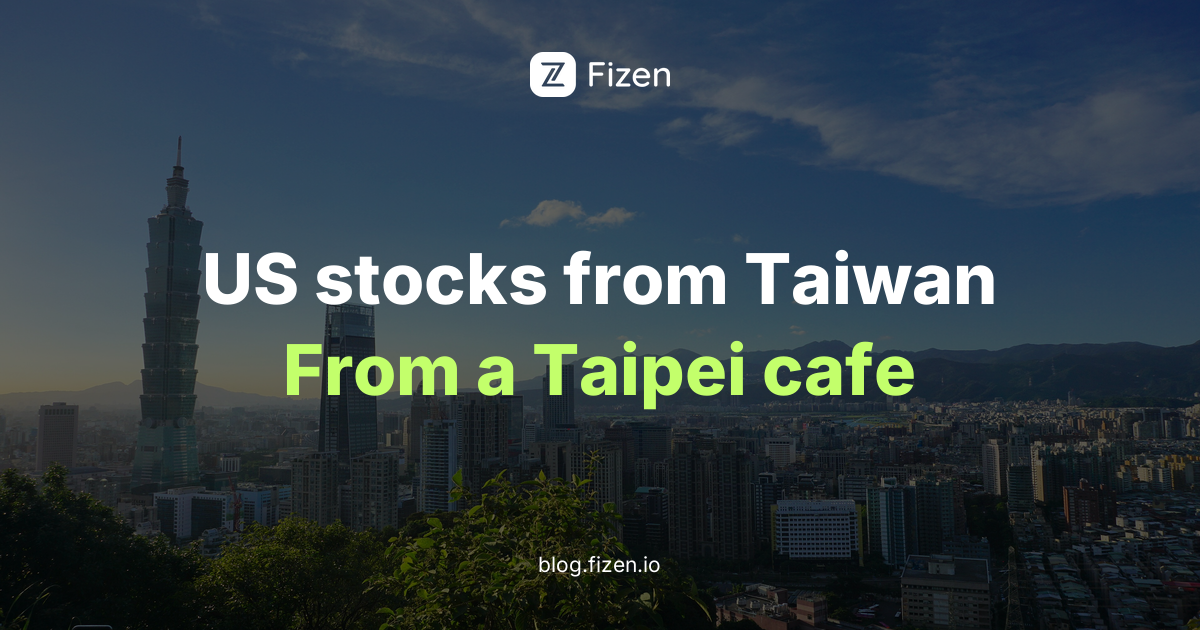
Quick answer: For a digital nomad in Taiwan paid in USDT, the shortest route to US market exposure is tokenised US stocks and ETFs bought directly with USDT or USDC, in fractions, from the same app that holds your working balance. Fizen offers 100+ tokenised US stocks and ETFs, bought and sold with USDT or USDC on Ethereum.
Key takeaways
- No foreign-passport wall: tokenised stocks are bought with USDT or USDC, so a broker that will not open an account for a foreign passport is not in the path.
- Fractions, not minimums: 100+ tokenised US stocks and ETFs can be bought in fractions, so a first position does not need a large deposit.
- Taiwan's rulebook changed: the Virtual Asset Service Act passed its third reading on 30 June 2026, per Tech Times, and requires FSC approval for digital-asset firms.
- Investing, not saving: prices move and losses are possible. Self-custody means you hold the tokens and the responsibility.
You are in Taipei on a working month, paid in USDT, and the broker back home wants a passport it will not accept or a minimum deposit you would rather keep in stablecoins. You want a slice of the US market sitting next to your working balance, not a second bank account and a wire transfer.
Tokenised US stocks and ETFs let you buy that slice with USDT or USDC, in fractions, from the same app. Below: what you actually get, what it costs you in Taiwan, and where the honest limits are.
Can a digital nomad in Taiwan buy US stocks with USDT without a brokerage account?
Yes, but the route is not a brokerage account. Tokenised US stocks let you buy exposure to US equities directly with USDT on crypto exchanges. According to Yellow.com (1 September 2026), platforms like Bitget, MEXC, Binance, BingX and Phemex offer tokenised US stocks with direct USDT access. You do not need to open a US brokerage account or convert to USD first.
For a digital nomad in Taiwan, this matters because traditional brokers often require a local tax ID, proof of address, or minimum deposits. Interactive Brokers, for example, accepts Taiwan residents (source 10), but the application process can be slow and may not accept USDT directly. Tokenised stocks bypass that: you deposit USDT, trade a token linked to a stock or ETF, and the token sits in your crypto wallet.
The trade-off is that you are not a shareholder. You hold a token that may or may not be backed 1:1 by real shares. Yellow.com warns that some products are certificates, synthetic assets or derivatives, with different investor rights. Before buying, check the issuer, custody, and whether the token can be redeemed.
What do you actually own when you buy a tokenised US stock, and how is it different from Binance's real-stock product?
Tokenised US stocks are blockchain tokens that aim to track the price of a US-listed stock or ETF. They may be backed 1:1 by real shares held in custody, or they may be synthetic products that provide price exposure without ownership. According to Yellow.com (1 September 2026), the structure varies by platform: some are spot tokens, some are conversion products, and some are derivatives.
| Feature | Tokenised US stocks (e.g., Bitget rTokens) | Binance US stocks |
|---|---|---|
| What you own | Blockchain token, may be backed by shares | Real US-listed stock |
| Custody | Issuer or platform | Regulated broker (Alpaca) |
| Dividends | Depends on issuer, often synthetic or none | Automatically credited |
| Transfer out | Mostly within crypto ecosystem | Can transfer to other brokers |
| Trading hours | Often around the clock | 24/5 for some instruments |
| Minimum | From 1 USDT (Bitget) | From $5 |
| Payment | USDT directly | USDC (USDT auto-converted) |
If you want actual shareholder rights and dividends, Binance's real-stock product is closer. If you want around-the-clock trading and direct USDT without conversion, tokenised stocks are the option. Neither is a savings account: prices move and losses are possible.
Which tokenised US stocks and ETFs can you buy, and in what size?
The selection depends on the exchange. Bitget, launched on 2 June 2026, offers more than 500 tokenised stocks and ETFs, with 61 selected rTokens available around the clock (Yellow.com, 1 September 2026). Minimum trade is from 1 USDT, and trading fees are 0.05% maker and taker through 30 August 2026. Other exchanges like MEXC and Binance have expanding catalogs, but exact counts vary.
You can buy fractions of a share. For example, with 1 USDT you can buy a fraction of an Apple or Nvidia token. This makes it accessible for small amounts, unlike some brokers that require minimum deposits. The tokens are traded against USDT pairs, so you do not need to convert to USD.
Not all tokens are equal. Some are backed by real shares, others are derivatives. Check the product description before buying. Also note that trading hours vary: some tokens trade around the clock, others follow US market hours.
What does Taiwan's new crypto law from 30 June 2026 change for someone holding USDT here?
Taiwan's Legislative Yuan passed the Virtual Asset Service Act on 30 June 2026, ending a legal gray zone. According to TechTimes (1 July 2026), the law requires all crypto firms to obtain a license from the Financial Supervisory Commission (FSC) and mandates customer asset segregation. This means your USDT held on a licensed Taiwanese exchange must be kept separate from the company's assets, improving safety.
The law also restricts stablecoin issuance to banks only. USDT and USDC are not issued in Taiwan, but they can be listed on exchanges with FSC approval. For you as a holder, this means the exchanges you use must comply with new rules. Firms have 12 months to apply for a license and 21 months to receive full approval. Those that fail will be barred from operating.
For digital nomads, the key change is that crypto exchanges in Taiwan will be more regulated, with legal protections for customer assets. However, the law does not directly affect tokenised US stocks bought on global exchanges like Bitget. You still need to check the exchange's own regulatory status and terms.
What does the 30% US dividend withholding mean for a Taiwan-based holder, and does H.R. 33 fix it yet?
Taiwan is the largest US trading partner with no income tax treaty, because the US does not maintain formal diplomatic relations with Taiwan, as getglobalyields.com explains in its 2026 guide. For a Taiwan-based holder, the practical result is the full 30% US withholding on dividends, regardless of how Form W-8BEN is completed. That form still certifies non-US person status and prevents backup withholding, but there is no reduced rate to claim yet.
H.R. 33, the US-Taiwan Expedited Double-Tax Relief Act, passed the House on January 15, 2025, by 423-1. It would authorize a 15% rate on dividends, reducible to 10% for qualifying 10%+ ownership, and 10% on most other covered income. As of the 2026 update from getglobalyields.com, it has not been enacted into law and has no fixed timeline. The 30% default still applies.
What does it cost to buy, and what are the fees and minimums?
Fees and minimums vary by platform. Bitget launched tokenized US stocks on June 2, 2026, offers more than 500 tokenized stocks and ETFs, and charges 0.05% maker and taker through August 30, 2026, with a minimum trade from 1 USDT, according to yellow.com's September 1, 2026 comparison. Binance launched US stock trading in June 2026 with 7,000+ real US stocks and ETFs, a US$5 minimum, fractional shares, and zero Binance commission, though a partner broker platform fee applies, per penchan.co's 2026 guide. Binance mainly uses USDC, but USDT balances can be automatically converted for orders.
| Platform | Minimum | Fee | Notes |
|---|---|---|---|
| Bitget | 1 USDT | 0.05% maker/taker through Aug 30, 2026 | 500+ tokenized stocks and ETFs; launched Jun 2, 2026 |
| Binance | US$5 | Zero Binance commission; partner broker platform fee applies | 7,000+ real US stocks and ETFs; mainly USDC, USDT auto-converted |
| Fizen | Not stated in product card | Not stated in product card | 100+ tokenised US stocks and ETFs; pay with USDT or USDC on Ethereum |
Frequently asked questions
Can I buy US stocks with USDT from Taiwan?
Yes, through tokenised US stocks and ETFs. Fizen offers 100+ of them, bought and sold with USDT or USDC on Ethereum, in fractions. It is investing, not saving: prices move and losses are possible.
Do I need a Taiwan brokerage account?
No. Tokenised stocks are bought with USDT or USDC inside the app, so a local securities account is not required. You still need to be eligible, and Fizen is not offered to US Persons.
What does Taiwan's crypto law change for me?
The Virtual Asset Service Act, passed 30 June 2026, requires digital-asset firms to get FSC approval. Tech Times reports firms have 12 months to apply and 21 months to be approved.
Are tokenised stocks the same as real shares?
Not always. Yellow.com notes some products are backed 1:1 by real shares while others are certificates or derivatives. Check the issuer, custody and dividend treatment before buying.
Can I buy a fraction of a share?
Yes. Fractional buying is the point: you can put a small amount of USDT into a tokenised stock or ETF rather than meeting a full-share or minimum-deposit threshold.
Hold a slice of the US market
Buy and sell 100+ tokenised US stocks and ETFs with USDT or USDC, in fractions, from the app that holds your working balance. Your money. Your freedom. No borders.
Terms and conditions
- Information only. This article is information only, not investment advice, and not an offer or solicitation to buy or sell any security or token.
- Investing, not saving. Tokenised stocks are an investment. Prices move, losses are possible, and past performance says nothing about the future.
- Self-custody. You hold the tokens and the responsibility. Nobody can restore a lost recovery phrase.
- For readers in the United States. Information only, not an offer or sale, and not advice. Fizen is not offered to US Persons.
Sources
- Yellow.com, 5 Best Exchanges To Buy Tokenized US Stocks Directly With USDT In 2026, 1 September 2026
- Tech Times, Taiwan Crypto Law Ends Gray-Zone Era, 1 July 2026
- Get Global Yields, How to Invest in US Stocks from Taiwan (2026 Guide)
- Taiwan Financial Supervisory Commission
- Taiwan Central Bank
- US SEC Investor.gov
- US IRS
Facts were checked on 16 November 2026.