The Best eSIM Setup for Digital Nomads in 2026
Working from a new country every month? The eSIM setup that keeps nomads online and billable: multi-country data, USDT payment, and a reliable backup line.
Key takeaways
- Nomads need data the moment they land, a reliable line for calls and work, and no roaming bill shock.
- An eSIM installs before you fly and keeps your home number on its own line as backup.
- Buying in USDT means no card decline mid-move, and one balance also pays by Visa and QR.
- For heavy work use, pick a larger daily or unlimited plan and keep a small buffer so it never runs dry mid-call.
If you change country every few weeks, connectivity is not a nice-to-have, it is your income. You need data on arrival, a line stable enough for calls and uploads, and no surprise roaming bill. Here is the eSIM setup that keeps digital nomads online and billable in 2026.
Why nomads use an eSIM
- Land connected: install before you fly and switch on data roaming when you arrive, no SIM shop hunt.
- Keep your home number: your physical SIM stays active for two-factor codes and calls while the eSIM carries data.
- No card roulette: paying in USDT avoids a card getting declined the day you move cities.
- One balance, many uses: the same Fizen USDT balance also spends by Visa card and QR, so you are not juggling apps.
How much data does a working nomad need?
Video calls, cloud sync, tethering a laptop and the odd upload burn through data fast. A light week of messaging and maps might fit in a few GB, but if you work online daily, a larger daily plan or unlimited is safer. Keep a small buffer above your usual usage so a plan never runs out mid-call.
A simple nomad connectivity stack
Keep your home SIM for your number and backup, run a Fizen eSIM for data in each country, and top up USDT once so it also covers Visa spending and QR payments. Compare plans on Fizen eSIM pricing, and read the full Fizen eSIM guide.
Get the Fizen eSIM and set it up
Frequently asked questions
What is the best eSIM for digital nomads?
One that covers the countries you move through, lets you top up on demand, and does not fail on a declined card. A Fizen eSIM paid in USDT across 150+ countries fits that, with a person to swap it if it fails.
How do nomads stay online when changing countries?
Install a new eSIM plan before each move, keep the home SIM for your number, and switch the eSIM on when you land. No shop queue, no gap in coverage.
How much eSIM data does remote work need?
More than sightseeing. Daily video calls and laptop tethering suit a larger daily or unlimited plan. Keep a buffer so it does not run dry mid-meeting.
Can I pay for a nomad eSIM without a bank card?
Yes. With Fizen you pay in USDT from your own balance, which also avoids a card getting declined the day you switch cities.
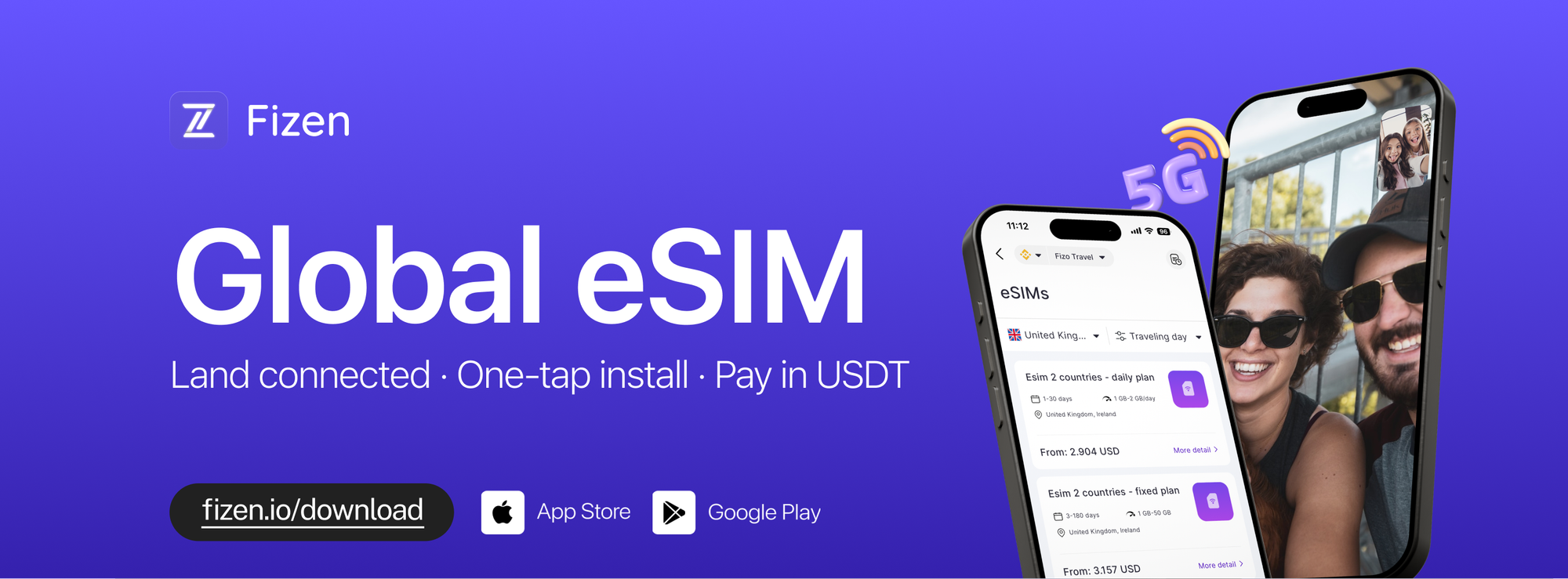
Land already online, from $4.
No midnight SIM queue, no roaming bill that eats your budget. A Fizen eSIM covers 150+ countries, with daily 1GB, 3GB and 5GB plans or unlimited data. Pay with USDT, or by card via Stripe, Apple Pay or Google Pay. And on the rare day one fails, you get a one-to-one replacement and a person who actually answers, not a ticket that replies next week.
Fizen eSIM works across 150+ countries; you pay in USDT with no bank card, and if a Fizen eSIM ever fails a real person swaps it one to one. See the Fizen eSIM page and eSIM pricing. Fizen is a self-custody app, backed by an investment from Tether.
Fizen eSIM docs
Terms and conditions
- Information only. Fizen publishes this article to inform, not to sell. Nothing here is an offer or solicitation, and it is not financial, investment, legal or tax advice. Prices, rules and availability change; check official sources.
- For readers in the United States. This article provides information only. It is not an offer, solicitation or sale of any product or service, and it is not financial, investment, legal or tax advice. Fizen is not offered to US Persons.
- Full terms. Master Terms of Use, Privacy Policy and Disclaimer on the Fizen site.