Best eSIM for Tokyo (2026): KDDI or DoCoMo, Speed Caps and Real Prices
Tokyo is a city you navigate from your phone, transfer by transfer, all day. Here is which network your eSIM roams on, what the speed caps really allow, and the plan that fits a week of trains.

Quick answer: For a first-time visitor on a seven-day Tokyo trip who navigates the train network from their phone, buy the Japan country plan: it roams on KDDI on 4G and 5G. A 10 GB plan for 7 days was US$17.18 on 23 September 2026, about US$2.45 a day and US$1.72 per GB, slowing to 384 kbps after the bucket.
Key takeaways
- Written for one trip: a first-time visitor in Tokyo for a week, checking the next transfer on their phone at every station, with one day trip out of the city.
- Two different eSIMs, two different carriers. The Japan country plan roams on KDDI (4G and 5G). The South-Eastern Asia regional plan, which also covers Japan, roams on NTT DoCoMo (5G) and costs more per GB.
- Dated prices, per day and per GB: the Japan 10 GB plan for 7 days was US$17.18 on 23 September 2026 (US$2.45 a day, US$1.72 per GB). The regional 10 GB for 7 days was US$23.52 (US$3.36 a day, US$2.35 per GB).
- Unlimited means unlimited at up to 10 Mbps. That is comfortable for one person on maps, messaging and a 1080p video call, and tight for a whole team on one hotspot.
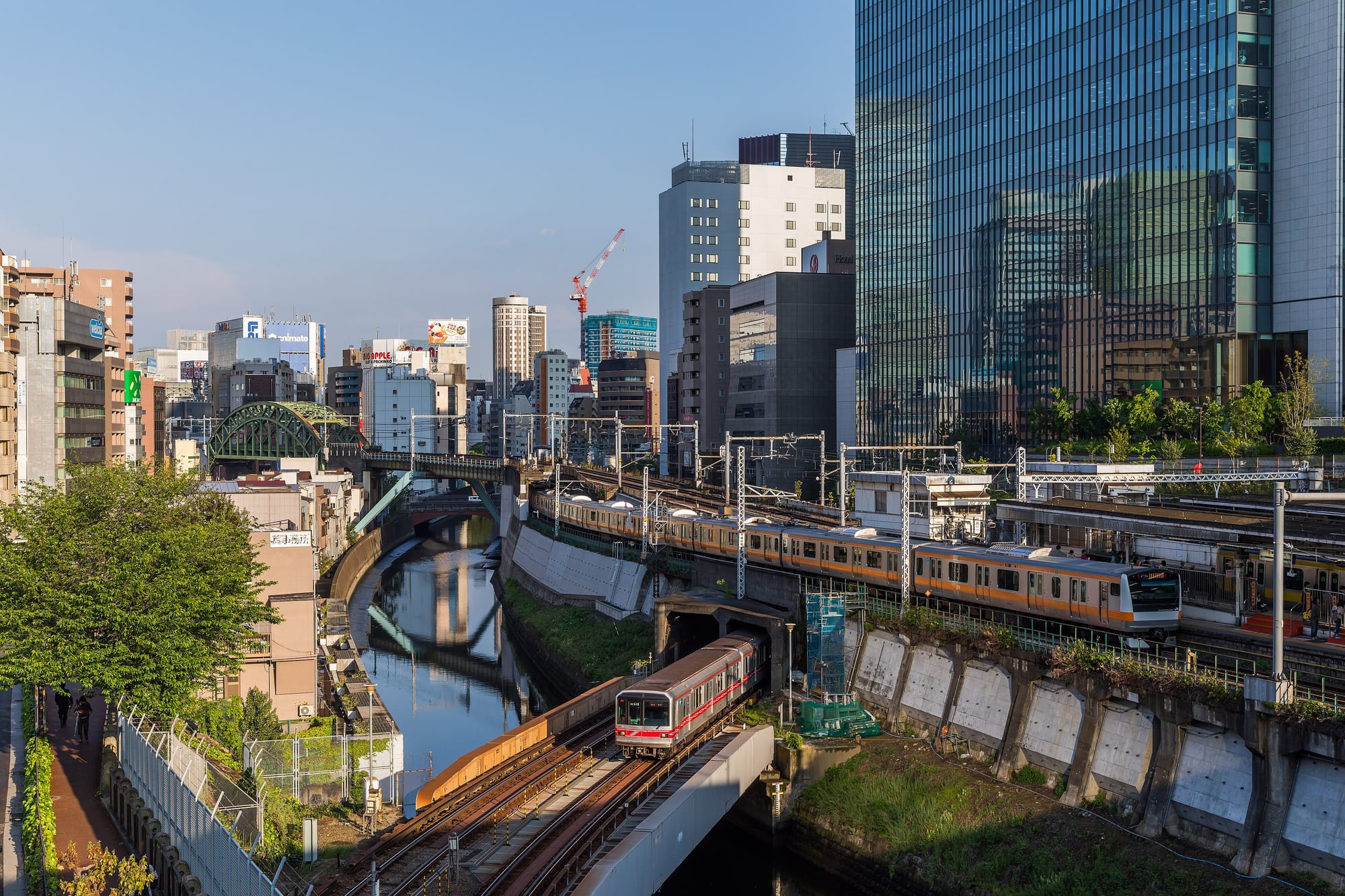
Tokyo is not a city you walk through with a paper map. You take a train, check the platform number, check the transfer, check which of the fourteen exits at Shinjuku is the right one, and then do it again twenty minutes later. The phone is the trip. When the data budget goes on day three, the trip does not stop, it just becomes annoying in a very particular way at a very particular moment.
Does a Tokyo eSIM roam on KDDI or NTT DoCoMo?
Japan is one of the few countries where you have a genuine choice, and the two options sit on different carriers.
- The Japan country plan roams on KDDI, on 4G and 5G. Fixed-data plans and an unlimited plan are both sold this way.
- The South-Eastern Asia regional plan roams on NTT DoCoMo, on 5G, and covers 18 countries including Japan.
Both are national networks and both cover Tokyo thoroughly. Japan's Ministry of Internal Affairs and Communications reported nationwide 5G population coverage of 98.4% as at 31 March 2025, with a spread across prefectures of 88.4% to 99.9%, and a target of 99% in every prefecture by the end of fiscal 2030. Tokyo sits at the top of that range. The bottom of it is where the day trips go.
Japan plan or Southeast Asia plan: which one?
If the trip is Japan only, this is not close. Prices from the Fizen catalogue on 23 September 2026.
| Japan country plan | South-Eastern Asia regional plan | |
|---|---|---|
| Carrier and networks | KDDI, 4G and 5G | NTT DoCoMo, 5G |
| Countries | Japan only | 18 countries including Japan |
| Speed after the bucket | 384 kbps | 128 kbps |
| 10 GB for 7 days | US$17.18 (US$2.45 a day, US$1.72 per GB) | US$23.52 (US$3.36 a day, US$2.35 per GB) |
| 5 GB for 7 days | US$10.12 (US$1.45 a day, US$2.02 per GB) | US$16.68 (US$2.38 a day, US$3.34 per GB) |
| Unlimited | Yes, at up to 10 Mbps | Not offered |
| Fits | A Tokyo week, or any Japan-only trip | Tokyo plus Seoul, Bangkok or Singapore on one eSIM |
What do the Japan plans cost right now, per day and per GB?
All from the Fizen catalogue on 23 September 2026, all roaming on KDDI, 4G and 5G. Fixed plans slow to 384 kbps once the high-speed data is used. The unlimited plan runs at up to 10 Mbps.
| Plan | Days | Total | Per day | Per GB |
|---|---|---|---|---|
| 1 GB | 3 | US$8.51 | US$2.84 | US$8.51 |
| 3 GB | 7 | US$8.11 | US$1.16 | US$2.70 |
| 5 GB | 7 | US$10.12 | US$1.45 | US$2.02 |
| 5 GB | 30 | US$10.14 | US$0.34 | US$2.03 |
| 10 GB | 7 | US$17.18 | US$2.45 | US$1.72 |
| 10 GB | 30 | US$18.21 | US$0.61 | US$1.82 |
| 20 GB | 30 | US$25.33 | US$0.84 | US$1.27 |
| Unlimited | 7 | US$27.50 | US$3.93 | not applicable |
| Unlimited | 30 | US$70.94 | US$2.36 | not applicable |
How much data does a week of Tokyo trains really use?
| A Tokyo day on the trains | Rough data | Note |
|---|---|---|
| Transit app and maps, checked dozens of times | 150 to 300 MB | Route lookups are small individually and add up |
| Translation, menus, museum signs, store labels | 50 to 150 MB | Camera translation costs more than typing |
| Messaging and sending photos | 250 to 400 MB | The photos, not the messages |
| Restaurant and queue apps, tickets, maps of station exits | 100 to 200 MB | Image heavy |
| One 30-minute 720p video call home | About 0.55 GB | The single biggest item in the day |
| Video scrolling on a long train ride | 1 GB per hour and up | Save it for hotel Wi-Fi if you are on a fixed plan |
Where does the signal actually drop in and around Tokyo?
- Deep underground passages and long tunnels. Data pauses between stations on some stretches. Station Wi-Fi covers the gap, and a downloaded offline map covers it better.
- Day trips into the mountains. The national 5G figure hides a prefecture range of 88.4% to 99.9%. Hakone's lake and hill roads, the Nikko mountain routes and the Fuji Five Lakes area are where that gap is felt, not in Shibuya.
- Remote islands. Not a Tokyo week problem, but worth knowing if you tack on Okinawa or the Izu islands.
- Big crowds. A packed stadium or a festival street is a capacity problem, not a coverage problem, and it affects every network at once.
Terms and conditions
- Information only. Fizen publishes this article to inform, not to sell. Nothing here is an offer, solicitation or sale of any product or service, and it is not financial, investment, legal or tax advice.
- For readers in the United States. This article provides information only. It is not an offer, solicitation or sale of any product or service, and it is not financial, investment, legal or tax advice. Fizen is not offered to US Persons.
- Not affiliated. Fizen is not affiliated with, endorsed by or a partner of KDDI, NTT DoCoMo, Sakura Mobile, Narita International Airport, Tokyo Metropolitan Government, Apple or any other third party named here.
- Prices and rules change. Plan prices are those shown in the Fizen catalogue on 23 September 2026 and change without notice. The Japanese local SIM price quoted is a from price published on the provider's own plan comparison page as it stood on 22 May 2026, and the provider prices its other plans from the dates you pick. Identity verification rules are changing in Japan and the commencement date is set by cabinet order. Check the official source before you rely on anything here.
- Coverage is not a promise. Population coverage figures come from Japan's Ministry of Internal Affairs and Communications and describe where people live, not every square kilometre. Real speed depends on terrain, buildings and how busy the local cell is.
- Data only. A travel eSIM provides mobile data. It does not give you a Japanese phone number, voice calls or SMS. Keep your home SIM active for bank codes. Your phone must support eSIM and must not be locked to a carrier.
- Full terms. Master Terms of Use, Privacy Policy and Disclaimer on the Fizen site.
Sources
- Japan Ministry of Internal Affairs and Communications: Publication of 5G development status (end of FY2024)
- Tokyo Metropolitan Government: TOKYO FREE Wi-Fi setting site
- Narita International Airport: internet, Wi-Fi and cell phone services
- Sakura Mobile: best travel SIM cards for Japan 2026 (page last updated 22 May 2026)
- GTN Magazine: prepaid SIM cards in Japan, where to buy and ID rules
- Apple Support: Use eSIM when you travel
- Mori Hamada & Matsumoto: amendment to the Act on Prevention of Improper Use of Mobile Phones
- Ushijima & Partners: outline of the 2026 amendment on identity verification
Updated 23 September 2026.