China eSIM 2026: What Works Behind the Great Firewall
The honest, been-there guide to data in China: whether an eSIM works, the gotchas nobody warns you about, and the one I use now (from $4).
Key takeaways
- Sort data before you fly and you walk out of the airport in China already online, no counter queue.
- Your phone must be eSIM-capable and carrier-unlocked, and an eSIM is data-only, so keep your normal SIM for calls and OTP texts.
- Install it before you leave home; some countries let you activate on landing, strict ones need full setup before arrival.
- The one I use (Fizen) starts at $4, covers 150+ countries, pays via USDT, Stripe, Apple Pay or Google Pay, with real one-to-one support if it ever fails.
Which network you get, and what it really costs
In China the Fizen eSIM roams on China Mobile (3G/4G/5G). This is a China-only plan. At 128 kbps you can still send messages and load map tiles, but not hold a video call.
| Plan | Days | Price | Per day | Per GB | After the high-speed data |
|---|---|---|---|---|---|
| Unlimited | 3 | US$11.93 | US$3.98 | n/a | no throttle stated |
| Unlimited | 5 | US$19.29 | US$3.86 | n/a | no throttle stated |
| Unlimited | 7 | US$27.38 | US$3.91 | n/a | no throttle stated |
| Unlimited | 10 | US$35.52 | US$3.55 | n/a | no throttle stated |
| Unlimited | 15 | US$49.75 | US$3.32 | n/a | no throttle stated |
| Unlimited | 30 | US$70.44 | US$2.35 | n/a | no throttle stated |
| 1 GB | 3 | US$7.33 | US$2.44 | US$7.33 | slows to 384 kbps |
| 3 GB | 3 | US$9.59 | US$3.20 | US$3.20 | slows to 128 kbps |
| 3 GB | 7 | US$10.09 | US$1.44 | US$3.36 | slows to 128 kbps |
| 5 GB | 7 | US$14.63 | US$2.09 | US$2.93 | slows to 128 kbps |
| 5 GB | 15 | US$15.14 | US$1.01 | US$3.03 | slows to 128 kbps |
| 5 GB | 30 | US$15.64 | US$0.52 | US$3.13 | slows to 128 kbps |
| 10 GB | 7 | US$24.67 | US$3.52 | US$2.47 | slows to 128 kbps |
| 10 GB | 15 | US$25.69 | US$1.71 | US$2.57 | slows to 128 kbps |
Prices and carrier read from the Fizen catalogue on 23 September 2026. Data only, no calls or SMS.
Prices are before the welcome credit. A new user who opens the eSIM tab in the Fizen app for the first time gets US$10 of eSIM credit automatically, with no code, valid for 12 months. The app shows how much of it comes off your order. Paying by card on the web works too, but the credit only applies in the app.
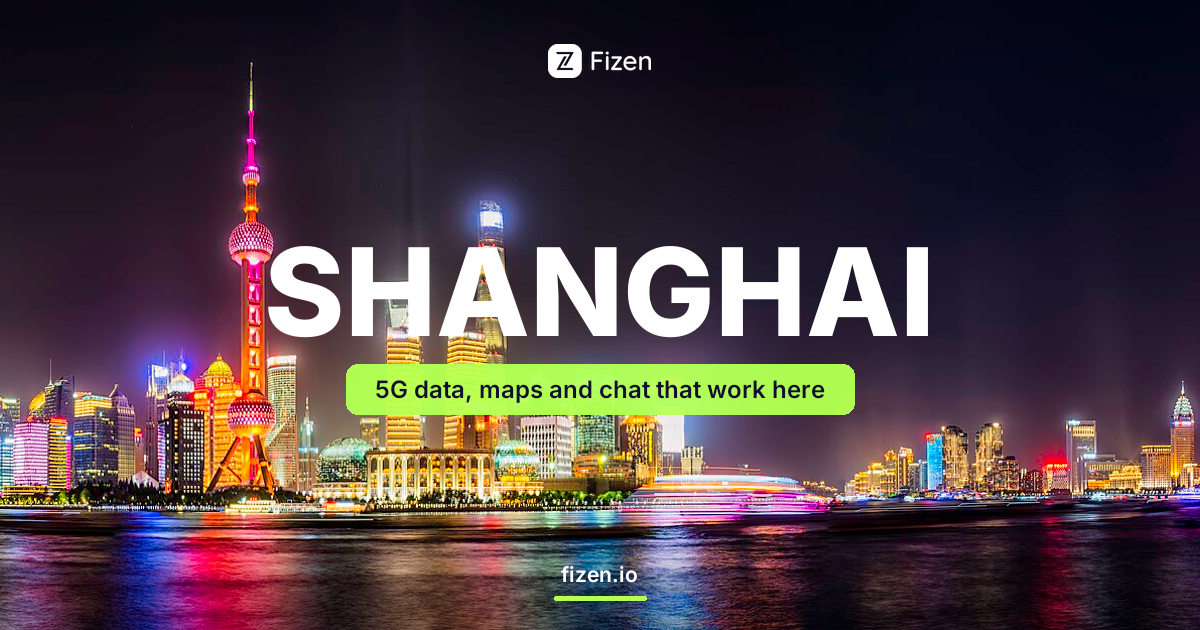
China is the one trip where 'I'll grab a SIM when I land' can genuinely leave you stranded, and the first time I nearly proved it. I landed in Shanghai, went to activate an eSIM I'd bought but not set up, and the activation page simply would not load, because it sat behind the exact firewall I was trying to get around. For about an hour, one of the most connected countries on earth had me completely offline.
New to Fizen? Open the eSIM tab in the Fizen app and $10 of eSIM credit is added automatically. New accounts only, while the campaign runs. Claim it here →
Roaming, local SIM, or eSIM? What I'd tell a friend
Short version over a bowl of noodles: roaming works but bleeds money, a local SIM means passport registration and still hits the Great Firewall, and an eSIM is the smart move only if you set it up right. The thing to check is how the plan routes traffic: Fizen's eSIM terms say mobile traffic may be routed through another country, and that access to particular services still depends on the routing, the network and local law gymnastics.
Does an eSIM actually hold up in China?
Coverage itself is excellent across Chinese cities. The catch is not signal, it is the Great Firewall: local SIMs block Google, WhatsApp, Instagram, Gmail and more. On a travel eSIM, mobile traffic may be routed through another country, which is why familiar apps often keep working. Access to any particular service is not guaranteed: it depends on the plan's routing, the network and local law, so check the Package details.
The eSIM gotchas nobody warns you about
- Your phone must be ready: it has to be eSIM-capable and carrier-unlocked. A phone still locked to a home contract will refuse a travel eSIM, and some models sold in one region ship with eSIM crippled, so check yours before you pay.
- It is data-only: the eSIM gives you internet, not a local number. Keep your normal SIM in for calls and the two-factor codes your bank loves to text.
- Install before you fly: download the eSIM on home Wi-Fi, not in an airport queue. China is the strict one: you must install AND fully set up the eSIM before you arrive, because once you land the Firewall can block the very page you'd use to activate it. Do it on home Wi-Fi, or during a Hong Kong or Taiwan layover.
- Check hotspot if you tether: if you run a laptop off your phone, confirm the plan allows hotspot. Some 'unlimited' plans quietly throttle or block it.
Why support matters more in China
Here is the part people underestimate. If your data breaks in China, you cannot simply Google a fix, the search itself may be blocked, and half the messaging apps you'd use to ask for help are down too. You need a provider you can reach through an app already working on your phone. That is the honest reason I use Fizen here: rare as failures are, if one happens you get a one-to-one replacement and a real person, not a dead FAQ behind a firewall.
What I use, and what it costs
None of this matters if the plan is a rip-off, so plainly: a Fizen eSIM starts at $4, and the same one works in 150+ countries, so I stopped re-buying an app for every trip. You pick a daily 1GB, 3GB or 5GB plan for a short stay, or go unlimited if you are working off it. You can pay with USDT, or by card through Stripe, Apple Pay or Google Pay, so there is no local bank card and no foreign-transaction fee in the way.
Terms and conditions
- Information only. Fizen publishes this article to inform, not to sell. Nothing here is an offer or solicitation, and it is not financial, investment, legal or tax advice. Prices, rules and availability change; check official sources.
- For readers in the United States. This article provides information only. It is not an offer, solicitation or sale of any product or service, and it is not financial, investment, legal or tax advice. Fizen is not offered to US Persons.
- Full terms. Master Terms of Use, Privacy Policy and Disclaimer on the Fizen site.