Cash or Card in the Philippines? Tourist Guide to ATM Fees, Apple Pay and QR Ph (2026)
Cards work in malls and hotels, cash rules the tricycle and the island boat, and QR Ph now sits in between. Here are the verified BDO and BPI ATM fees and limits, what Apple Pay's August launch means for visitors, and what to carry.
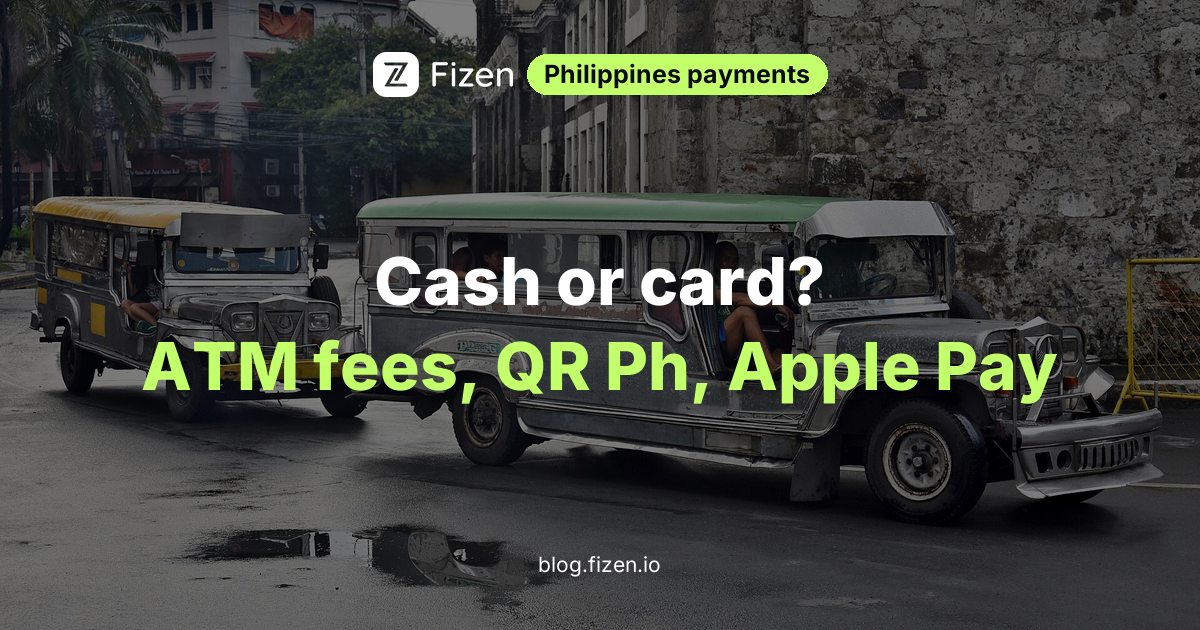
Quick answer: Bring both: as of 2 November 2026 cards work in malls, hotels and chains, but tricycles, markets, small islands and many local eateries still run on cash, and BDO charges ₱250 per ATM withdrawal on cards issued overseas, on top of your home bank's fee. QR Ph is the middle way: the BSP reports 2.47 billion QR Ph payments in 2025, ahead of cards, and a visitor can pay them with Fizen QR Pay without a local account.
Key takeaways
- Cash is still needed. The BSP says 64.7% of retail payments by volume were digital in 2025, so more than a third were not (Daily Tribune, 19 August 2026).
- BDO's ATM fee for overseas cards is ₱250, with a ₱25,000 per-transaction limit on BDO's own page; BPI publishes no foreign-card fee, only that access fees may apply.
- Apple Pay launched on 4 August 2026 with four Philippine banks and does not mention visitors' cards, so test it before relying on it.
- QR Ph beat card transactions for the first time in 2025. It is the realistic cash-light route for a visitor.
The tricycle driver outside the market holds up two fingers and says 'fifty'. You have a card, a phone full of payment apps and not one peso note smaller than a thousand. Ten minutes earlier the same card paid for dinner in a mall without a flicker.
That gap is the whole story of paying in the Philippines in 2026. Here is where each method wins, with the ATM numbers we could verify.
Where is cash still king in the Philippines?
Cards are widely accepted at resorts, higher-end restaurants and established shops. Many local eateries, tricycles, market vendors and small tour operators are cash-only, and some card payments carry a surcharge (4stogo guide, updated March 2026). Wise's August 2026 guide likewise says cash is still needed in rural beach areas, such as remote Palawan or Siargao.
Our guides to paying tricycles, jeepneys and sari-sari stores, El Nido and Port Barton cash and Manila money changers go deeper. The rule of thumb: the smaller the vendor, the more likely it is cash.
What do BDO and BPI ATMs charge foreign cards?
| Bank | Fee on a foreign-issued card | Limits stated on the bank's page |
|---|---|---|
| BDO | ₱250 per withdrawal, plus whatever your card issuer charges | ₱25,000 per transaction and ₱50,000 per day (₱10,000 via QR or biometrics); the page does not say these apply to foreign cards |
| BPI | No figure published; the BPI page says access fees may apply and your bank may add its own | Up to ₱100,000 per day on the BPI page; no foreign-card per-transaction figure published |
Figures are from BDO's ATM page and BPI's ATMs page as read on 2 November 2026. Your home bank's limit usually binds first. Third-party guides give ₱200 to ₱300 per withdrawal across banks and typical per-transaction limits of ₱10,000 to ₱20,000 (YOU, April 2026), and say HSBC machines, mostly in Manila and Cebu, charge foreign cards nothing and allow up to ₱40,000. We could not match one widely repeated BPI figure of US$3.50 or 1.75% to a foreign-card fee, so we left it out.
- Withdraw less often and in larger amounts, since the local fee is flat per withdrawal.
- Always choose pesos if the machine offers to convert to your currency.
- Use ATMs inside malls or bank lobbies; guides report that machines on islands can run dry at peak times, so withdraw in the daytime.
Do cards and Apple Pay work for visitors?
Apple Pay launched in the Philippines on 4 August 2026, with Chinabank, GoTyme Bank, Metrobank and UnionBank as the first partners for their eligible Visa and Mastercard cards, and merchants including Jollibee, Rustan's and Shake Shack (Apple Newsroom). Apple's announcement does not mention visitors' foreign-issued cards, and we could not verify them on Philippine terminals, so try one small purchase first.
On 3 August 2026 Mastercard and GCash announced Mastercard Pay Local, which would let eligible foreign visitors pay local QR codes through GCash with a Mastercard, expected in the third quarter. We could not confirm it is live, so check the GCash app (Daily Tribune).
Why is QR Ph the middle way?
The BSP reports 2.47 billion QR Ph transactions worth ₱1.16 trillion in 2025, the first year QR Ph exceeded debit and credit card transactions (Daily Tribune, 19 August 2026). The same code is read by every participating app, so one sticker serves all of them; our QR Ph explainer shows how.
A visitor still needs an app that reads it. Some can use a GCash GTourist account (see GCash requirements for foreigners). The other route is Fizen QR Pay, which pays QR Ph codes from USDT, so there is no card fee and no declined foreign card at the till. The order matters. Create or import your Fizen wallet (self-custody). Get USDT on Solana or BNB Chain into that wallet. Deposit from the wallet into QR Pay and complete KYC, which applies per wallet and per device, so a new phone means verifying again. Then scan the shop's QR Ph code, check the merchant name and the peso amount, and confirm. Depositing on BNB Chain has no gas fee; on Solana you need a little SOL in the wallet, so BNB Chain suits anyone holding no SOL. USDT on another network, or another token, cannot be deposited into QR Pay. Limits are US$800 per payment and US$1,000 per week, with no daily limit. Step by step: QR Pay getting started.
What it does not do: it does not hand you cash, it is not for Philippine residents, and it will not help with the tricycle driver. The Fizen wallet is self-custody. QR Pay works differently: USDT you move into QR Pay is governed by the Fizen QR Pay Terms, so only move in what you plan to spend.
How much cash should you actually carry?
- A float of ₱1,500 to ₱2,000 on arrival, then top up (YOU, April 2026).
- Small notes of ₱20, ₱50 and ₱100 for fares, tips and market stalls.
- Enough for the whole stay before you reach a small island, where ATMs are few.
These are guide suggestions, not rules; adjust for how much you will pay by QR.
What do travellers say?
Reddit and TripAdvisor would not open for us on 2 November 2026, so these are paraphrased from travel-guide roundups, not quoted.
- One traveller's account says jeepneys, tricycles and ferries all asked for exact cash.
- Guides warn that card skimming occurs at standalone ATMs in tourist hotspots, so prefer bank lobbies.
- Several suggest carrying only about a week of cash and topping up.
Frequently asked questions
Is the Philippines a cash or card country?
Both. Cards work in malls, hotels and chains; tricycles, markets, small islands and many local eateries still prefer cash. The BSP says 64.7% of retail payments by volume were digital in 2025.
Does Apple Pay work in the Philippines?
It launched on 4 August 2026 with four Philippine banks for their cards. Apple's announcement does not mention visitors' foreign cards, so test it on one small purchase.
What are ATM fees for foreigners in the Philippines?
BDO charges ₱250 per withdrawal on cards issued overseas, plus your home bank's fees. BPI says access fees may apply and publishes no foreign-card figure.
Can a tourist pay by QR Ph?
Yes, with an app that reads it: a GCash GTourist account if your country is listed, or Fizen QR Pay funded with USDT on Solana or BNB Chain.
Is QR Pay available to Filipinos in the Philippines?
No. QR Pay is cross-border only and works for visitors and foreigners in the Philippines and Vietnam.
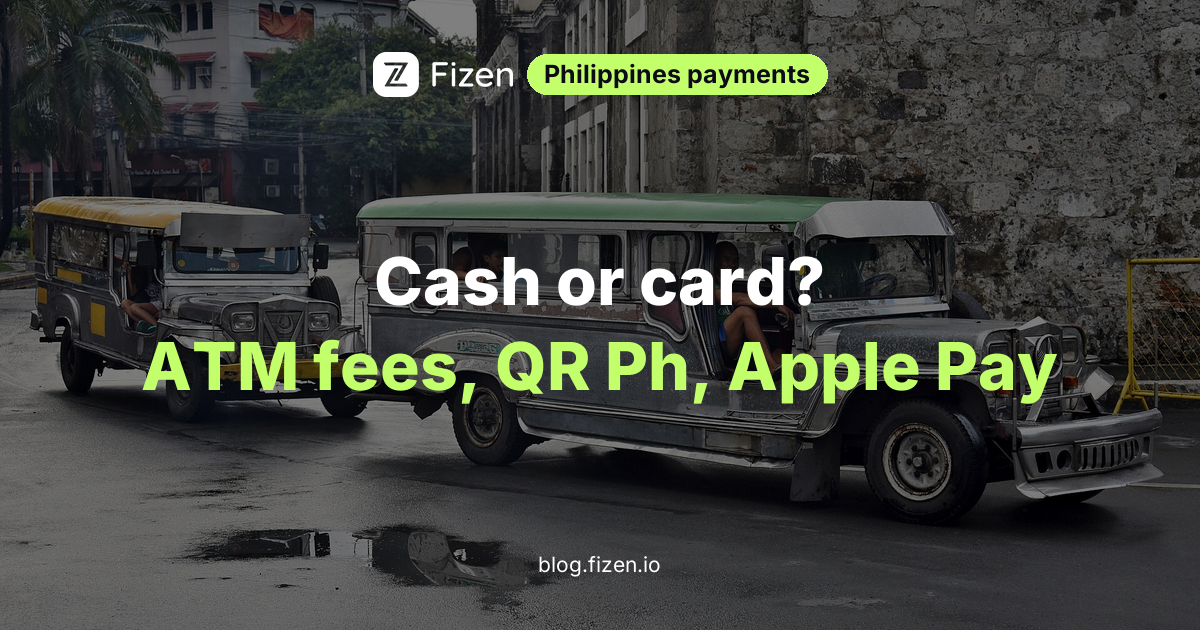
Skip the ATM fee: pay QR Ph from USDT
Fizen QR Pay lets visitors to the Philippines pay QR Ph codes from USDT, funded only with USDT on Solana or BNB Chain from your self-custody Fizen wallet. US$800 per payment, US$1,000 per week. KYC per wallet and per device.
Terms and conditions
- Information only. Fizen publishes this article to inform, not to sell. Nothing here is an offer, solicitation or sale of any product or service, and it is not financial, legal, tax or banking advice for any specific situation.
- For readers in the United States. This is information only, not an offer or sale, and not advice. Fizen products and services are not offered to US Persons.
- QR Pay availability. QR Pay is for cross-border use by travellers and foreigners in Vietnam and the Philippines only, and is not available to residents of those countries in their own country. It is funded only with USDT on Solana or BNB Chain; USDT on another network, or another token, cannot be deposited. KYC, KYT, AML and sanctions checks apply. Use of QR Pay is governed by the Fizen QR Pay Terms.
- Not affiliated. Fizen is not affiliated with, endorsed by or a partner of the Bangko Sentral ng Pilipinas, GCash, Maya, any bank, government body or publication named here. Rules, fees and limits are as published on the dates given and can change; check the official source before you travel.
Sources
- BDO Unibank, ATMs: withdrawal limits and fees
- BPI, ATMs and Cash Accept Machines
- Apple Newsroom Philippines, Apple Pay launches in the Philippines, 4 August 2026
- Daily Tribune, BSP: digital payments nearly two thirds of retail volume, 19 August 2026
- Daily Tribune, Tourists go cashless with GCash and Mastercard, 3 August 2026
- YOU, Philippines ATM withdrawal guide, 20 April 2026
- Wise, QR code payments in the Philippines for foreigners, 3 August 2026
- 4stogo, ATMs and card acceptance on the island (Boracay), updated 17 March 2026
- Fizen Help Center, QR Pay getting started
Updated 2 November 2026. BDO and BPI pages read on that date; third-party fee figures are dated in the text and may be outdated.