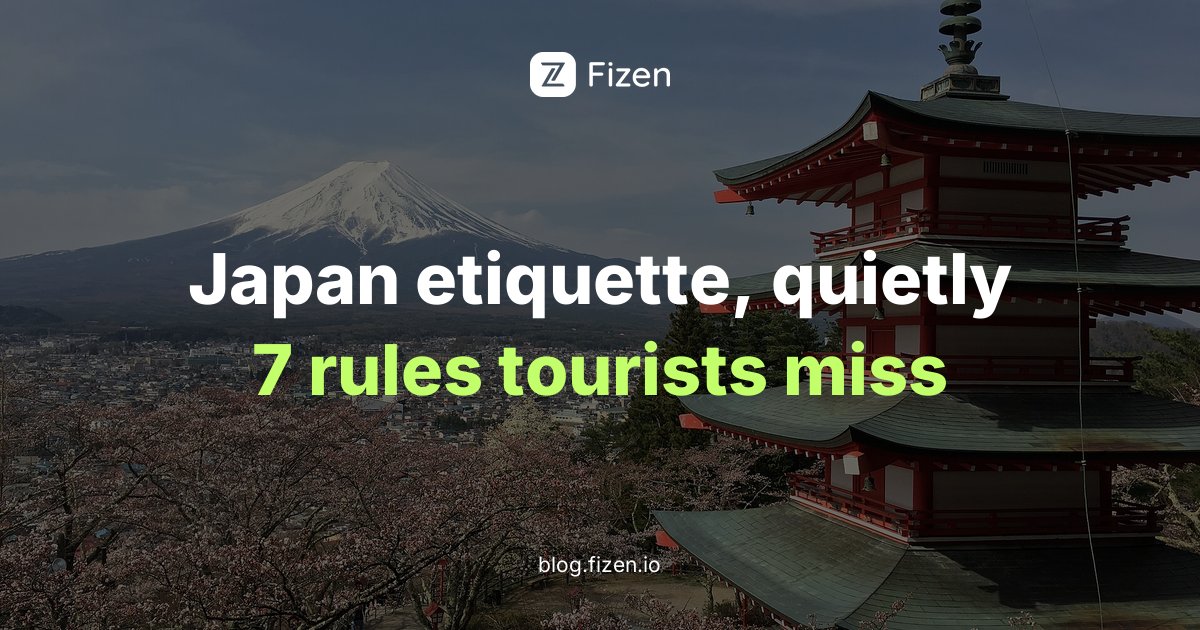
7 Japan Etiquette Rules Tourists Get Wrong (What I Wish I Knew)
Seven etiquette rules tourists actually break in Japan, from the Yamanote Line to Nishiki Market, and why your phone matters more than your bow.
Quick answer: For the visitor who wants to not be the loud foreigner, the seven rules that matter most are: no phone calls on trains, no eating while walking, no tipping, shoes off at the genkan, chopsticks never upright in rice, quiet in shrines, and place money on the tray not in the cashier's hand.
Key takeaways
- No calls on trains. The Yamanote Line and every subway car are silent by default. Set your phone to silent before you board, per JapanManners.
- No eating while walking. Eating while walking is generally frowned upon, per The Invisible Tourist.
- No tipping. Good service is expected without extra payment, per JapanManners. Saying arigatou gozaimasu is enough.
- Shoes off at the genkan. Place them facing the door, not the room. Toilet slippers stay in the toilet, per Japan Atlas.
You are standing on the Keihan line at 8:40am, the carriage is full, and your phone rings. Everyone in the car looks at the floor. You silence it, but you still need to know which exit at Sanjo gets you to Nishiki Market, and whether the ramen shop you queued for is cash only. That is the etiquette problem nobody writes down: the quiet rules are the ones you break by accident, and half of them need a working phone to solve.
Which etiquette rules need a phone, and how much data do they use?
| Etiquette task | What it needs | Data per use, approximate |
|---|---|---|
| Nearest 7-Eleven or FamilyMart ATM | Maps query plus walking route | About 5 MB |
| Find a restaurant open past 7 PM | Maps plus review pages | 15 to 30 MB |
| Reply to a message instead of calling on the train | Messaging app, text only | Under 1 MB |
| Translate a menu or a sign | Camera translation, on-device or cloud | 10 to 40 MB per image |
| Check a shrine or onsen rule before entering | One web page | 2 to 5 MB |
None of it is heavy. The problem is not volume, it is that every one of them happens at the moment you cannot afford to be offline, standing at a genkan or a ticket gate with no signal.
What network do you land on in Japan, and what does the plan allow at its cap?
A Japan eSIM connects to local Japanese networks. Plans come in two shapes: fixed data buckets and unlimited day passes. Plan terms vary by operator, so check the shop page for the details of each plan.
| Plan shape | Network | What it allows at the cap |
|---|---|---|
| Fixed data, 5 to 30 GB | Local Japanese networks | Full speed until the bucket ends, then throttled to text and map tiles |
| Unlimited, 3 to 30 days | Local Japanese networks | No bucket, hotspot often capped separately |
| 3 GB per day | Local Japanese networks | Daily allowance resets, suited to hotspot and remote work |
How much data does a Japan etiquette trip really use?
| Trip and use | Daily data | Trip total | Data size to choose |
|---|---|---|---|
| 7 days, city only, maps and messages | 400 to 450 MB | About 3 GB | 5 GB over 7 days |
| 14 days, maps, messages, 1 hour of calls daily | About 900 MB | About 12.5 GB | 15 GB over 15 days |
| 14 days, hotspot for a laptop and calls | 1.5 to 2 GB | 21 to 28 GB | 30 GB over 30 days |
| 30 days, remote work, calls and hotspot | 1.5 to 2 GB | 45 to 60 GB | Unlimited over 30 days |
Where does coverage actually fail in Japan?
In the cities, the dead zones are underground and indoors. Basement food halls, deep subway platforms and the lower floors of large electronics stores often sit below street-level antenna coverage. If you are meeting someone at a specific exit, agree on the exit number before you go down, not after.
| Route or area | What happens to signal | What to do |
|---|---|---|
| Tokaido Shinkansen, Tokyo to Shin-Osaka | Drops in tunnels past Odawara and Suzuka | Send the message before the tunnel, not during |
| Tateyama Kurobe Alpine Route | No usable signal for long stretches on the cable car section | Screenshot the timetable and the return leg |
| Shiretoko peninsula beyond Utoro | Long stretches with no signal | Offline map downloaded at the last convenience store |
| Tokyo metro basements and depachika | Weak to none below street level | Agree the exit number before going underground |
Which plan fits your trip?
Plans are data-only and sized for the whole trip, not the first week. Choose a plan sized for your whole trip; plans are fixed-size. Entry level is from about US$0.30 a day.
| Trip length | Expected daily use | Data for the trip | Data size to choose |
|---|---|---|---|
| 7 days, city only | Maps, messaging, 30 min calls | About 4 GB | 5 GB over 7 days |
| 10 days, city plus day trips | Above plus photo backup | About 8 GB | 10 GB over 10 days |
| 14 days, Tokyo to Kyoto to Osaka | Above plus one 1 hour call daily | About 14 GB | 15 GB over 15 days |
| 14 days, hotspotting a laptop | Above plus 2 hours remote work daily | About 25 GB | 30 GB over 15 days |
Frequently asked questions
Can I talk on the phone on the Shinkansen?
In the ordinary cars, no. Step into the deck between carriages to take a call.
Do I need cash in Japan?
Carry some. Many small restaurants, souvenir shops and taxi drivers still take cash only, per Japan Highlights.
Is it rude to eat on the street in Japan?
Generally yes, except at festivals, night markets and pedestrian-only streets. Eat where you bought it, per Japan Highlights.
What do I do with my trash if there are no bins?
Carry a small plastic bag and empty it at your hotel or a convenience store. Public bins are rare outside convenience stores, per Japan Atlas.
Do I need to remove my shoes at a restaurant?
Only at traditional places with tatami or low tables. Look for a raised threshold and a slipper rack at the entrance, per Japan Atlas.

Stay quiet, stay connected
A Japan eSIM installs at home on WiFi and you turn the travel line on after landing, so you never queue at a counter with your passport. Pay by card, Apple Pay or Google Pay. New users get eSIM credit the first time they open the eSIM tab in the app, no code needed, valid 12 months, in-app purchases only.
Terms and conditions
- Information only. This article is information only, not an offer or sale, and not advice. Prices and rules change; check the operator or venue before you travel.
- For readers in the United States. This is information only, not an offer or sale, and not advice. Fizen is not offered to US Persons.
- Data only. Travel eSIMs are data-only. They do not provide a voice number for calls or SMS. Keep your home SIM active for bank codes.
- Coverage and speed. Actual speed and coverage depend on your device, location and network conditions. No speed is promised.
Sources
All facts and rules were checked on 07 October 2026.