eSIM vs VPN When Travelling: You Probably Need Both
People search eSIM vs VPN as if it is a choice. It is not. One gets you connected, the other decides who can watch. Here is what each actually does.

Quick answer: an eSIM and a VPN solve different problems. The eSIM gives you mobile data abroad without roaming fees; the VPN encrypts that connection and unlocks home-country content. For most trips you want both: a travel eSIM for connectivity, a VPN on top for security and banking apps.
Key takeaways
- An eSIM is your connection: it gives you mobile data abroad without a local SIM.
- A VPN is a privacy and routing layer on top of whatever connection you already have.
- A VPN cannot get you online. With no data and no wifi, a VPN does nothing at all.
- Travellers who use hotel and airport wifi have the strongest case for a VPN.
- Some countries restrict VPN use, so check local rules before you rely on one.
These two get compared constantly, usually by people about to travel who are not sure which one they are missing. The honest answer is that they are not alternatives. One is the road, the other is the tinted window.
What an eSIM does
An eSIM is a digital SIM profile. It connects your phone to a local mobile network abroad, so you have data without buying a physical SIM or paying roaming. That is the whole job: getting you online, on the same networks locals use.
What a VPN does
A VPN encrypts your traffic and routes it through a server somewhere else. It hides what you are doing from the network you are connected to, which matters on shared airport and hotel wifi, and it changes the apparent location of your connection. It does not create a connection; it only reshapes one you already have.
When you need which
- Landing in a new country with no data: you need an eSIM. A VPN is useless here.
- Working from cafe or hotel wifi: you want a VPN, because you do not control that network.
- Banking or logging into work accounts on public wifi: VPN, every time.
- Wanting maps, rides and messaging to just work on the street: eSIM.
- Both, if you travel with a laptop and use public networks regularly.
The part people get wrong
A VPN does not make mobile data cheaper, and it does not make you anonymous. It shifts trust from the network you are on to the VPN provider, which is a real improvement on unknown airport wifi and a meaningless one if you pick a provider you know nothing about. Also worth saying plainly: several countries restrict or block VPN use, so check the local rules rather than assuming.
A sensible traveller stack
Mobile data from an eSIM as your primary connection, your home SIM kept active for calls and verification codes, and a reputable VPN switched on whenever you use a network you do not control. Setting up the first part takes two minutes on Wi-Fi before you fly, and the steps are in the eSIM setup guide.
Frequently asked questions
Is an eSIM the same as a VPN?
No. An eSIM gives you a mobile data connection abroad. A VPN encrypts and reroutes traffic on a connection you already have. They solve different problems and are often used together.
Do I need a VPN if I have an eSIM?
Not for connectivity. You may still want one for privacy on public wifi, or when logging into sensitive accounts from a network you do not control.
Can a VPN replace an eSIM?
No. Without mobile data or wifi there is nothing for a VPN to run on, so it cannot get you online.
Are VPNs legal everywhere?
No. Some countries restrict or ban VPN use. Check local rules before travelling rather than assuming a VPN is always acceptable.
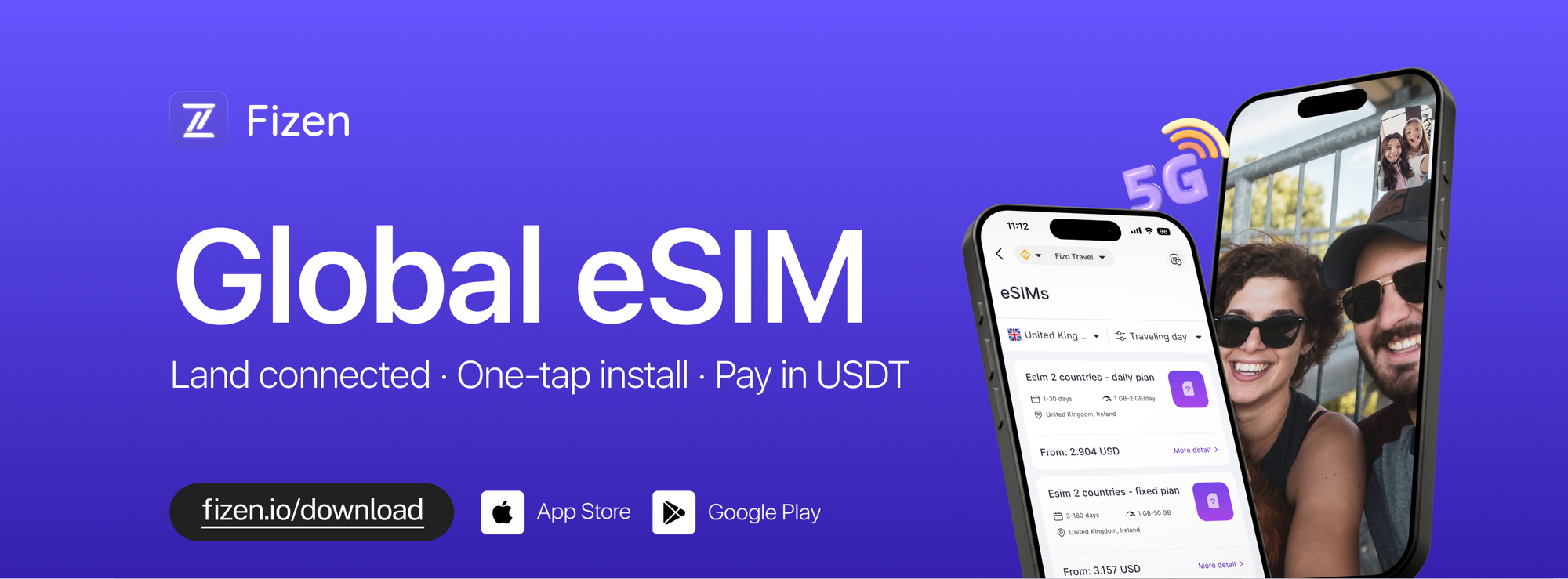
Land already online. The price is shown before you pay.
No midnight SIM queue, no roaming bill that eats your budget. A Fizen eSIM covers 150+ countries, with daily 1GB, 3GB and 5GB plans or unlimited data. Pay with USDT, or by card via Stripe, Apple Pay or Google Pay. And on the rare day one fails, you get a one-to-one replacement and a person who actually answers, not a ticket that replies next week.
Fizen eSIM covers 150+ countries, is paid in USDT with no bank card, and a real person replaces a failed eSIM one to one. Plans and prices are on Fizen eSIM pricing. Fizen is a self-custody app, backed by an investment from Tether.
Fizen eSIM docs
- Buy and activate in one tap
- Manual installation by brand
- Supported devices
- Check your remaining data
- Troubleshooting: no data after landing
- 1:1 Trip Guarantee
Terms and conditions
- Information only. Fizen publishes this article to inform, not to sell. Nothing here is an offer or solicitation, and it is not financial, investment, legal or tax advice. Prices, rules and availability change; check official sources.
- For readers in the United States. This article provides information only. It is not an offer, solicitation or sale of any product or service, and it is not financial, investment, legal or tax advice. Fizen is not offered to US Persons.
- Full terms. Master Terms of Use, Privacy Policy and Disclaimer on the Fizen site.