Buy eSIM With USDT: The Complete Fizen eSIM Guide
Land connected the moment you arrive. A complete guide to eSIM: what it is, eSIM vs roaming, how to install, and how to buy an eSIM with USDT in the Fizen Super App.

You land after a long flight, the plane doors open, and your phone has no signal. You cannot call a ride, you cannot message the people waiting for you, and the airport WiFi wants a local number you do not have yet. Surveys of travelers regularly find the same thing: staying connected the moment you arrive is the number one priority, cited by more than 60 percent of people. An eSIM fixes this, and if you would rather not hand over a bank card, you can now buy an eSIM with USDT. This complete guide explains what an eSIM is, how it compares to roaming and local SIMs, and how the Fizen eSIM, a crypto eSIM built into the Fizen Super App, works from purchase to install.
Key takeaways
- An eSIM is a digital SIM built into your phone. You install a data plan online before you fly, and it runs alongside your normal SIM.
- For most trips an eSIM beats roaming on cost and beats a local SIM on convenience, though each still has its place.
- Fizen eSIM lets you buy an eSIM with USDT inside the Fizen Super App, so no international bank card is needed.
- Supported iPhones install in one tap from a link. Android and older devices use a QR code and a short guide.
- Coverage spans 150+ countries, with clear per-gigabyte plans and one to one replacement if a fault is on Fizen's side.
What is an eSIM?
An eSIM, or embedded SIM, is a digital version of the plastic SIM card you already know. Instead of sliding a chip into a tray, you download a mobile plan straight onto a chip that is already built into your phone. Most people using an eSIM today are trying one for the first time, so here is the plain version.
- It is software, not plastic: there is no card to buy at a kiosk, no tray to open, and nothing to lose.
- You set it up before you fly: buy and install the plan at home on WiFi, then arrive already online.
- It runs next to your main SIM: your usual number keeps receiving calls and texts while the eSIM carries your data abroad.
- You can hold several: phones can store multiple eSIM profiles, so one destination plan does not erase the last.
The technology is a global mobile-industry standard, described by the GSMA, and it is supported on most modern phones. Apple explains device setup in its own eSIM support guide.
eSIM vs roaming vs local SIM: which should you choose?
There is no single right answer, so here is an honest comparison. Each option wins in a different situation.
| Option | Cost | Setup | Best for |
|---|---|---|---|
| eSIM | Low, by data | Before you fly, in minutes | Most trips |
| Roaming | Most expensive | Nothing to do | Short hops |
| Local SIM | Cheap locally | Shop and ID on arrival | Long stays |
In short: roaming is the least effort but usually the priciest, a local SIM can be cheap for a long stay but costs you time and a kiosk visit on arrival, and an eSIM sits in the middle by being both affordable and ready before you land. If you value being online the second you step off the plane, the eSIM is the natural pick.
Three problems with the eSIM market today
eSIMs are great, but the market has rough edges. Three of them are worth knowing before you buy anything, from any provider.
1. So-called unlimited plans get throttled
Many providers sell plans labelled unlimited, then slow your speed sharply once you pass a daily threshold. You keep a connection, but it can crawl, and these plans often cost more than a clear data allowance would. The word unlimited on the label rarely means unlimited in practice.
2. Most providers require an international bank card
The standard checkout assumes you hold a card that global merchants accept. A very large number of people do not, whether because their local bank cards are not accepted internationally or because they simply prefer not to use one. For them, a lot of eSIM shops are closed doors.
3. When an eSIM breaks, you wait
If an eSIM fails mid-trip, the industry norm is to open a support ticket, wait days for an investigation, and receive a refund as store credit rather than a working connection. That is little comfort when you are standing in a foreign airport with no data right now.
How Fizen eSIM works (a crypto eSIM done simply)
Fizen eSIM is a feature inside the Fizen Super App, not a separate app. It was built to remove the three problems above, and it does so in ways you can check for yourself in the app.
Pay with USDT, no bank card
You buy your eSIM with USDT from your own balance inside the Fizen Super App. There is no international bank card step, which is the point: it works for people that most eSIM shops turn away. Because Fizen is a self-custody app, that balance stays under your control until you spend it.
One-tap install on supported iPhones
On supported iPhones you receive an install link, tap it, confirm, and the eSIM is set up. No QR code to scan, no wandering through Settings. On Android and older devices you get a QR code with a short, clear guide, so those phones are covered too.
Clear plans priced by the gigabyte
Fizen prices plans by data rather than selling a vague unlimited label, so you can see what you are getting. On many major routes this tends to come in meaningfully lower than popular eSIM brands. To be fair, on some very small or very large plans other providers can be more competitive. Prices change by period and by plan, so the live prices in the app are the ones that matter, and checking them there takes seconds.
One to one replacement, handled by a person
If an eSIM fault sits on Fizen's side, you get a one to one replacement during your trip, sorted by a real person, instead of a ticket that takes days and a refund paid only in credit. The goal is to get you connected again, not to file paperwork.
Coverage across 150+ countries
Fizen eSIM works in 150+ countries. That includes popular routes such as many European countries, Japan, Korea, China, and Southeast Asia, plus global plans that cover several regions on a single eSIM. You choose the destination, and you see the plans that fit it.
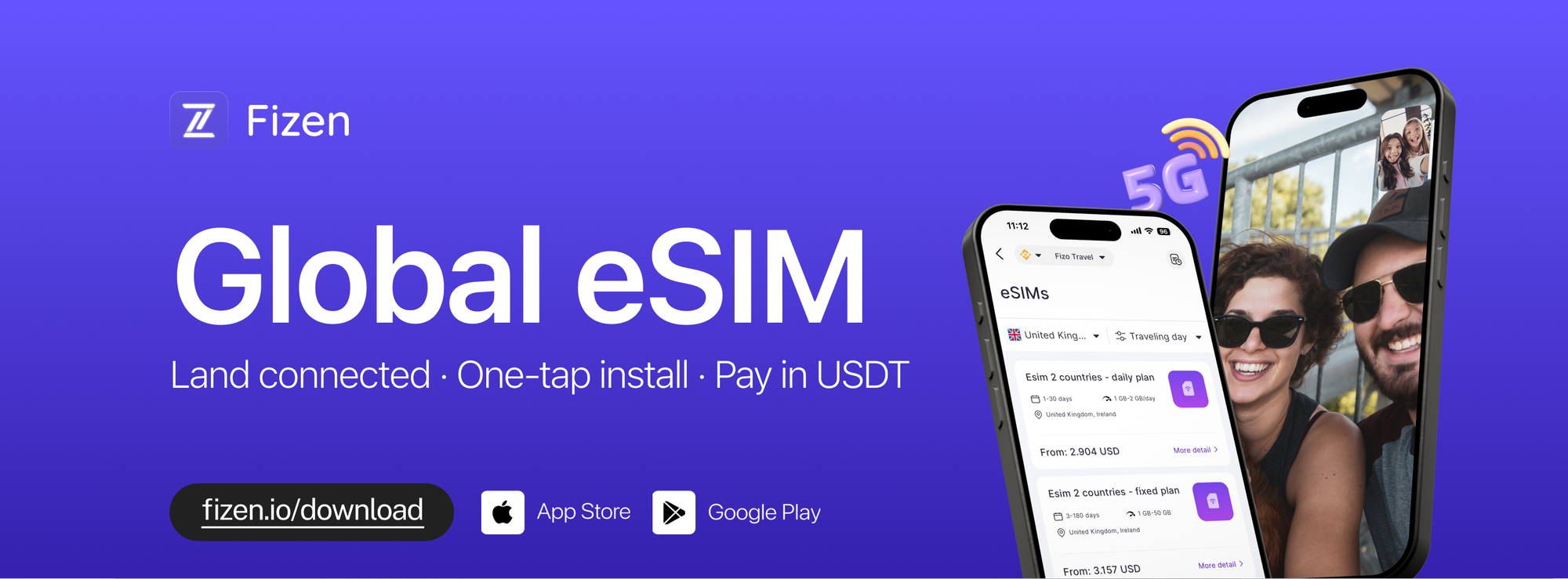
Land connected. Skip the roaming bill.
No airport SIM hunt, no roaming shock. Pay with USDT, no bank card. And if a Fizen eSIM ever fails, a real person swaps it one to one, no ticket queue.
How to buy and install an eSIM with Fizen in 3 steps
The whole flow lives in one app. Here is the short version.
- Step 1, top up USDT: add USDT to your balance in the Fizen Super App. This is what you pay with, so no bank card is needed.
- Step 2, choose destination and plan: pick where you are going and select a plan sized to your trip. Daily and fixed plans are shown per destination.
- Step 3, tap to install: on a supported iPhone, tap the install link and confirm. On Android or an older device, scan the QR code and follow the guide.
One tip that saves a lot of stress: install the eSIM before you fly, while you are on trusted home WiFi or mobile data. Then you arrive already connected, with nothing left to set up in the airport.
Prefer to watch? This short walkthrough shows the whole flow inside the app, start to finish.
Watch: buy and install an eSIM with the Fizen Super App.
Skip the airport SIM hunt and the roaming bill. Get your eSIM in the app
How much data do you need?
Pick by how you actually use your phone, not by a number on a price tag. Here is a rough guide by trip type.
| Trip type | Typical use | What to look for |
|---|---|---|
| One week of sightseeing | Maps, chat, some photos and social | A modest daily or fixed plan is usually plenty |
| Business trip | Email, calls over data, maps, occasional video call | A mid-size plan with steady daily data |
| Long stay | Weeks abroad, streaming and browsing | A larger fixed plan, or top up as you go |
| Remote work | Video calls, uploads, tethering a laptop | The largest plan for your destination, checked for hotspot use |
If you are unsure, start smaller and add another plan mid-trip. It is easy to buy more in the app, and you avoid paying for data you never touch. Heavy map and video use burns through data faster than messaging and browsing, so lean up a size if your days are full of both.
Terms and conditions
- Information only. Fizen publishes this article to inform, not to sell. Nothing here is an offer or solicitation, and it is not financial, investment, legal or tax advice. Prices, rules and availability change; check official sources.
- For readers in the United States. This article provides information only. It is not an offer, solicitation or sale of any product or service, and it is not financial, investment, legal or tax advice. Fizen is not offered to US Persons.
- Full terms. Master Terms of Use, Privacy Policy and Disclaimer on the Fizen site.
Related reading
- Best Travel eSIM for Vietnam (2026)
- Fizen eSIM vs Airalo vs Holafly
- eSIM Scams: 5 Types and How to Stay Safe
Frequently asked questions
What is an eSIM and how does it work?
An eSIM is a digital SIM built into your phone, so there is no plastic card to insert. You buy a data plan online, install it in a few taps, and your phone connects to a local network at your destination. It runs alongside your normal SIM, so your usual number keeps working while the eSIM handles data.
Can I buy an eSIM with USDT without a credit card?
Yes. In the Fizen Super App you pay for your eSIM with USDT from your own balance, so an international bank card is not required. This is useful in the many places where cards from local banks are not accepted by global eSIM shops.
Is an eSIM better than roaming for travel?
For most short trips an eSIM is cheaper than carrier roaming and easier than hunting for a SIM kiosk on arrival. Roaming can still make sense for a very short hop where you only need a little data and want zero setup. Choose by trip length and how much data you use.
How do I install an eSIM?
On supported iPhones, Fizen sends an install link: you tap it, confirm, and the eSIM is ready, with no QR code and no digging through Settings. On Android and older devices you scan a QR code and follow a short guide. Install it before you fly, over a trusted WiFi or mobile network.
Does my phone support eSIM?
Most recent iPhones and many Android flagships support eSIM. Some older devices and certain region-specific phone models do not. You can check under your phone's cellular or mobile data settings, or look up your exact model before buying.
What happens if my Fizen eSIM does not work?
If the problem is on Fizen's side, you get a one to one replacement during your trip, handled by a real person, rather than a support ticket that takes days to investigate and a refund paid only as store credit.
Which countries does Fizen eSIM cover?
Fizen eSIM covers 150+ countries. That includes many European countries, Japan, Korea, China, and Southeast Asia, along with global plans that work across multiple regions on one eSIM.
Land connected, on your terms
An eSIM turns the worst part of arriving, the dead-signal scramble, into a non-event. Fizen eSIM adds two things the market often withholds: you can pay with USDT instead of a bank card, and if something goes wrong on our side, a person fixes it during your trip rather than after it. Set it up before you fly, and step off the plane already online.
Land connected. Skip the roaming bill.
No airport SIM hunt, no roaming shock. Pay with USDT, no bank card. And if a Fizen eSIM ever fails, a real person swaps it one to one, no ticket queue.
eSIM is a feature inside the Fizen Super App. Coverage, data plans and pricing vary by destination and change over time, so check current details in the app. Some older devices and certain phone models do not support eSIM. Fizen products, including the eSIM feature, are not offered to US Persons. Fizen is backed by an investment from Tether. This article is for general information only.
Terms of Use | Privacy | Disclaimer
Travel eSIM by destination