Chuyển Khoản in Vietnam: How to Pay Like a Local as a Visitor (2026)
In Vietnam, "local pay" mostly means one thing: chuyển khoản, a bank transfer started by scanning a QR code. Here is what locals actually do at the counter, the words you will hear, and how a visitor can pay the same way without a Vietnamese bank account.
Quick answer: "Chuyển khoản" (often written "ck") is Vietnamese for bank transfer, and it is how most locals pay small bills: they scan the shop's VietQR code in their banking app, type the amount and show the success screen. Visitors usually cannot open the bank account this needs, so the options are cash, a home payment app that works with Vietnamese QR codes, or a visitor service such as Fizen QR Pay, funded with USDT on Solana or BNB Chain.
Key takeaways
- Local pay in Vietnam means bank transfer by QR. A printed VietQR code at the counter, scanned from a banking app, money arrives in seconds.
- Learn four words. Chuyển khoản (transfer), quét mã (scan the code), tiền mặt (cash), thành công (successful).
- The account is the hard part for visitors. Vietnamese banking apps need a local account, so most short-stay visitors pay cash or use an app built for visitors.
- Fizen QR Pay is one visitor option. Visitors and foreigners only, USDT on Solana or BNB Chain only, up to US$800 per payment and US$1,000 per week.
You order two bánh mì, the woman behind the cart says "chuyển khoản nhé?", points at a laminated square taped to the glass, and the man behind you is already holding up his phone. You have a 500,000 dong note and a card she cannot take. That small moment is what "local pay" means in Vietnam, and it is worth understanding before you land.
What does "chuyển khoản" mean, and why does everyone ask for it?
Chuyển khoản is a plain bank transfer from one account to another. Since Vietnam adopted a single QR standard, VietQR, run by the national switch NAPAS, the transfer usually starts with a scan: the shop prints a QR code that carries its bank and account number, and the customer's banking app fills those details in. NAPAS says the VietQR standard follows the EMVCo QR payment specification and works across more than 50 member banks.
It caught on because it costs a stall nothing to set up: no card terminal, no contract, just a printed code. The State Bank of Vietnam reported in February 2026 that QR payments were the fastest-growing cashless channel over 2021 to 2025, and NAPAS said VietQR transactions rose 85% in value in the first ten months of 2025. Vegetable sellers in Hanoi markets now tape the code to the stall.
How does a local actually pay at the counter?
- Find the code. Usually a printed card at the till or on the cart, with the VietQR and NAPAS 247 logos, a bank logo and the owner's name.
- Scan it in the banking app. The app shows the account holder's name, which the customer glances at before going on.
- Type the amount. On a printed code the amount is blank, so you say or type it. Restaurants and shops with a till often show a code with the amount already filled in.
- Confirm and show the screen. The customer turns the phone round to show "thành công" (successful), and the vendor checks their own phone for the incoming notification.
Two habits are worth copying. Locals check the name on screen against the shop, because swapped QR stickers are a known scam. And they show the success screen rather than walking off, because the vendor needs to see the money arrive.
Which Vietnamese words will you hear at the till?
| You hear or see | Meaning | When |
|---|---|---|
| Chuyển khoản / ck | Bank transfer | "Chuyển khoản được không?" Can you pay by transfer? |
| Quét mã | Scan the code | The vendor points at the QR card |
| Tiền mặt | Cash | "Tiền mặt hay chuyển khoản?" Cash or transfer? |
| Nội dung | Transfer message | The note field in the payment screen |
| Thành công | Successful | The screen you show after paying |
| Ck rồi | Already transferred | What you say as you show the screen |
Can a foreigner pay by chuyển khoản without a Vietnamese bank account?
Not with a local banking app, because the transfer leaves from your own Vietnamese account, and opening one needs documents and identity checks that short-stay visitors usually cannot meet. That leaves three practical routes:
- Cash. Still accepted almost everywhere. Carry small notes, because a 500,000 dong note for a 30,000 dong coffee is a nuisance for the vendor.
- Your home payment app. Since late 2025, visitors with certain home apps can scan participating Vietnamese QR codes directly, for example WeChat Pay and UnionPay users from China, and networks in Thailand, Laos, Cambodia and South Korea. Coverage depends on your country and the merchant.
- A payment app built for visitors. These let you scan the same VietQR code and pay from a balance you hold in the app, with the merchant receiving dong as usual.
How does Fizen QR Pay fit in?
Fizen QR Pay is the visitor route in the Fizen Super App. You scan the shop's VietQR code, or a VNPay, MoMo or ZaloPay code, the app shows the recipient and the amount in dong, and you confirm from your QR Pay balance. The vendor sees a normal incoming transfer, so you can show the success screen and say "ck rồi" like everyone else.
The rules are strict, and worth knowing before you deposit:
- Visitors and foreigners only. QR Pay is for cross-border use, so people who live in Vietnam cannot use it in Vietnam.
- Funded only with USDT on Solana or BNB Chain. No bank account link, no card, no dong deposit. USDT on another network, or another token, cannot be deposited into QR Pay. If your USDT sits on another chain, use Swap and Bridge in the app first.
- Vietnamese account holders only. In Vietnam, QR Pay pays codes linked to Vietnamese accounts, not accounts held by foreigners.
- Limits. Up to US$800 per payment and US$1,000 per week, with no daily limit. Any fee shows before you confirm.
- Custody. The Fizen wallet is self-custody. QR Pay works differently: USDT you move into QR Pay is governed by the Fizen QR Pay Terms, so only move in what you plan to spend.
Keep the transfer message plain. Many Vietnamese banks reject a message with a hyphen, slash or dot, and the payment fails. Fizen's in-app keyboard has only letters, numbers and spaces.
When is cash still the better choice?
Be honest with yourself about the trip. For a weekend with a handful of street meals, a few small notes from one ATM withdrawal may be all you need. Cash also wins with xe ôm drivers and cyclos who quote a price before the ride, at temples that collect donations, and anywhere the vendor has no code on display. QR earns its place on longer stays, when the ATM fees and leftover notes start to add up, and in cities where the person in front of you in the queue never touches cash.
Once it is set up, the picture is small and specific: you scan the code at the bánh mì cart, show the screen, say "ck rồi", and go home without a pocket of dong you cannot change back.
Frequently asked questions
What does "ck" mean in Vietnam?
"Ck" is short for chuyển khoản, a bank transfer. A vendor asking "ck được không?" is asking whether you can pay by transfer, usually by scanning their QR code.
Is VietQR the same as chuyển khoản?
VietQR is the QR standard that starts the transfer. Scanning a VietQR code fills in the bank and account number, and the payment itself is an instant bank transfer through NAPAS.
Can tourists use Vietnamese banking apps?
Generally not, because they need a Vietnamese bank account and identity checks that short-stay visitors usually cannot complete. Visitors pay cash, use a supported home payment app, or use an app built for visitors.
Can I fund Fizen QR Pay with a bank card?
No. Fizen QR Pay is funded only with USDT on Solana or BNB Chain. It does not take a bank account, a card or a dong deposit.
Can Vietnamese residents use Fizen QR Pay in Vietnam?
No. QR Pay is for cross-border use only, so people who live in Vietnam cannot use it to pay in Vietnam.
What should I show the vendor after paying?
The success screen. Vietnamese customers turn the phone round so the vendor can see the payment went through, and the vendor checks their own notification.
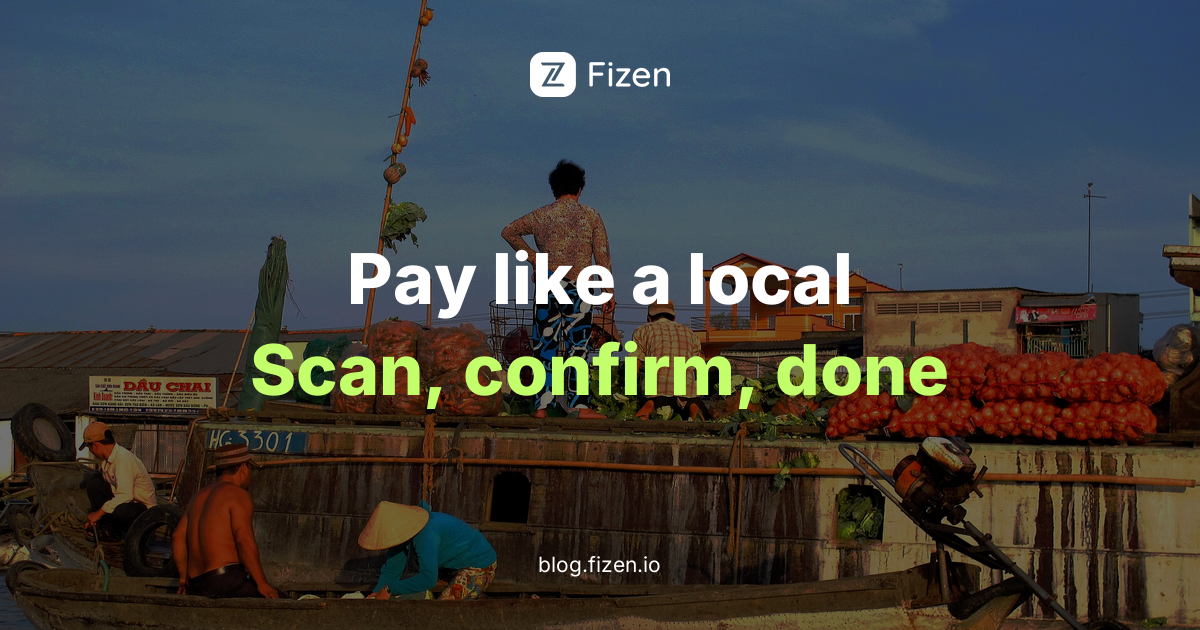
Pay the local way, as a visitor
Fizen QR Pay lets travellers and foreigners in Vietnam scan VietQR, VNPay, MoMo and ZaloPay codes. Fund it with USDT on Solana or BNB Chain and confirm the amount in dong before you pay.
Terms and conditions
- Information only. This article explains how bank-transfer QR payments work in Vietnam and how Fizen QR Pay fits in. It is not financial, legal, tax or investment advice, and the QR Pay Terms and the in-app information prevail over this summary.
- For readers in the United States. This is information only, not an offer or sale, and not advice. Fizen products and services are not offered to US Persons.
- QR Pay availability. QR Pay is for cross-border use by travellers and foreigners in Vietnam and the Philippines only, and is not available to residents of those countries in their own country. It is funded only with USDT on Solana or BNB Chain; USDT on another network, or another token, cannot be deposited. KYC, KYT, AML and sanctions checks apply. Use of QR Pay is governed by the Fizen QR Pay Terms.
Sources
- NAPAS, FastFund 247 with VietQR code service
- Viet Nam News, value of cashless payments nearly 28 times GDP (3 February 2026)
- VOV, Vietnamese street vendors go cashless as QR payments surge 85% (13 December 2025)
- Tuoi Tre News, international tourists can pay in Vietnam using familiar apps through VNPAY-QR (12 August 2026)
- DTiNews, shop owners warned about scam QR code payments (4 October 2023)
- Fizen QR Pay Terms, effective 5 June 2026
Payment statistics and cross-border QR coverage checked on 25 October 2026. QR Pay rules checked against the Fizen QR Pay Terms and product information on 25 October 2026.