Best eSIM for Switzerland 2026: Roaming Rules and Mountain Coverage
Switzerland is not in the EU, and plenty of European SIMs find that out at the border with a roaming text. Here is how a Swiss travel eSIM compares, what mountain coverage is really like, and how to set it up.
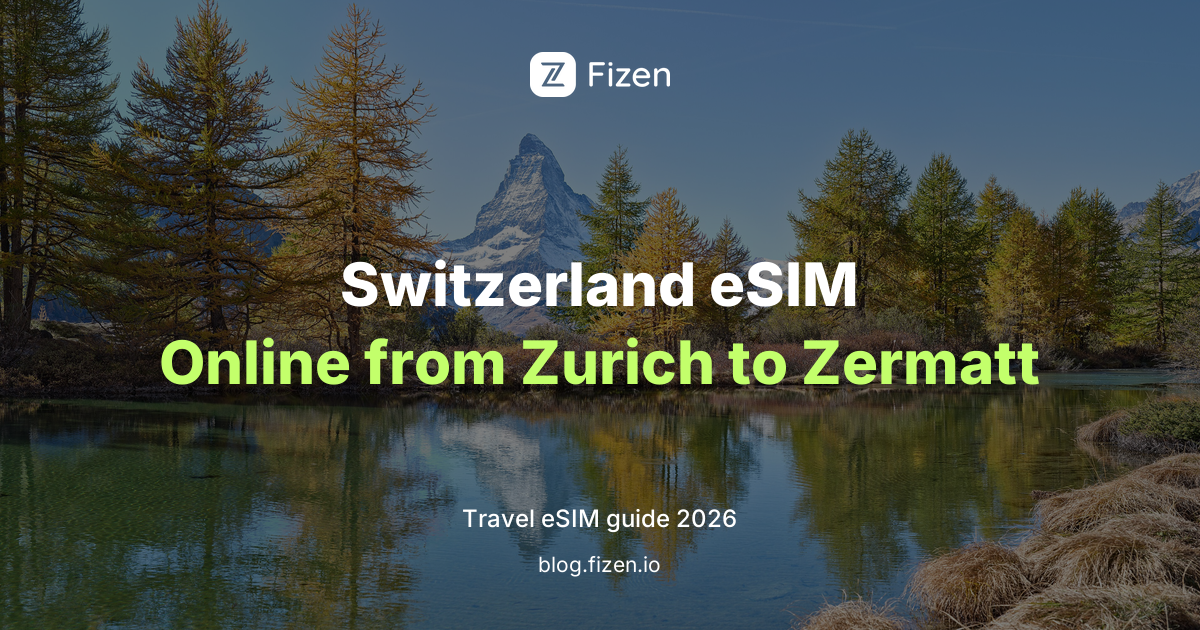
Quick answer: The best eSIM for Switzerland is a travel eSIM that specifically lists Switzerland, installed at home and switched on when you land in Zurich or Geneva. Switzerland is outside the EU and EEA, so EU Roam Like at Home rules do not apply there. Swiss networks are strong in towns, valleys, trains and many ski areas, with gaps on remote trails. Around 5 to 10GB suits a typical week.
Key takeaways
- Switzerland is not in the EU or EEA, so EU Roam Like at Home rules do not cover it. Some EU carriers include it anyway, many charge extra.
- Not every Europe regional eSIM includes Switzerland. Check the country list before you buy.
- Swisscom, Sunrise and Salt run the main networks. Coverage is strong in cities, valleys and on major rail lines, but patchy on high trails and in deep side valleys.
- The SBB Mobile app shows timetables and can display a Swiss Travel Pass bought with an SBB login.
- 112 works from any phone; 1414 calls Rega air rescue for mountain emergencies.
- Plan 5 to 10GB for a typical week; more if you stream, hotspot or film every viewpoint.
I crossed from France into Switzerland on a regional train, still feeling smug about my EU SIM that had worked everywhere for two weeks. Somewhere after the border, a text arrived: welcome to Switzerland, here are your roaming rates. I switched data off and spent the rest of the afternoon hunting for station Wi-Fi to check the connection to Lauterbrunnen.
Switzerland sits in the middle of Europe but outside the EU's roaming rules, and that catches out a lot of travelers, including Europeans. The good news: once you are connected, Swiss networks are some of the most reliable in the Alps. Here is how to sort it before you go.
Why do you need mobile data in Switzerland?
Swiss travel runs on precise connections. Trains, buses, cable cars and lake boats are timed to meet each other, and when a connection changes, the fastest way to know is your phone. Mountain weather also changes quickly, and lift operators post closures online.
- Trains and connections. The SBB Mobile app shows live departures, platform changes and disruptions across the rail network.
- Swiss Travel Pass. If you buy the pass with an SBB login, it can be shown in the SBB Mobile app during ticket checks. Passes bought without a login or from another vendor cannot be displayed in the app, so keep the emailed ticket.
- Weather and lifts. Mountain forecasts, webcams and lift status pages decide whether today is a summit day or a lake day.
- Hiking safety. Offline maps help, but checking the weather mid-hike or sending your location needs a signal.
- Everyday logistics. Restaurant bookings, hotel check-in messages and ride apps in the cities.
Many hotels have Wi-Fi, but you will not find it on a cable car or a trail. To be online from arrival, get your Switzerland eSIM and install it before you fly.
Does EU roaming work in Switzerland?
Not automatically. The EU's Roam Like at Home rules cover EU member states plus Iceland, Liechtenstein and Norway, and have been extended to Moldova and Ukraine. Switzerland is not on that list. Switzerland has many bilateral agreements with the EU, but regulated mobile roaming is not one of them.
In practice this means every carrier sets its own Swiss prices. Some EU operators include Switzerland in their Europe zone, others treat it as a separate or rest-of-world zone with daily fees or per-megabyte charges. Visitors from the UK, the US and Asia face the same carrier-by-carrier picture. Always check your exact tariff before crossing the border.
One quirk worth knowing: Liechtenstein is part of the EEA, so EU roaming rules do cover it, even though it uses the Swiss franc and is often visited as a day trip from Switzerland. Near borders, your phone can also latch onto a French, German, Italian or Austrian network, so keep an eye on which network you are on in border towns like Basel or Geneva.
If Switzerland is one stop on a longer trip, a Europe regional plan can be tidy, but some regional plans leave Switzerland out. Read our best eSIM for Europe guide, then confirm Switzerland is on the plan's country list, or pair a regional plan with a Switzerland-specific eSIM.
Roaming vs local SIM vs travel eSIM in Switzerland: which is best?
| Option | Online when you land? | Cost pattern | The honest catch |
|---|---|---|---|
| Home roaming (EU SIM) | Yes | Depends on your carrier, Switzerland is outside regulated EU roaming | Easy to assume it is free when it is not |
| Home roaming (non-EU SIM) | Yes | Daily pass or per-MB rates | Often expensive for a full week |
| Swiss prepaid SIM | After you buy one | Local prepaid bundles from Swisscom, Sunrise, Salt or their brands | Shop visit, ID registration, SIM swap, top-up menus |
| Travel eSIM listing Switzerland | Yes, if installed before you fly | Fixed data or daily plans shown at checkout | Data only, no Swiss number; check the country list |
For most short trips, a travel eSIM is the least friction: no shop, no ID registration, and you know the price before you arrive. A Swiss prepaid SIM can make sense for long stays where you want a local number.
What is mobile coverage like in Switzerland, including the mountains and tunnels?
Switzerland's three main networks are Swisscom, Sunrise and Salt. Coverage in populated areas is excellent, and it extends further into the Alps than many visitors expect, because resorts, valleys and rail lines are well served. But mountains are still mountains, and it is worth being honest about the gaps.
| Area | What to expect |
|---|---|
| Zurich, Geneva, Basel, Bern, Lucerne | Fast 4G and 5G nearly everywhere |
| Main rail lines and intercity trains | Generally reliable; SBB has invested in signal repeaters on trains and in tunnels, but brief drops can still happen in the longest tunnels |
| Resort towns: Zermatt, Grindelwald, Interlaken, St. Moritz | Good coverage in town and at main lift stations |
| Popular summits and ski areas | Often usable near stations and restaurants; can fade on the far side of ridges |
| High hiking trails, glaciers, deep side valleys | Patchy or none; do not rely on signal for navigation or safety |
Before a big hike, download offline maps, check the weather forecast while you still have signal, and tell someone your route. If you are going high or remote, save 1414 (Rega air rescue) and 112. Rega advises that if a call to 1414 fails, you change your location or try 112.
How much data do you need for a trip to Switzerland?
Train apps, maps and messaging are light. The data hogs are video calls, streaming on long train rides and uploading mountain footage. For more detail, see how much eSIM data you need.
| Trip length | Light use | Typical use | Heavy use (video, hotspot, work) |
|---|---|---|---|
| Weekend (2 to 3 days) | 1 to 2GB | 3GB | 5GB or more |
| One week | 3GB | 5 to 10GB | 15GB or a daily or unlimited plan if offered |
| Two weeks | 5GB | 10 to 15GB | 20GB or more |
| Month-long stay | 10GB | 20GB | Consider a local SIM or several eSIMs |
Scenic trains are tempting places to stream a show between viewpoints. If you plan to, size up, or download episodes at the hotel first.
How do I set up an eSIM for Switzerland? (5 steps)
The whole job takes about ten minutes, and the only part that needs Wi-Fi is the install. Do it the evening before you fly, not at the gate.
- Check your phone. Make sure it supports eSIM and is carrier-unlocked. On most phones you can dial *#06# and look for an EID, or look for an Add eSIM option in your mobile settings. Our eSIM compatibility list covers the common models.
- Pick a plan for your trip length. Open the plan page, choose Switzerland, and compare the fixed-data and daily options against the data table above. Check hotspot and validity details in the plan description, then get your Switzerland eSIM. You can pay in USDT on Solana or BNB Chain or with the other methods shown at checkout.
- Install at home on Wi-Fi. On supported iPhones it is a one-tap install; on other phones you scan the QR code or enter the details manually. Label the new line something obvious, such as "Travel data", so you do not mix it up with your home SIM.
- Set the lines before you leave. Keep your home SIM on for calls and bank texts, set the travel eSIM as the line for mobile data, and leave data roaming switched off on your home line so it cannot run up charges. If you are arriving by train from an EU country, switch your home line's data roaming off before the border so it cannot connect to a Swiss network at roaming rates.
- Switch on when you land. Turn the eSIM line on after landing in Zurich or Geneva, or as your train crosses the border, and it should pick up a Swiss network within a minute or two. If nothing connects after a couple of minutes, toggle airplane mode, check that data roaming is on for the eSIM line, and message support with your order details. A real person walks you through it.
What else should tourists know about phones and practicalities in Switzerland?
Transport apps
SBB Mobile is the core app for trains and connections, and it can show a Swiss Travel Pass bought with an SBB login; SBB says passes bought without a login or from another vendor cannot be displayed in the app. Lake boats, mountain railways and cable cars often have their own apps or websites for timetables and weather-related closures.
Money, plugs and emergency numbers
- Currency. Switzerland uses the Swiss franc (CHF), not the euro. Cards and phone wallets are widely accepted; some places also take euros, usually at a poor rate.
- Plugs. Type C and J sockets at 230V. Many European Type C plugs fit, but chunky Type F (Schuko) plugs often do not, so bring a Swiss adapter.
- Emergency numbers. 112 for any emergency, 117 for police, 144 for ambulance, 118 for fire, and 1414 for Rega air rescue in the mountains.
- Useful apps. SBB Mobile, a mountain weather app, offline maps for hikes, and your lift or resort app in winter.
eSIM gotchas worth knowing
- Data only. A travel eSIM gives you internet, not a local phone number. Calls to restaurants or tour operators go through WhatsApp or your home SIM.
- Top-ups work differently. Most travel eSIMs cannot be topped up. If you run out, you buy and install a second eSIM, which takes a minute or two on a working connection, so do it before you hit zero.
- Hotspot is per plan. If you want to tether a laptop, confirm the plan allows hotspot before you buy.
- Changed plans? If your Switzerland trip is cancelled, unused eSIMs can be returned; eligibility depends on the plan.
Why I use a Fizen eSIM for Switzerland
After the border text, I stopped trusting my home plan outside the EU. Now I install a Fizen eSIM that lists Switzerland before I go, and my home line stays on for calls and bank texts with data roaming off.
Fizen eSIM covers 150+ destinations with plans from $4, one-tap install on supported iPhones, and payment in USDT on Solana or BNB Chain plus the other methods at checkout. If an eSIM fails, there is a trip-long warranty with free 1-for-1 replacement, handled by a real person. Check the live Switzerland plans and hotspot details, then get your Switzerland eSIM.
Frequently asked questions
Does EU roaming work in Switzerland?
Not by law. Switzerland is outside the EU and EEA, so Roam Like at Home rules do not apply. Some EU carriers include Switzerland in their plans voluntarily, while others charge roaming fees, so check your exact tariff before you travel.
Does an eSIM work in Switzerland?
Yes. Travel eSIMs that list Switzerland connect to Swiss networks, which are strong in cities, valleys, resorts and along main rail lines. Your phone must support eSIM and be carrier-unlocked, and it is best to install the eSIM at home.
Does a Europe eSIM work in Switzerland?
Only if Switzerland is on the plan's country list. Because Switzerland is outside the EU, some Europe regional plans leave it out. Check before you buy, or add a Switzerland-specific eSIM for that part of the trip.
What is the best eSIM for Switzerland for tourists?
A data-only travel eSIM that explicitly covers Switzerland, sized to your trip, with clear hotspot details and real support. Around 5 to 10GB covers a typical week of trains, maps and messaging.
Is there mobile signal in Swiss train tunnels and in the mountains?
Main rail lines and many tunnels are well covered thanks to repeaters, though brief drops can occur in the longest tunnels. Resorts and lift stations are usually fine, but high trails, glaciers and remote valleys can have no signal, so carry offline maps.
Can I show my Swiss Travel Pass in the SBB app?
Yes, if you bought the Swiss Travel Pass while logged in to an SBB account, it appears in the SBB Mobile app. SBB says passes bought without a login or through another vendor cannot be displayed in the app, so keep the emailed ticket handy.
What is the emergency number in Switzerland?
Dial 112 for any emergency from any phone. Switzerland also uses 117 for police, 144 for ambulance, 118 for fire and 1414 for Rega air rescue, which is the number to know in the mountains.
Do Swiss travel eSIMs include a phone number?
No. Travel eSIMs are data-only, so you can use WhatsApp and other apps but not make regular calls or receive SMS on a Swiss number. Keep your home SIM on for calls and verification codes.
Land connected. Skip the roaming bill.
Install your Switzerland eSIM at home and switch it on when you land. Data plans in 150+ destinations from $4, one-tap install on supported iPhones, pay in USDT on Solana or BNB Chain or with the other methods shown at checkout. Trip-long warranty with free 1-for-1 replacement and a real person to help. Not offered to US Persons.
Terms and conditions
- Information only. This guide is general information for travelers. It is not financial, legal, tax or investment advice.
- For readers in the United States. This article provides information only. It is not an offer, solicitation or sale of any product or service, and it is not financial, investment, legal or tax advice. Fizen is not offered to US Persons.
- Plans vary. Prices, data allowances, hotspot support and when validity starts differ by plan and destination. The details shown at checkout take precedence over anything written here.
- Your phone. A travel eSIM needs an eSIM-capable, carrier-unlocked phone. Fizen eSIMs are data-only, with no local number, calls or SMS.
- Rules change. Entry and visa rules, roaming terms, transport fares, network coverage and emergency arrangements are set by official sources and can change. Check the official government, operator or tourism site before you travel.
- No affiliation. Fizen is not affiliated with Swisscom, Sunrise, Salt, SBB, Swiss Travel Pass, Rega or any other carrier, transport operator, app or venue named in this guide. Names are used for reference only.
- Availability. Fizen is not offered to US Persons. Unused eSIMs can be returned, and eligibility depends on the plan.
- Full terms. Master Terms of Use, Privacy Policy and Disclaimer on the Fizen site.
Sources
- Your Europe: mobile roaming costs (Roam Like at Home coverage)
- Rega: emergency numbers
- SBB: help with Swiss Travel Pass for tourists
- SWI swissinfo.ch: Swiss trains and mobile coverage
- WorldStandards: plug, socket and voltage by country
Information checked in September 2026. Roaming terms, network coverage, transport rules and plan prices change, so check official sources and the live plan before you travel.