Best eSIM for Europe 2026: One Plan for 30+ Countries
The honest, been-there guide to data in Europe: whether an eSIM works, the gotchas nobody warns you about, and the one I use now (from $4).


Key takeaways
- Sort data before you fly and you walk out of the airport in Europe already online, no counter queue.
- Your phone must be eSIM-capable and carrier-unlocked, and an eSIM is data-only, so keep your normal SIM for calls and OTP texts.
- Install it before you leave home; some countries let you activate on landing, strict ones need full setup before arrival.
- The one I use (Fizen) starts at $4, covers 150+ countries, pays via USDT, Stripe, Apple Pay or Google Pay, with real one-to-one support if it ever fails.
I learned the Europe lesson on a train. I'd bought a French SIM in Paris, felt clever about it, then crossed into Italy and watched my data quietly die somewhere around Milan. One country, one SIM, and Europe has rather a lot of countries stacked close together.
Now I carry one eSIM for the whole continent. Here's the honest guide to staying online across Europe, the gotchas, and what it costs.
Roaming, local SIM, or eSIM? What I'd tell a friend
The friend version: roaming is fine if you live in the EU, but a visitor from outside gets charged like a tourist. A local SIM ties you to one country, which is useless when you're doing Spain, France and Italy in ten days. A regional eSIM is the obvious win, one plan, dozens of countries, no swapping at every border.
Does an eSIM actually hold up in Europe?
Strong across the continent. The real advantage in Europe is not signal, it is borders: a single regional eSIM covers 30-plus countries, so you cross from Spain to Portugal to France without swapping a thing or watching a fresh roaming charge appear.
The eSIM gotchas nobody warns you about
A few things I wish someone had told me before my first eSIM, so you can skip the learning curve:
- Your phone must be ready: it has to be eSIM-capable and carrier-unlocked. A phone still locked to a home contract will refuse a travel eSIM, and some models sold in one region ship with eSIM crippled, so check yours before you pay.
- It is data-only: the eSIM gives you internet, not a local number. Keep your normal SIM in for calls and the two-factor codes your bank loves to text.
- Install before you fly: download the eSIM on home Wi-Fi, not in an airport queue. Europe is relaxed: install at home and switch on when you land in your first country, it follows you across the rest.
- Check hotspot if you tether: if you run a laptop off your phone, confirm the plan allows hotspot. Some 'unlimited' plans quietly throttle or block it.
The catch with multi-country trips
The thing about a Europe trip is that when the data dies, you are almost always in motion, on a train, at a border, in a city you landed in an hour ago, which is exactly when a dead 'contact us' form is useless. That is why I check support before price now. With Fizen, one eSIM carries the whole trip, and if it ever hiccups you reach a real person for a one-to-one fix, mid-journey, not next week.
What I use, and what it costs
None of this matters if the plan is a rip-off, so plainly: a Fizen eSIM starts at $4, and the same one works in 150+ countries, so I stopped re-buying an app for every trip. You pick a daily 1GB, 3GB or 5GB plan for a short stay, or go unlimited if you are working off it. You can pay with USDT, or by card through Stripe, Apple Pay or Google Pay, so there is no local bank card and no foreign-transaction fee in the way.
Which plan makes sense for Europe?
City-hopping on maps, trains and translation stays light, 3 to 5GB covers a week or two easily. Go unlimited if you're working as you travel or moving to a new city every day.
| Option | Online on arrival | The honest catch |
|---|---|---|
| Home roaming | Yes | Priced to sting |
| Local SIM in Europe | After the queue | Counter, passport, swap your card |
| Fizen eSIM | Yes, instantly | Set it up before you fly, from $4 |
A few questions I get asked
Does an eSIM work in Europe?
Strong across the continent.
Is my phone compatible with a travel eSIM?
It needs to be eSIM-capable and carrier-unlocked. Most recent iPhones and flagship Android phones qualify, but a carrier-locked phone or some region-specific models will not, so check before you buy.
Do I install the eSIM before I fly?
Yes, download it at home on Wi-Fi. Europe is relaxed: install at home and switch on when you land in your first country, it follows you across the rest.
How much does an eSIM for Europe cost?
The one I use (Fizen) starts at $4 and covers 150+ countries, with daily 1GB, 3GB and 5GB plans or unlimited, paid via USDT, Stripe, Apple Pay or Google Pay.
What if it does not work when I land?
Pick a provider you can actually reach. With Fizen, if an eSIM fails you get a one-to-one replacement and a real person who answers, instead of a dead FAQ page.
Where to Buy a Europe eSIM and Get Online in Minutes
You can buy a Europe eSIM in the Fizen app in about two minutes: pick a daily or unlimited data plan, pay in USDT or by card via Stripe, Apple Pay or Google Pay, and install it before you fly. When you land you are already online on 4G or 5G, with no airport SIM counter and no roaming bill. Compare plans on the Fizen eSIM page and Fizen eSIM pricing.
Where can I buy a Europe eSIM?
You can buy a Europe eSIM online in the Fizen app: choose a daily or unlimited plan, pay in USDT or by card, and install it before you travel so you have Europe internet on 4G or 5G the moment you land.
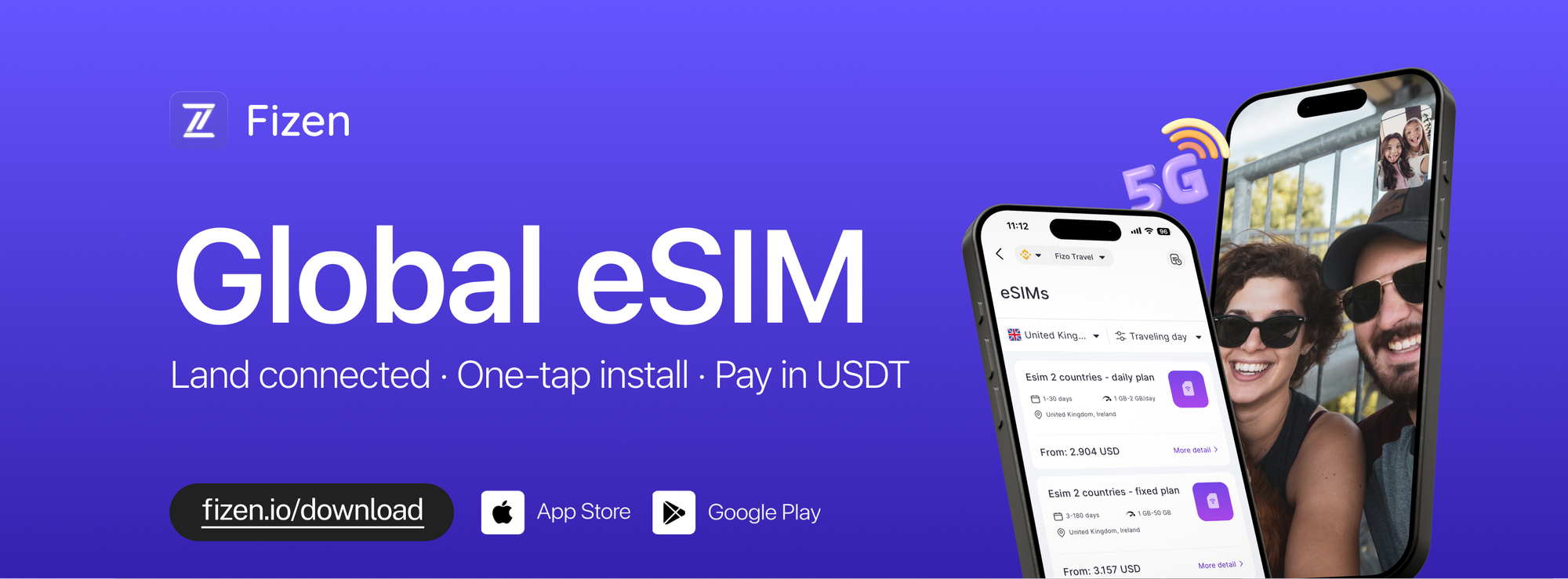
Land already online, from $4.
No midnight SIM queue, no roaming bill that eats your budget. A Fizen eSIM covers 150+ countries, with daily 1GB, 3GB and 5GB plans or unlimited data. Pay with USDT, or by card via Stripe, Apple Pay or Google Pay. And on the rare day one fails, you get a one-to-one replacement and a person who actually answers, not a ticket that replies next week.
Honest note: I use Fizen myself, and plans and prices change, so check the current one before you buy. Fizen is a self-custody super app, backed by an investment from Tether.
More from the road
- Staying Connected in Thailand
- The Complete Fizen eSIM Guide
- eSIM Scams in 2026 and How to Avoid Them
- Best Travel eSIM 2026: Every Country, Honestly Compared
- Best eSIM for Italy
- Best eSIM for Turkey
Get the Fizen eSIM and set it up
Terms and conditions
- Information only. Fizen publishes this article to inform, not to sell. Nothing here is an offer or solicitation, and it is not financial, investment, legal or tax advice. Prices, rules and availability change; check official sources.
- For readers in the United States. This article provides information only. It is not an offer, solicitation or sale of any product or service, and it is not financial, investment, legal or tax advice. Fizen is not offered to US Persons.
- Full terms. Master Terms of Use, Privacy Policy and Disclaimer on the Fizen site.