Best eSIM for Morocco 2026: Tourist Data Guide for Marrakech, Fes and the Sahara
Getting lost in the Marrakech medina is a rite of passage; doing it at night with no data and a riad owner you cannot message is not. Here is how a Morocco eSIM compares, where coverage really ends, and how to set it up.
Quick answer: The best eSIM for Morocco is a data-only travel eSIM you install at home and switch on when you land in Marrakech, Casablanca, Fes or Agadir. It skips the passport registration at airport SIM kiosks and works on Moroccan networks in cities and along main routes. Coverage fades in deep desert camps and high Atlas trails, so download offline maps. About 5 to 10GB suits a typical week.
Key takeaways
- Morocco has three networks: Maroc Telecom, Orange and inwi. Cities, main roads and tourist towns are generally well covered.
- Buying a local prepaid SIM normally means showing your passport for registration. A travel eSIM installed at home skips that step.
- Coverage is genuinely limited in the Sahara: towns and main roads are fine, but deep desert camps, especially around Erg Chigaga, can be offline for the night.
- Morocco is not in the EU, so European SIMs do not get Roam Like at Home, and Europe regional plans often leave it out. Check the country list.
- The dirham is a closed currency, so you get it after arrival from ATMs or licensed exchange offices.
- Emergency numbers: 19 for police in cities, 177 for the Royal Gendarmerie outside cities, 15 for ambulance and fire, and 112 from a mobile.
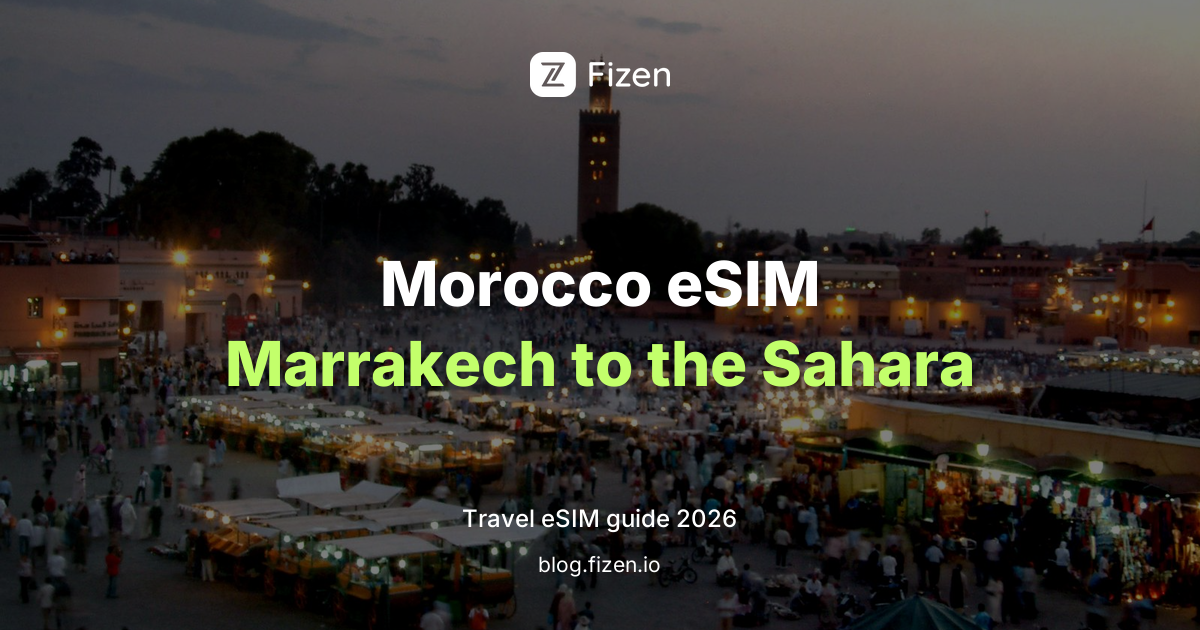
My riad in Marrakech had sent directions: turn left at the orange seller, right after the blue door, then ask anyone for the house with the fig tree. By the time I reached the medina it was dark, the orange seller had gone home, and every door looked blue. My phone had no data, so I could not message the riad, and a helpful teenager offered to guide me for a fee I did not want to negotiate.
Morocco is magical, chaotic and very doable, and it is noticeably easier when you can message your host, check a taxi fare and pull up a map. Here is how to arrive connected, and where to accept that you will be offline.
Why do you need mobile data in Morocco?
Morocco trips often combine old medinas, long drives and a night or two in the desert. Each part asks something different of your phone.
- Finding your riad. Many riads are tucked into medina alleys where addresses mean little. Hosts usually send a location pin and meet guests by WhatsApp.
- Taxis and transfers. Petit taxis should use the meter or an agreed fare; checking the route and distance on a map helps you judge a fair price.
- Trains between cities. Morocco's rail network links cities such as Tangier, Rabat, Casablanca, Marrakech and Fes, and live times and tickets are easier with data.
- Desert tours. Pickup times, meeting points and driver details for Sahara trips usually come by message, often the night before.
- Translation. Arabic, Darija and French are widely used; a translation app bridges gaps with drivers and shopkeepers.
Riad Wi-Fi is common but often slow, and it does not follow you into the souks. To walk out of the airport ready, get your Morocco eSIM before you fly.
Roaming vs local SIM vs travel eSIM in Morocco: which is best?
| Option | Online when you land? | Cost pattern | The honest catch |
|---|---|---|---|
| Home roaming (any foreign SIM) | Yes | Morocco is outside EU roaming rules; carriers charge daily fees or per-MB rates | Often expensive, even for European visitors |
| Moroccan prepaid SIM (Maroc Telecom, Orange, inwi) | After buying one at the airport or a shop | Local prepaid data bundles | Passport registration, kiosk queues after a long flight, SIM swap |
| Travel eSIM | Yes, if installed before you fly | Fixed data or daily plans shown at checkout | Data only, no Moroccan number |
Local SIMs in Morocco are good value, and carriers run kiosks in the arrivals halls of the main airports. The trade-off is time and paperwork: you normally need your passport, and your home SIM comes out on single-slot phones. A travel eSIM is the no-queue option, with your home number still in place for bank codes.
Does a Europe eSIM or EU roaming work in Morocco?
EU roaming does not. Morocco is not in the EU or EEA, so Roam Like at Home rules do not apply. Some European carriers sell Morocco add-ons, but you should expect roaming charges unless your plan says otherwise.
Europe regional plans often leave Morocco out. A lot of travelers combine southern Spain with northern Morocco, crossing the Strait of Gibraltar by ferry. For that route, check the country list carefully, and consider pairing a Europe plan for the Spanish leg with a Morocco eSIM. Our best eSIM for Spain guide and best eSIM for Europe guide cover the European side.
What is mobile coverage like in Morocco, including the Sahara and Atlas?
Morocco's three networks are Maroc Telecom, Orange and inwi. Traveler reports differ on which is strongest in rural areas, but all three work well in cities, tourist towns and along main routes, and 5G has started appearing in larger cities. Travel eSIMs connect to one or more of these networks depending on the plan.
| Area | What to expect |
|---|---|
| Marrakech, Casablanca, Rabat, Fes, Tangier, Agadir | Good 4G across the city; signal can weaken deep inside medina alleys and thick-walled riads |
| Chefchaouen, Essaouira, Ouarzazate and main road routes | Generally good in towns, with gaps on mountain passes |
| Merzouga and the edge of Erg Chebbi | Usable in the village and near the dunes; camps deeper in may have weak or no signal, some offer slow satellite Wi-Fi |
| Zagora and Erg Chigaga | Expect to be offline at remote camps overnight |
| High Atlas (Imlil and Toubkal) | Imlil village has signal; it drops as you climb, and the Toubkal refuge area is generally offline |
Honest advice for desert and mountain trips: tell family you will be offline for a night, download offline maps before you leave the city, and keep your tour operator's details saved in your phone.
How much data do you need for a trip to Morocco?
Maps, messaging and translation are light. What eats data is photo and video uploads from the souks and the dunes. See how much eSIM data you need for app-by-app numbers.
| Trip length | Light use | Typical use | Heavy use (video, hotspot, work) |
|---|---|---|---|
| Marrakech long weekend | 1 to 2GB | 3GB | 5GB or more |
| One week (Marrakech plus desert tour) | 3GB | 5 to 10GB | 15GB or a daily or unlimited plan if offered |
| Two weeks (imperial cities, coast and Sahara) | 5GB | 10 to 15GB | 20GB or more |
| A month or longer | 10GB | 20GB | Consider a local SIM or several eSIMs |
Tip: download offline maps of each medina you will visit. Map apps are not perfect in the narrowest alleys, but a saved pin for your riad is still the best way home.
How do I set up an eSIM for Morocco? (5 steps)
The whole job takes about ten minutes, and the only part that needs Wi-Fi is the install. Do it the evening before you fly, not at the gate.
- Check your phone. Make sure it supports eSIM and is carrier-unlocked. On most phones you can dial *#06# and look for an EID, or look for an Add eSIM option in your mobile settings. Our eSIM compatibility list covers the common models.
- Pick a plan for your trip length. Open the plan page, choose Morocco, and compare the fixed-data and daily options against the data table above. Check hotspot and validity details in the plan description, then get your Morocco eSIM. You can pay in USDT on Solana or BNB Chain or with the other methods shown at checkout.
- Install at home on Wi-Fi. On supported iPhones it is a one-tap install; on other phones you scan the QR code or enter the details manually. Label the new line something obvious, such as "Travel data", so you do not mix it up with your home SIM.
- Set the lines before you leave. Keep your home SIM on for calls and bank texts, set the travel eSIM as the line for mobile data, and leave data roaming switched off on your home line so it cannot run up charges. Save your riad's location pin and WhatsApp number offline before you fly.
- Switch on when you land. Turn the eSIM line on after landing in Marrakech, Casablanca, Fes or Agadir, and it should connect to a Moroccan network within a minute or two. If nothing connects after a couple of minutes, toggle airplane mode, check that data roaming is on for the eSIM line, and message support with your order details. A real person walks you through it.
What else should tourists know before arriving in Morocco?
Money: the dirham, ATMs and cash
- Closed currency. The Moroccan dirham (MAD) cannot be bought or sold outside Morocco, so you get it after arrival from ATMs or licensed exchange offices. Keep exchange receipts in case you want to change dirhams back before leaving.
- Cash still matters. Cards work in hotels, larger restaurants and chain shops, but souks, petit taxis and small cafés mostly run on cash.
- Tips and small notes. Keep small notes for tips, guides and taxis.
Getting around
Petit taxis operate within cities; ask for the meter or agree the fare before you get in. Grand taxis and buses cover longer routes, and trains link major cities. Ride-hailing app availability varies by city, so do not count on it everywhere.
Plugs and emergency numbers
- Plugs. Type C and E sockets at 230V, so most continental European plugs fit.
- Emergency numbers. 19 for police in cities, 177 for the Royal Gendarmerie outside urban areas, 15 for ambulance or fire, and 112 from a mobile phone. Keep your home SIM active for calls, since travel eSIMs are data-only.
- Useful apps. Offline maps, a translation app with Arabic and French, WhatsApp for riads and tours, and a currency converter.
eSIM gotchas worth knowing
- Data only. A travel eSIM gives you internet, not a local phone number. Calls to restaurants or tour operators go through WhatsApp or your home SIM.
- Top-ups work differently. Most travel eSIMs cannot be topped up. If you run out, you buy and install a second eSIM, which takes a minute or two on a working connection, so do it before you hit zero.
- Hotspot is per plan. If you want to tether a laptop, confirm the plan allows hotspot before you buy.
- Changed plans? If your Morocco trip is cancelled, unused eSIMs can be returned; eligibility depends on the plan.
Why I use a Fizen eSIM for Morocco
After that night of blue doors, I set up my data before I fly and send my riad a message from the taxi. A Fizen eSIM means no kiosk queue or passport photocopy after a long flight, and my home SIM stays in for bank codes.
Fizen eSIM covers 150+ destinations with plans from $4, one-tap install on supported iPhones, and payment in USDT on Solana or BNB Chain plus the other methods shown at checkout. There is a trip-long warranty with free 1-for-1 replacement if an eSIM fails, and a real person on support. Check the live Morocco plans and hotspot details, then get your Morocco eSIM.
Frequently asked questions
Do eSIMs work in Morocco?
Yes. Travel eSIMs connect to Moroccan networks and work well in cities, tourist towns and along main routes. Your phone must be eSIM-capable and unlocked, and installing it at home before you fly is the easiest option.
What is the best eSIM for Morocco for tourists?
A data-only travel eSIM that lists Morocco, sized to your trip, with clear hotspot details and reachable support. Around 5 to 10GB covers a typical week including a desert tour.
Do I need a passport to buy a SIM card in Morocco?
Normally yes. Prepaid SIMs from Maroc Telecom, Orange and inwi are registered with your passport at the airport kiosk or shop. A travel eSIM bought online and installed at home avoids that step.
Is there mobile signal in the Sahara Desert in Morocco?
In towns like Merzouga and near the edge of the dunes, usually yes. Deeper desert camps can have weak or no signal, and remote camps around Erg Chigaga are often offline overnight, so plan for it.
Does a Europe eSIM work in Morocco?
Often not, because Morocco is outside the EU and Europe regional plans frequently leave it out. Check the plan's country list, and for Spain and Morocco trips consider separate plans for each leg.
Does EU roaming work in Morocco?
No. Morocco is not covered by EU Roam Like at Home rules, so European SIMs are charged whatever their carrier sets for Morocco. Check your tariff or use a travel eSIM.
Can I get Moroccan dirhams before I travel?
Generally no. The dirham is a closed currency, so you get it in Morocco from ATMs or licensed exchange offices. Keep your exchange receipts if you plan to change money back.
What is the emergency number in Morocco?
Call 19 for police in cities, 177 for the Royal Gendarmerie outside urban areas, and 15 for ambulance or fire. From a mobile phone, 112 also reaches emergency services.
Land connected. Skip the roaming bill.
Install your Morocco eSIM at home and switch it on when you land. Data plans in 150+ destinations from $4, one-tap install on supported iPhones, pay in USDT on Solana or BNB Chain or with the other methods shown at checkout. Trip-long warranty with free 1-for-1 replacement and a real person to help. Not offered to US Persons.
Terms and conditions
- Information only. This guide is general information for travelers. It is not financial, legal, tax or investment advice.
- For readers in the United States. This article provides information only. It is not an offer, solicitation or sale of any product or service, and it is not financial, investment, legal or tax advice. Fizen is not offered to US Persons.
- Plans vary. Prices, data allowances, hotspot support and when validity starts differ by plan and destination. The details shown at checkout take precedence over anything written here.
- Your phone. A travel eSIM needs an eSIM-capable, carrier-unlocked phone. Fizen eSIMs are data-only, with no local number, calls or SMS.
- Rules change. Entry and visa rules, roaming terms, transport fares, network coverage and emergency arrangements are set by official sources and can change. Check the official government, operator or tourism site before you travel.
- No affiliation. Fizen is not affiliated with Maroc Telecom, Orange, inwi, ONCF, desert tour operators or any other carrier, transport operator, app or venue named in this guide. Names are used for reference only.
- Availability. Fizen is not offered to US Persons. Unused eSIMs can be returned, and eligibility depends on the plan.
- Full terms. Master Terms of Use, Privacy Policy and Disclaimer on the Fizen site.
Sources
- Traveltomtom: best prepaid SIM card in Morocco (registration and coverage)
- MarocMama: connectivity in Morocco, desert and Atlas coverage
- Morocco Guide: useful and emergency phone numbers
- Globe Drifters: money in Morocco (closed currency)
- WorldStandards: plug, socket and voltage by country
Information checked in September 2026. Network coverage, SIM registration rules, currency rules and plan prices change, so check official sources and the live plan before you travel.