Best eSIM for Croatia 2026: Tourist Data Guide for Dubrovnik, Split and the Islands
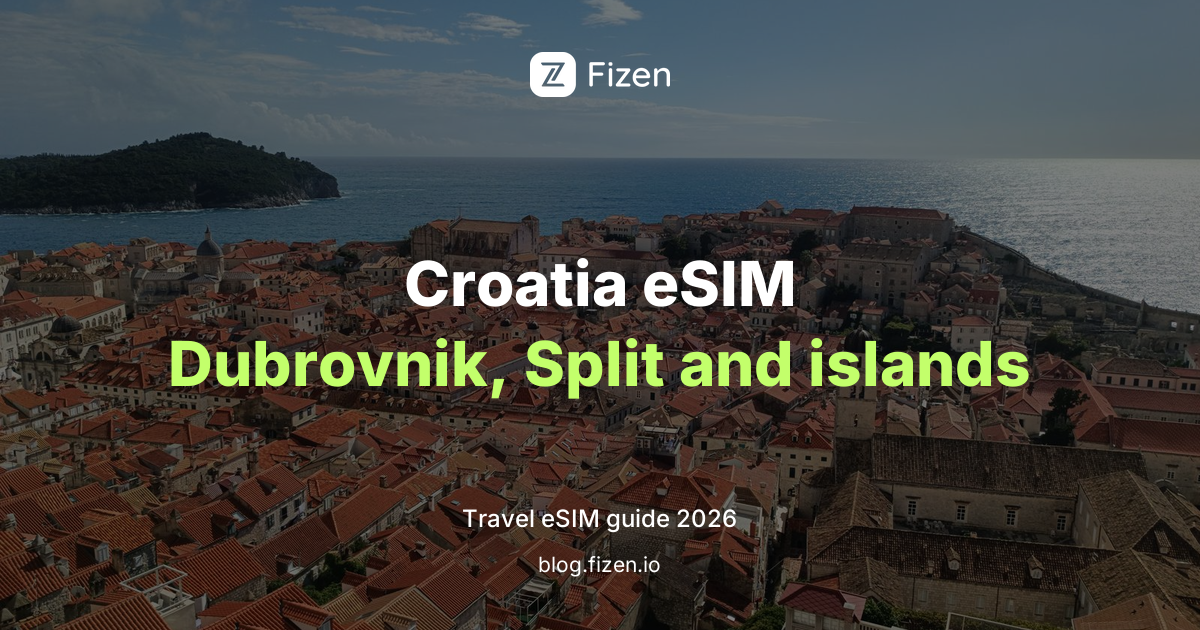
Standing at Split harbour with a ferry leaving in ten minutes and no data to find the right pier is a very Croatian kind of stress. Here is how a Croatia eSIM compares, where coverage thins out, and how to set it up before you fly.
Quick answer: The best eSIM for Croatia is a data-only travel eSIM you install at home and switch on when you land in Dubrovnik, Split or Zagreb. Croatian networks cover the coast, towns and inhabited islands well, with thinner signal in remote inland parks and mid-channel on ferries. EU visitors usually roam at home prices. Plan around 5 to 10GB for a week of maps, ferry apps and photos.
Key takeaways
- Croatia's main networks are Hrvatski Telekom, A1 and Telemach, with good coverage along the coast and on inhabited islands.
- Croatia has used the euro and been part of Schengen since 1 January 2023, and EU visitors can usually roam at home prices.
- The mJadrolinija app sells tickets and shows sailing schedules for Adriatic ferry and catamaran routes.
- Driving or taking a bus through the Neum corridor briefly enters Bosnia and Herzegovina, where your phone may switch to a non-EU network. The Pelješac Bridge route avoids it.
The catamaran to Hvar was leaving from a pier I could not find. Split harbour was full of boats, signs and people pulling suitcases, my ticket was in an email I could not load, and my roaming had quietly failed somewhere between the airport and the Riva. I made it, barely, by asking three different ticket sellers.
Why do you need mobile data in Croatia?
A Croatia trip moves a lot: old towns, beaches, ferries, national parks and often a border or two. Wi-Fi at your apartment will not help at a ferry port or on a coastal road.
- Ferries and catamarans. Sailings sell out in summer, schedules change by season, and your ticket often lives in an app or email.
- Old towns. Dubrovnik and Split are pedestrian mazes where maps save time, and parking apps and guest-house check-in messages need data.
- Rides and transfers. Ride-hailing apps operate in the bigger cities and tourist areas, and airport transfers are arranged by message.
- National parks. Popular parks such as Plitvice sell tickets online, and buying ahead is common in peak season, so having the ticket on your phone helps.
- Beaches and boats. Weather, wind and boat-trip updates come through messaging apps, often on the morning of the trip.
To walk out of arrivals already online, get your Croatia eSIM and install it at home before the flight.
Roaming vs local SIM vs travel eSIM in Croatia: which is best?
| Option | Online when you land? | Cost pattern | The honest catch |
|---|---|---|---|
| Home roaming (EU SIM) | Yes | Usually home prices under EU rules, within fair-use limits | Does not cover Bosnia or Montenegro day trips |
| Home roaming (non-EU SIM) | Yes | Daily pass or per-MB rates from your carrier | Adds up across a two-week island trip |
| Croatian prepaid SIM | After you buy one | Local tourist and prepaid bundles | Finding a kiosk or shop, SIM swap, top-ups in Croatian |
| Travel eSIM | Yes, if installed before you fly | Fixed data or daily plans shown at checkout | Data only, no Croatian number; check border countries |
For most visitors outside the EU, a travel eSIM is the simplest option. EU visitors on a short trip may be fine on roaming, but a separate eSIM keeps holiday photos from eating a capped home allowance.
Does EU roaming work in Croatia, and what about Neum, Bosnia and Montenegro?
Croatia joined the euro area and Schengen on 1 January 2023, and as an EU member it is covered by Roam Like at Home rules. SIMs from EU countries, Iceland, Liechtenstein and Norway generally roam at domestic prices, within fair-use limits. UK SIMs are no longer covered by those rules.
The Neum corridor catch. The old coastal road between Split and Dubrovnik crosses a short strip of Bosnia and Herzegovina around Neum. Your phone may stay on a Croatian network thanks to boosters, but it can also switch to a Bosnian network, where EU roaming rules do not apply. The Pelješac Bridge, open since 2022, lets drivers stay in Croatia the whole way, but some buses and tours still pass through Neum. Watch the network name on your phone, or pause data for that stretch.
What is mobile coverage like in Croatia, including the islands?
Croatia's main networks are Hrvatski Telekom, A1 and Telemach, with 4G across the coast, cities and inhabited islands, and 5G in larger towns. Travel eSIMs connect to one or more of these depending on the plan.
| Area | What to expect |
|---|---|
| Zagreb, Split, Dubrovnik, Zadar, Pula | Fast 4G, 5G in many areas; very crowded old towns can feel slow at peak hours |
| Inhabited islands (Hvar, Brač, Korčula, Vis, Krk) | Usually good in towns and harbours; can thin out in coves, on the far side of hills and on remote beaches |
| Ferries and catamarans | Good near the coast and ports; brief drops mid-channel and on longer crossings |
| Plitvice Lakes and inland valleys | Usable at entrances and hotels; patchy down in canyons and forest trails |
| Mountain areas (Velebit, Biokovo) | Patchy away from roads; download offline maps |
On boat days, screenshot your tickets and booking details before you leave port. If signal drops mid-crossing, you will still have what you need at the other end.
How much data do you need for a trip to Croatia?
Maps, ferry apps and messaging are light. Beach photos, reels and video calls are not. For app-by-app numbers, read how much eSIM data you need.
| Trip length | Light use | Typical use | Heavy use (video, hotspot, work) |
|---|---|---|---|
| Long weekend in Dubrovnik or Split | 1 to 2GB | 3GB | 5GB or more |
| One week (city plus islands) | 3GB | 5 to 10GB | 15GB or a daily or unlimited plan if offered |
| Two weeks island-hopping | 5GB | 10 to 15GB | 20GB or more |
| A month or longer | 10GB | 20GB | Consider a local SIM or several eSIMs |
If you are sailing or on a yacht week, add a buffer: phones get used as hotspots on boats more than people expect.
Terms and conditions
- Information only. This guide is general information for travelers. It is not financial, legal, tax or investment advice.
- For readers in the United States. This article provides information only. It is not an offer, solicitation or sale of any product or service, and it is not financial, investment, legal or tax advice. Fizen is not offered to US Persons.
- Plans vary. Prices, data allowances, hotspot support and when validity starts differ by plan and destination. The details shown at checkout take precedence over anything written here.
- Your phone. A travel eSIM needs an eSIM-capable, carrier-unlocked phone. Fizen eSIMs are data-only, with no local number, calls or SMS.
- Rules change. Entry and visa rules, roaming terms, transport fares, network coverage and emergency arrangements are set by official sources and can change. Check the official government, operator or tourism site before you travel.
- No affiliation. Fizen is not affiliated with Hrvatski Telekom, A1, Telemach, Jadrolinija, BH Telecom, m:tel, HT Eronet or any other carrier, transport operator, app or venue named in this guide. Names are used for reference only.
- Availability. Fizen is not offered to US Persons. Unused eSIMs can be returned, and eligibility depends on the plan.
- Full terms. Master Terms of Use, Privacy Policy and Disclaimer on the Fizen site.
Sources
- European Commission: Croatia joins the euro and Schengen areas
- Your Europe: mobile roaming costs (Roam Like at Home coverage)
- Expat in Croatia: mobile phone providers in Croatia
- mJadrolinija app (Google Play)
- Wikivoyage: Neum (mobile phones and the Pelješac Bridge)
Information checked in September 2026. Roaming terms, network coverage, ferry schedules and plan prices change, so check official sources and the live plan before you travel.