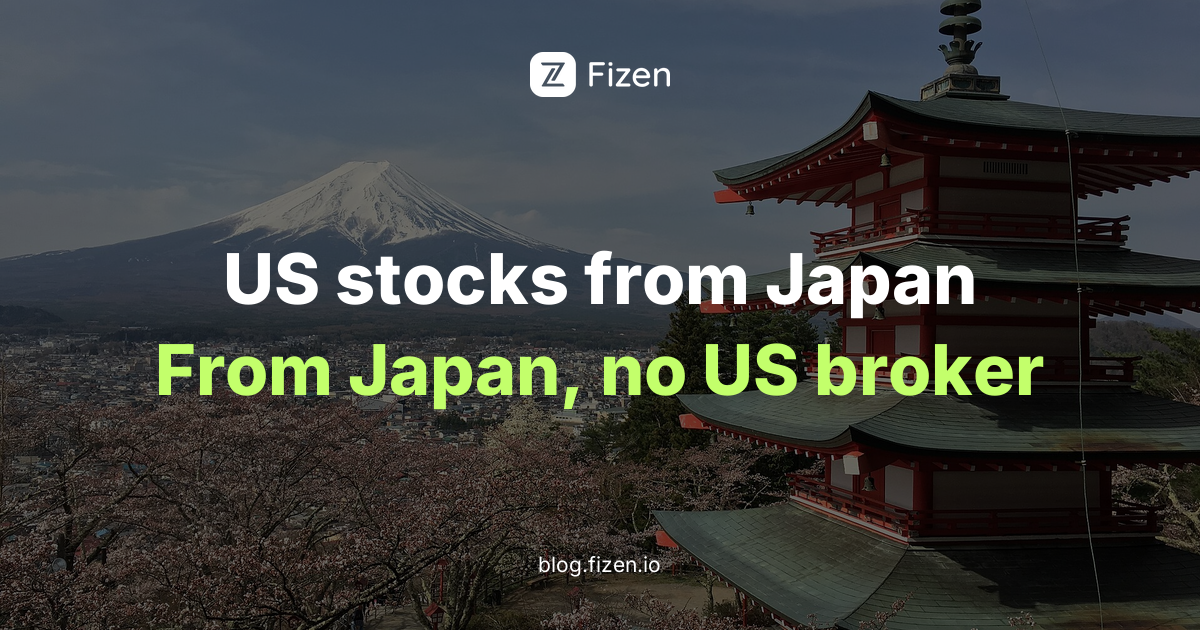
Buying US Stocks from Japan with USDT: A Nomad's Guide for 2026
Japanese brokers want a My Number Card and a yen account. If you are paid in stablecoins and based in Japan for a few months, here is how tokenised US stocks work instead.
Quick answer: For a digital nomad based in Japan and paid in stablecoins, buying tokenised US stocks and ETFs with USDT is the shorter route than a Japanese brokerage, which expects a My Number Card and a yen account. Fizen offers 100+ tokenised US stocks and ETFs, bought and sold with USDT or USDC on Ethereum, and it is investing, not saving: prices move and losses are possible.
Key takeaways
- Funding rail: tokenised US stocks let you go from USDT to US equity exposure without a US bank account or a cross-border wire, as StableStock described in its July 2026 guide.
- Japan's own apps are open: Woodstock, registered with the Kanto Local Finance Bureau (Kinchu No. 965), lets residents buy from 0.0001 shares, about 200 yen, with no trading or forex fee, per a June 2026 comparison.
- USDT in Japan: from 1 June 2026 qualifying foreign stablecoins can be distributed through licensed channels, but USDC qualifies and USDT largely does not, per Fystack's 2026 regulatory explainer.
- Scope: Fizen offers 100+ tokenised US stocks and ETFs settled with USDT or USDC on Ethereum, held in self-custody, and it is not offered to US Persons.
You are a digital nomad in Tokyo, paid in USDT, and your broker wants a Japanese residence card, a My Number card and a yen bank account before it will let you buy a single Apple share.
Japan now has a formal pathway for foreign stablecoins since 1 June 2026, and tokenised US stocks let you put part of that working balance into the US market from the same app, in fractions, without a Japanese brokerage account.
Can a digital nomad in Japan buy US stocks with USDT at all?
Yes, but not through a Japanese brokerage. Japanese brokers require a Japanese bank account, a My Number Card and a tax residency status that most digital nomads do not have. The route that works is a stablecoin-funded platform: you deposit USDT or USDC, place an order, and the platform routes it to a licensed brokerage that holds the shares in custody (StableStock, 10 July 2026). No US bank account, no wire transfer, no JPY to USD conversion chain.
The catch is on the stablecoin side. Since 1 June 2026, Japan's Payment Services Act allows qualifying foreign stablecoins through licensed distributors, but USDC qualifies and USDT does not (Fystack, 2026). USDT has no licensed distribution pathway inside Japan. That does not stop you from holding USDT in a self-custody wallet and sending it to an offshore platform, but it does mean you cannot buy USDT from a Japanese exchange and expect it to sit inside the regulated perimeter.
What does the Japanese brokerage route actually demand that you cannot give?
A Japanese brokerage account is built around residency. Woodstock, a US stock app registered in Japan, opens accounts with a My Number Card in as little as one minute (gisuser.com, June 2026). That is fast if you have the card. If you are on a tourist visa or a short-term stay, you do not. SBI Securities, the established alternative, requires standard share purchases and a Japanese securities account, which in turn requires a Japanese address and tax status.
| Requirement | Japanese brokerage (e.g. Woodstock, SBI) | Stablecoin-funded platform |
|---|---|---|
| Residency proof | My Number Card or Japanese address | Passport and KYC, no Japanese address |
| Funding currency | JPY bank transfer | USDT or USDC |
| Minimum ticket | About ¥200 (0.0001 shares) at Woodstock | From US$1 at OKX (MGBABA, March 2026) |
| Tax reporting | Japanese capital gains tax 15-25% (MGBABA) | Your responsibility, check local rules |
Which stablecoin can you legally move inside Japan, USDT or USDC?
USDC. Since 1 June 2026, foreign stablecoins can enter Japan through licensed Electronic Payment Instrument Exchange Service Providers, and USDC is eligible via SBI VC Trade. USDT is not currently eligible and has no licensed distribution pathway (Fystack, 2026). The regulator is the Financial Services Agency, and the governing law is the Payment Services Act.
This matters for how you fund a stock purchase. If your USDT sits on an offshore exchange or in a self-custody wallet, you can send it to a platform that accepts USDT directly. StableStock, for example, accepts USDT and USDC interchangeably through Combo Payments, ranking your stablecoins by priority so the next one covers a shortfall in the same transaction (StableStock, 10 July 2026). If you try to move USDT through a Japanese licensed exchange, you will not find a compliant on-ramp.
The practical rule for a nomad in Japan: do not try to convert JPY to USDT inside Japan. Keep your stablecoin balance offshore, and use USDC if you need a regulated Japanese rail for any reason. For buying tokenised stocks, the platform's acceptance of USDT is what matters, not Japanese distribution rules.
How do you buy tokenised US stocks with USDT, step by step?
The process has four steps and no Japanese bank account. First, create an account and complete KYC. Identity verification is a regulatory requirement for anything that touches real securities, and on StableStock it includes an investor questionnaire and a risk assessment that typically takes a few minutes (StableStock, 10 July 2026). Second, deposit USDT or USDC. Third, search the ticker, choose market or limit order, and confirm. Fourth, settlement: US equities settle T+1, one business day after the trade, and the shares are held in custody by a licensed brokerage partner for your benefit (StableStock, 10 July 2026).
What you own depends on the product. On the brokerage layer you own real shares held in custody, with dividends accruing to your account and corporate actions like splits applied automatically. On the tokenised layer, platforms like StableStock offer sStocks, on-chain tokens backed 1:1 by real shares in custody, which carry economic rights such as dividends but not voting rights (StableStock, 10 July 2026). If a platform cannot tell you clearly which one you are getting, that ambiguity is the answer.
What do you actually own, and what does it cost?
You own tokenised US stocks and ETFs, not a derivative or a synthetic tracker. Fizen offers 100+ tokenised US stocks and ETFs, bought and sold with USDT or USDC on Ethereum. The token is backed by the underlying share, but you hold it in self-custody, so the economic exposure is yours and so is the key.
Cost has three parts, and each is visible before you confirm: the platform trading fee, the bid-ask spread on the stock, and the Ethereum network fee for moving USDT or USDC. A 2026 guide to buying US stocks with USDT puts it plainly: you skip the bank wire and the FX conversion chain, but you still pay the spread and the network fee (StableStock, 10 July 2026).
| Cost component | What it is | When it applies |
|---|---|---|
| Platform trading fee | Fizen's fee per order | On every buy or sell |
| Bid-ask spread | Difference between buy and sell price | On every trade, wider in thin markets |
| Ethereum network fee | Gas to move USDT or USDC | On deposit and withdrawal |
| FX to yen | None inside the app | Only if you cash out to a Japanese bank |
How much do you need to start, and can you buy fractions?
You can start with the smallest amount you are willing to lose, because tokenised stocks trade in fractions. There is no minimum deposit gate on the Fizen side. The comparison that matters is with a Japanese brokerage: Woodstock, a registered financial instruments intermediary (Kanto Local Finance Bureau Kinchu No. 965), lets you buy from 0.0001 shares, about ¥200, with zero commission and zero explicit forex fee (gisuser, June 2026).
That ¥200 entry is real and it is cheap. But Woodstock funds from yen through a Japanese bank account and a My Number Card. If your working balance is USDT and your residency is a moving target, the funding rail is the friction, not the minimum.
| Route | Minimum to start | Funding rail | Best for |
|---|---|---|---|
| Fizen tokenised stocks | Fractional, no minimum deposit | USDT or USDC on Ethereum | Nomads paid in stablecoins |
| Woodstock (Japan) | About ¥200 (0.0001 shares) | Yen via Japanese bank | Residents with a My Number Card |
| SBI Securities (Japan) | Standard share lots | Yen via Japanese bank | Long-established brand, broader selection |
Frequently asked questions
Can I buy US stocks from Japan with USDT?
Yes, through platforms that accept stablecoin deposits and route orders to real equity. Japanese-licensed apps like Woodstock work in yen instead. Check which product you are actually buying, because tokenised stock structures differ.
Do I need a Japanese bank account to invest from Japan?
Not for a stablecoin-funded platform. Japanese brokers generally expect a yen account and a My Number Card for onboarding, which is awkward if you are in Japan on a tourist or short-stay visa.
Is USDT legal in Japan?
From 1 June 2026 qualifying foreign stablecoins can be distributed through licensed channels under the Payment Services Act. USDC qualifies via SBI VC Trade; USDT largely does not, per Fystack's 2026 explainer.
What is the minimum to start?
On Fizen you can buy fractions, so the minimum is set by the order size rather than a whole share. Japanese app Woodstock lets residents start from 0.0001 shares, about 200 yen, per a June 2026 comparison.
Do tokenised stocks pay dividends?
It depends on the structure. Some tokens are backed 1:1 by real shares held in custody and carry economic rights including dividends, but not voting rights. Confirm the terms before you buy.
Hold a slice of the US market
Buy and sell 100+ tokenised US stocks and ETFs with USDT or USDC, in fractions, from the same app that holds your working balance. Your money. Your freedom. No borders.
Terms and conditions
- Information only. This article is general information, not investment advice, and nothing here is a recommendation to buy or sell any asset.
- Investing, not saving. Tokenised stocks are an investment: prices move, and losses are possible. Self-custody means you control the keys.
- For readers in the United States. This is information only, not an offer or sale of securities and not advice. Fizen is not offered to US Persons.
- Rules vary by market. Tokenised stock products differ in structure, custody and investor rights between platforms, so check what you actually hold before you trade.
Sources
- StableStock, How to Buy US Stocks with USDT (10 July 2026)
- Yellow.com, 5 Best Exchanges To Buy Tokenized US Stocks Directly With USDT In 2026 (1 September 2026)
- GISUser, Best Apps to Buy American Stocks in Japan: A 2026 Comparison (June 2026)
- Fystack, Japan Stablecoin Regulation Explained (2026)
- Japan Financial Services Agency
- Bank of Japan
- FINRA
Facts and dates in this article were checked on 12 November 2026.