Vietnam QR Code Payment for Foreigners (2026): How to Pay Step by Step, No Local Bank Needed
Vietnam's counters run on QR codes built for Vietnamese bank accounts. The five steps a foreigner follows, which route fits your passport and money, and exactly what Fizen QR Pay does and does not do, checked on 2 November 2026.
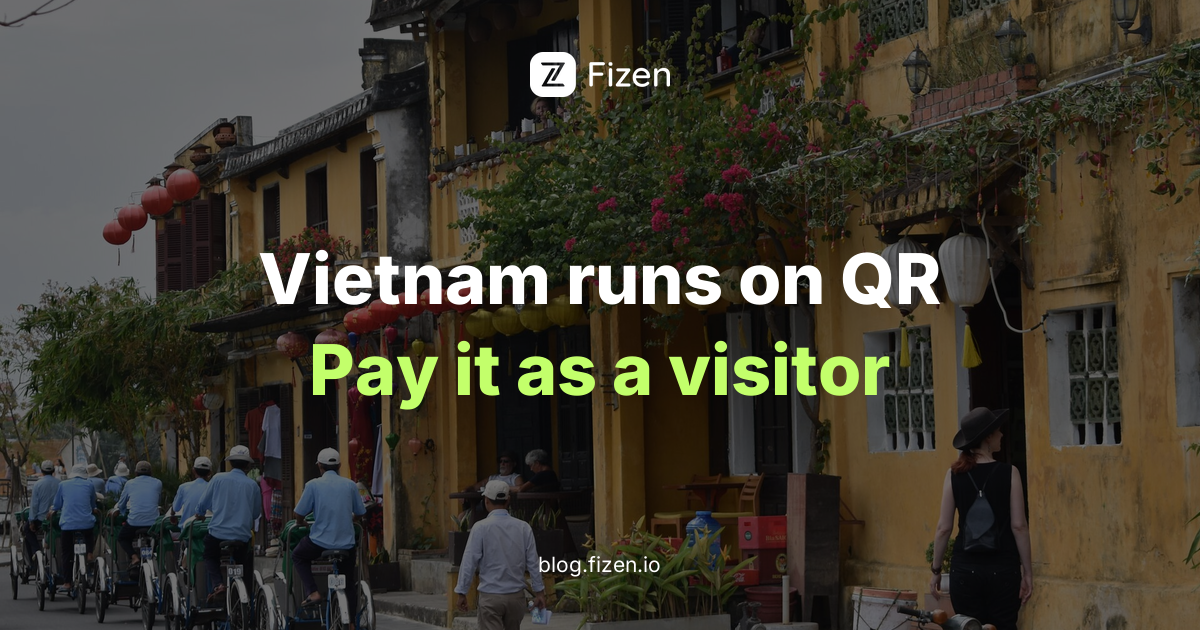
Quick answer: To pay a QR code in Vietnam as a foreigner, read which logo is on the stand, pick a route that supports it (a home app from one of six linked countries, VNPAY with an international card, or Fizen QR Pay from USDT), set it up before you land, then scan and check the name and the dong amount before you confirm. As of November 2026 none of these needs a Vietnamese bank account. QR Pay allows US$800 per payment and US$1,000 per week and is for visitors only, not Vietnamese residents.
The short version: as a visitor you can pay with USDT at any VietQR, MoMo or VNPay counter through Fizen QR Pay: no Vietnamese bank account, no card, the shop receives dong. Try QR Pay in the Fizen app
Key takeaways
- Most Vietnamese QR codes are bank transfers. VietQR, run by NAPAS, moves dong between Vietnamese accounts, which is why a foreign card cannot pay it directly.
- Six countries have a home-app route. China, South Korea, Thailand, Laos, Cambodia and Singapore were linked to NAPAS's cross-border QR network as of July 2026.
- QR Pay is the USDT route for everyone else. Funded only with USDT on Solana or BNB Chain, KYC applies, limits US$800 per payment and US$1,000 per week, no daily limit.
- It is cross-border only. Vietnamese residents cannot use QR Pay in Vietnam, and in Vietnam it pays Vietnamese account holders' codes only.
Which network you get, and what it really costs
In Vietnam the Fizen eSIM roams on Viettel Mobile (4G). Vietnam is sold inside the Asia plan, which covers 18 countries. At 128 kbps you can still send messages and load map tiles, but not hold a video call.
| Plan | Days | Price | Per day | Per GB | After the high-speed data |
|---|---|---|---|---|---|
| 1 GB | 3 | US$10.06 | US$3.35 | US$10.06 | slows to 128 kbps |
| 5 GB | 7 | US$17.13 | US$2.45 | US$3.43 | slows to 128 kbps |
| 5 GB | 15 | US$17.14 | US$1.14 | US$3.43 | slows to 128 kbps |
| 5 GB | 30 | US$18.15 | US$0.60 | US$3.63 | slows to 128 kbps |
| 10 GB | 7 | US$23.21 | US$3.32 | US$2.32 | slows to 128 kbps |
| 10 GB | 15 | US$24.22 | US$1.61 | US$2.42 | slows to 128 kbps |
| 10 GB | 30 | US$25.24 | US$0.84 | US$2.52 | slows to 128 kbps |
| 20 GB | 15 | US$38.40 | US$2.56 | US$1.92 | slows to 128 kbps |
| 20 GB | 30 | US$39.43 | US$1.31 | US$1.97 | slows to 128 kbps |
| 50 GB | 30 | US$78.91 | US$2.63 | US$1.58 | slows to 128 kbps |
Prices and carrier read from the Fizen catalogue on 24 November 2026. Data only, no calls or SMS.
The bun cha is on the table, the owner taps a laminated QR code by the till, and your card is useless here: there is no terminal, only the code. You have no Vietnamese bank account and about 40,000 dong in your pocket.
This guide is for that moment: the steps first, then the route that fits your passport and money, then the fine print of the USDT route.
How to pay with a QR code in Vietnam for foreigners: five steps
- Read the stand. Look for the logo: VietQR, VIETQRGlobal, VNPAY-QR, Alipay+, MoMo or ZaloPay. The key question, as Wise puts it, is whether your app supports the specific code in front of you.
- Pick a route before you fly (table below): a home app if you are from one of six linked countries, VNPAY with an international card, or Fizen QR Pay if you hold USDT.
- Set it up and get online. Every route needs data at the counter, and QR Pay needs wallet, USDT and a few minutes of KYC done in advance.
- Scan, then check the name and the amount in dong. A printed stand is static, so you type the amount; a code on a till screen is dynamic and pre-filled, which Wise says is faster and less error-prone.
- Confirm, show your screen, and carry some dong. If a payment is still processing, do not pay again. Small stalls and rural areas often still take cash only.
QR payment in Vietnam for foreigners: which route fits your passport and money?
| Route | Who it is for | Funded with | Watch out for |
|---|---|---|---|
| Home app on VIETQRGlobal or VNPAY-QR | Visitors from China, South Korea, Thailand, Laos, Cambodia, Singapore | Your own bank or wallet app | Only participating merchants; no new app to install |
| Wise via Alipay+ codes | Wise customers resident in Europe, Malaysia, Singapore or the UK | Wise balance | Only codes with the Alipay+ mark |
| VNPAY visitor sign-up | Anyone with a passport and a Visa, Mastercard or JCB card | Foreign card | Your card's foreign fee still applies |
| Fizen QR Pay | Travellers and foreigners in Vietnam and the Philippines holding USDT | USDT on Solana or BNB Chain | Not for residents; needs USDT first |
Comparing visitor apps? See Fizen QR Pay vs LocalPay vs Moreta Pay.
How does Fizen QR Pay work in Vietnam?
- Create or import your Fizen wallet. It is self-custody: you hold the keys, so write the recovery phrase down.
- Get USDT on BNB Chain or Solana into the wallet. Holding it on an exchange? Withdraw it on one of those networks to your Fizen wallet address. USDT on another network, or another token, cannot be deposited into QR Pay; swap and bridge it in the app first.
- Deposit from the wallet into QR Pay. On BNB Chain it costs no gas; on Solana keep a little SOL in the wallet.
- Pass KYC. It applies per wallet and per device, so a new phone means verifying again.
- Scan and pay. Check the merchant name and the dong amount, then confirm. The merchant receives dong in their Vietnamese account.
Illustrated walkthrough: QR Pay getting started. Codes covered in Vietnam: VietQR bank codes, VNPay, MoMo and ZaloPay. QR Pay also works in the Philippines on QR Ph, again for visitors only. You need USDT first; Fizen does not sell it to you.
What are the QR Pay rules, limits and fees?
| Rule | What it means for you (November 2026) |
|---|---|
| Who can use it | Travellers and foreigners in Vietnam and the Philippines. Residents cannot use it in their own country; your home country is set from KYC |
| Funding | USDT on BNB Chain or Solana only. No bank link, no card, no VND deposit |
| Recipients in Vietnam | QR codes of Vietnamese account holders. A code linked to a foreigner's account will not go through |
| Limits | US$800 per payment and US$1,000 per week per user. No daily limit |
| Fees | Any fee is shown before you confirm. Inviting friends can earn up to US$50 in fee vouchers in total, applied at up to US$0.20 per payment |
| Checks | KYC for every user; every deposit passes KYT, AML, counter-terrorist-financing, sanctions and fraud checks |
On custody: the Fizen wallet is self-custody. QR Pay works differently: USDT you move into QR Pay is governed by the Fizen QR Pay Terms, so only move in what you plan to spend this trip.
What does QR Pay not do?
- It does not take a bank card or bank transfer as funding, and the app does not sell you USDT.
- It is not for Vietnamese residents, and not a way to send money to family in Vietnam.
- It cannot pay a code whose account belongs to a foreigner, and does not work in Korea, Japan, Thailand or China.
Why would a QR payment fail, and what should you do?
- The receiving bank is under maintenance. If it shows as failed, try later or contact Fizen support.
- Still processing. Do not pay again; wait for the final status.
- The code is old or expired. Ask for a new one.
- The message has special characters, or you are over the limit. Many banks reject hyphens, slashes or dots; tell the merchant. Limits: US$800 per payment, US$1,000 per week.
Where in Vietnam can you pay by QR, and where do you still need cash?
QR reaches far beyond hotels: a Ben Thanh Market stall owner told Viet Nam News in September 2026 that about 70% of her customers pay cashless. Wise's June 2026 guide still advises cash off the main routes, so keep some dong for the 6am market.
Every QR payment needs data. Fizen's travel eSIM covers 150+ countries; fizen.io/esim or the app's eSIM tab shows current Vietnam plans. New app users also get US$10 of eSIM credit, applied at checkout up to 30% of each plan.
What changed for foreigners paying by QR in 2026?
- Singapore went live on NAPAS's cross-border network on 2 July 2026; Weixin Pay joined in August.
- NAPAS said in June 2026 it aims to connect India and Taiwan within 2026; we found no launch announcement by 2 November 2026, and no route yet for European, American, Australian or Russian home apps.
- QR Pay's earlier 5% holding bonus has ended.
Your money. Your freedom. No borders. Fizen is the stablecoin neobank for travelers, digital nomads and online workers; get the Fizen app to set up QR Pay before you land. More: Fizen QR Pay: 10 things to know.
Frequently asked questions
Can foreigners use QR code payment in Vietnam?
Yes. As of November 2026, visitors from China, South Korea, Thailand, Laos, Cambodia and Singapore can use home apps at cross-border-enabled merchants, and other visitors can use VNPAY with an international card or Fizen QR Pay funded with USDT on BNB Chain or Solana.
How do I do QR code payment in Vietnam for foreigners?
Read the logo on the stand, use an app that supports it, scan, check the account name and the dong amount, and confirm. Set up your route and mobile data before you arrive.
What is QR Pay in Vietnam?
Fizen QR Pay is a feature in the Fizen app that lets foreign visitors scan Vietnamese VietQR, VNPay, MoMo and ZaloPay codes and pay from USDT, with the merchant receiving dong. It is cross-border only, so Vietnamese residents cannot use it in Vietnam.
Can I top up Fizen QR Pay with a bank card?
No. QR Pay is funded only with USDT on BNB Chain or Solana, deposited from your Fizen wallet. It does not accept a bank account, a card or a dong deposit.
What is the QR Pay limit in Vietnam?
Up to US$800 per payment and US$1,000 per week per user, with no separate daily limit.
Why did my QR payment fail in Vietnam?
Common reasons are bank maintenance, an expired code, special characters in the transfer message, being over the limit, or a code linked to a foreigner's account. If it is still processing, wait and do not pay again.
Do I need mobile data to pay by QR in Vietnam?
Yes. Your phone must be online to confirm the payment, which is why many visitors install a travel eSIM before landing.

Pay the shop's QR as a visitor
Your money. Your freedom. No borders. Fizen, the stablecoin neobank for travelers, digital nomads and online workers. Fizen QR Pay lets travellers and foreigners in Vietnam pay VietQR, VNPay, MoMo and ZaloPay codes from USDT on BNB Chain or Solana, and the shop receives dong. Deposit from your Fizen wallet into QR Pay (no gas on BNB Chain), pass KYC, then scan and pay, up to US$800 a payment and US$1,000 a week. Not for Vietnamese residents.
Terms and conditions
- Information only. This guide describes payment options for visitors to Vietnam as published on 2 November 2026. It is not an offer or sale and not financial, legal or tax advice, and each provider's own terms and in-app information prevail.
- For readers in the United States. This is information only, not an offer or sale, and not advice. Fizen products and services are not offered to US Persons.
- QR Pay availability. QR Pay is for cross-border use by travellers and foreigners in Vietnam and the Philippines only, and is not available to residents of those countries in their own country. It is funded only with USDT on Solana or BNB Chain; USDT on another network, or another token, cannot be deposited. KYC (per wallet and per device), KYT, AML and sanctions checks apply. The Fizen wallet is self-custody; USDT you move into QR Pay is governed by the Fizen QR Pay Terms, so only move in what you plan to spend.
- eSIM credit. The US$10 eSIM credit is for new Fizen users, added in the app's eSIM tab, applied automatically at checkout up to 30% of each plan, valid 12 months, one per person. Full terms: eSIM welcome credit.
- Third-party apps. Fizen is not affiliated with NAPAS, VNPAY, Wise, Alipay, WeChat Pay or the other apps named. Their features and coverage are taken from public pages and press reports and may change without notice.
Sources
- State Bank of Vietnam, official launch of the Vietnam-Singapore cross-border QR payment service, 3 July 2026
- NAPAS, cross-border QR payment solutions at Digital Finance Day 2026, 8 June 2026
- Tuoi Tre News, international tourists can pay using familiar apps through VNPAY-QR, 12 August 2026
- Viet Nam News, QR payments make Viet Nam more convenient for international visitors, 28 September 2026
- NAPAS, FastFund 247 with VietQR code service
- Wise, the complete guide to using VietQR for foreigners, updated 4 June 2026
- Fizen Help Center, getting started with QR Pay (checked 2 November 2026)
- Fizen QR Pay Terms, effective 5 June 2026
- Fizen Help Center, eSIM welcome credit terms
- Da Nang Fantasticity, how to use the VNPAY app for international visitors (30 September 2025)
- Wise, how to make QR code payments in Vietnam (30 June 2026)
QR Pay rules were checked against the Fizen QR Pay Terms and Help Center, and third-party facts against the sources below, on 2 November 2026.