Paying in Hoi An Without a Local Bank Account: A Nomad's Guide to QR Pay
You work from a Hoi An cafe, your card gets declined at the market, and the ATM fee hits twice a week. Here is how QR Pay lets you pay from a USDT balance, and where it stops.
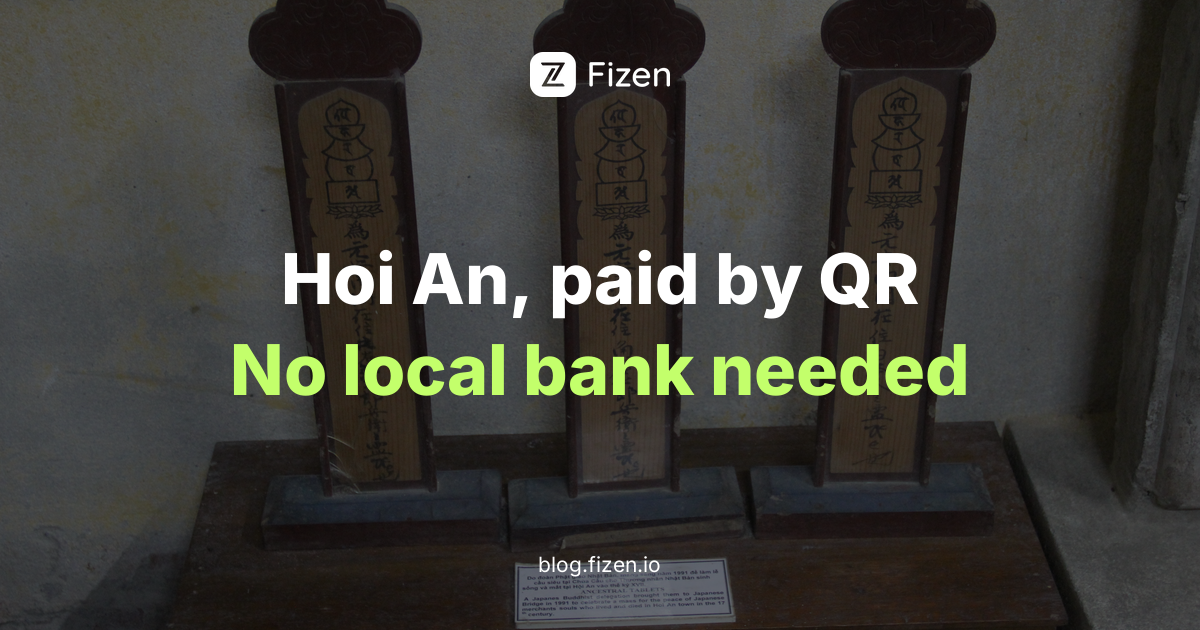
Quick answer: For a digital nomad working from Hoi An cafes, Fizen QR Pay lets you scan Vietnamese VietQR codes and pay from a USDT balance, up to US$800 per payment and US$1,000 per week, with KYC. It is for foreign visitors only, not for Vietnamese residents, as of 16 November 2026.
Key takeaways
- Visitor only: QR Pay is for travellers and foreigners in Vietnam, not for Vietnamese residents, and it is funded only with USDT on Solana or BNB Chain moved from the Fizen wallet.
- Limits: US$800 per payment, US$1,000 per week, no daily limit, and KYC applies before you can pay.
- What you see: the amount in VND is shown before you confirm, and you keep your keys, the balance is yours.
- Data first: QR Pay needs working data, so pair it with a travel eSIM before you land in Da Nang.
A 9am call from a cafe in Hoi An is the test every digital nomad fails on day one: the laptop is open, the coffee is 35,000 VND, the counter has a QR code taped to it, and your card is not what anyone wants. You have no Vietnamese bank account, and MoMo or ZaloPay will not open one for you on a tourist visa.
The fix is not a bank account. It is a QR app funded with stablecoin that scans the same merchant code locals scan, plus a data plan that survives a month of hotspotting. Here is what works in Hoi An in 2026, what it costs, and where it still fails.
Can I pay in Hoi An without a Vietnamese bank account?
Yes, but not with the apps locals use. A Vietnamese bank account is not required for most tourist spending: you can pay with an international card at hotels and larger restaurants, use VND cash for small purchases, or use a compatible cross-border or stablecoin-funded QR app where the merchant's code is supported (BKJ Pay, updated 18 August 2026). The catch is that the QR code on the counter at a Hoi An cafe is tied to a Vietnamese bank account, and your foreign card cannot connect to it directly.
| Payment route | Vietnamese bank account needed? | What you still need | Where it works in Hoi An |
|---|---|---|---|
| International card | No | Valid card, issuer approval, merchant acceptance | Hotels, upscale restaurants, some tailors |
| VND cash | No | Obtaining and carrying cash safely | Street food, markets, small vendors |
| Cross-border QR app | Usually no | Eligible overseas app, KYC, funded balance | Participating VietQRGlobal points |
| Local e-wallet (MoMo, ZaloPay) | Yes, in practice | Vietnamese phone number, ID, biometrics | Not practical for tourists |
Why does my foreign card fail at a Hoi An cafe or market stall?
Because most small merchants never installed a card terminal. In Hoi An, cards are accepted at hotels, resorts, upscale restaurants and some boutique shops, but not commonly at street vendors or smaller cafes (Hoi An Photoshoot guide). Even where a terminal exists, some places add a 2 to 3% fee for card payments, so ask before you swipe.
The QR code on the wall is the local payment rail. Vietnam's QR infrastructure is built on domestic bank accounts and designed for Vietnamese residents, so foreign cards and mobile wallets like Apple Pay or Google Pay cannot connect to it at the QR level (NUS March Grad Show, 22 July 2026). That is why the barista points at the code instead of the card reader.
Cash still works, but it costs you. ATMs in Vietnam charge 22,000 to 55,000 VND per withdrawal, plus your home bank's foreign transaction fee; on small withdrawals that can hit 5 to 8% (NUS March Grad Show, 22 July 2026). Running a month in Hoi An on ATM cash gets expensive quickly.
How does QR Pay work at a Hoi An merchant, and what are the limits?
You open the QR Pay scanner in the Fizen app, scan the merchant's Vietnamese QR code, check the merchant name and the VND amount on screen, and confirm. The money comes from a USDT balance you have moved into QR Pay from your Fizen wallet. The merchant receives local fiat through the local payment channel; they do not need to handle stablecoins.
The limits are clear. QR Pay is for foreign visitors only, not for Vietnamese residents. You fund it only with USDT on Solana or BNB Chain moved from the Fizen wallet into QR Pay. The caps are US$800 per payment and US$1,000 per week, with no daily limit. KYC applies. The balance is governed by the Fizen QR Pay Terms, and the amount in local currency is shown before you confirm.
If you are in Hoi An for a month, fund QR Pay once with USDT and top up as needed. You pay for the bun cha, the Grab and the market stall from the same balance, and fly home with no leftover cash.
Is my phone data enough to run QR Pay for a month of hotspotting?
QR Pay needs a working data connection at the moment you scan, and a nomad's month in Hoi An is data-heavy: hotspot for the laptop, calls from a cafe, maps while you drive. A QR scan itself uses very little data, but the hotspot does. If your data runs out, you cannot pay by QR.
Size the plan for the hotspot, not the QR. A 9am call from a cafe and a few hours of laptop work add up to several GB per week. Use the app's data calculator or a local eSIM with a generous bucket. The same Fizen app that runs QR Pay also sells travel eSIMs, so you can keep both in one place.
The practical rule: buy a plan that covers your hotspot days with headroom, and keep a cash backup for the rare moment the network drops. QR Pay is not a replacement for a data plan; it is the payment layer on top of one.
Where in Hoi An does QR payment still not work?
QR codes are on almost every counter in Hoi An, from the tailor shops on Tran Phu to the market stalls near the Ancient Town. But the QR you see is a VietQR code tied to a Vietnamese bank account, and your foreign banking app cannot scan it directly. According to Wise's 2026 guide to VietQR for foreigners, the national QR standard was built by NAPAS with 14 Vietnamese banks, and it requires a domestic account to pay. The same guide notes that many local e-wallets now demand in-person biometric verification, which rules out MoMo and ZaloPay for a short stay.
The practical gap is not the QR itself but the funding. A vendor either accepts electronic payment, which in Vietnam means QR, or they are cash-only. There is no middle ground where they take cards but not QR, as one July 2026 guide to rural payments puts it. Hoi An's Old Town is dense with QR merchants, but step into the outskirts or a family-run guesthouse and the code on the wall is still a VietQR code that needs a Vietnamese account behind it.
What does cash cost me if I fall back on ATMs in Hoi An?
ATMs are easy to find near the Ancient Town and the markets, but the cost adds up. A July 2026 guide to paying in Vietnam without a local bank account reports ATM withdrawal fees of 22,000 to 55,000 VND per transaction, plus your home bank's foreign transaction charge. On small withdrawals that can reach 5 to 8 percent of the amount taken out. If you withdraw 2,000,000 VND and pay a 50,000 VND fee, that is 2.5 percent before your own bank adds anything.
Cards are accepted at hotels, upscale restaurants and some tailor shops, but some places add a 2 to 3 percent surcharge, according to a Hoi An payment guide. Street vendors and small cafes rarely take cards at all. So the cash fallback is not free: you pay to get the cash, you pay again when the card surcharge appears, and you carry the risk of losing a stack of dong.
Frequently asked questions
Can I use QR Pay in Hoi An if I am not Vietnamese?
Yes, if you are a foreign traveller or foreign resident in Vietnam. Vietnamese residents cannot use QR Pay. You need to complete KYC and fund the balance with USDT on Solana or BNB Chain from the Fizen wallet.
How much can I pay per QR transaction?
Up to US$800 per payment and US$1,000 per week, with no daily limit. The VND amount is shown before you confirm, so you see what you are paying in local currency.
Do I need a Vietnamese bank account for QR Pay?
No. QR Pay works with VietQR codes and is funded from a USDT balance, not from a Vietnamese bank account. You still need to pass KYC and have data on your phone to scan.
What happens if my card is declined at a Hoi An shop?
A declined foreign card is common at small vendors. QR Pay gives you a second route if the shop displays a VietQR code and you have funded your balance. Keep some VND cash as a fallback.
Is QR Pay the same as MoMo or ZaloPay?
No. MoMo and ZaloPay are built for Vietnamese residents and require local identity and phone verification. QR Pay is built for foreign visitors and is funded with USDT, not a Vietnamese bank account.
Pay Hoi An by QR from your USDT balance
Scan VietQR codes and pay from USDT. Your money. Your freedom. No borders. The app is free to download.
Terms and conditions
- Information only. This article is information only and does not constitute financial or legal advice.
- For readers in the United States. Information only, not an offer or sale, not advice. Fizen is not offered to US Persons.
- QR Pay scope. QR Pay is available to foreign travellers and foreigners in Vietnam and the Philippines only, funded only with USDT on Solana or BNB Chain, and subject to KYC and the Fizen QR Pay Terms.
- Self-custody. The Fizen wallet is self-custody, so nobody can restore a lost recovery phrase. USDT moved into QR Pay is governed by the Fizen QR Pay Terms.
Sources
- BKJ Pay, How to Pay in Vietnam Without a Local Bank Account, updated 18 August 2026
- Wise, VietQR for Foreigners: The Complete Guide (2026)
- Hoi An Photo Shoot, Your Complete Guide to Payment Methods in Hoi An
- BKJ Pay, Paying in Vietnam as a Tourist (2026), updated 18 August 2026
Facts checked on 16 November 2026.