Card Declined in Vietnam? Why It Happens and How Foreigners Pay by QR (2026)
Your card was waved away at a cafe, or declined at a Grab checkout. Here is why that happens in Vietnam, what to check in two minutes, and how foreigners pay the QR code instead.

Quick answer: Foreign cards fail in Vietnam for two main reasons: many small shops have no card terminal at all and only take VietQR bank transfers, and where terminals exist, your bank may block overseas use or need a one-time code you cannot receive. A foreigner without a Vietnamese bank account can pay the QR instead through a cross-border wallet where supported, or with Fizen QR Pay, which pays VietQR, VNPay, MoMo and ZaloPay codes from USDT on Solana or BNB Chain (as of November 2026).
Key takeaways
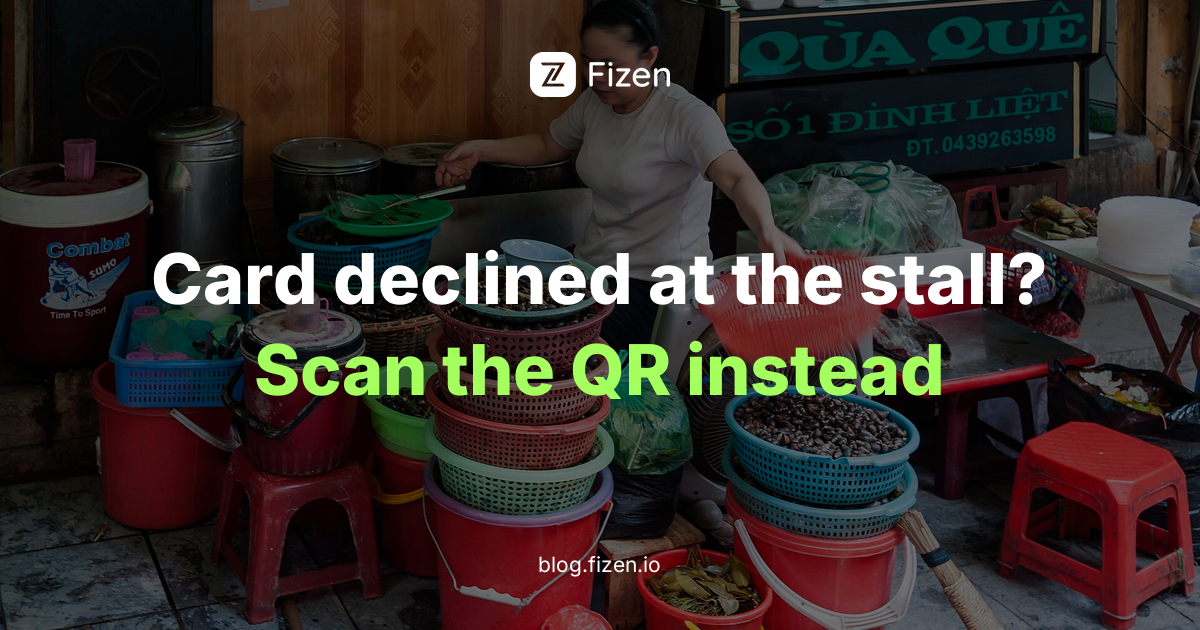
- Often it is not a decline. A cafe or stall that waves your card away usually has no terminal; it takes VietQR, a bank-to-bank transfer through NAPAS.
- Real declines are usually your bank. International use switched off, a fraud block, or a one-time code sent to a SIM you left at home (Trip.com, 6 October 2026).
- Foreign apps cannot scan local VietQR. Only Vietnamese apps can, except VietQR Global for selected Chinese, Korean and ASEAN wallets.
- Visitors can still pay the QR. Fizen QR Pay is for foreigners only, pays Vietnamese account holders' codes, and allows up to US$800 per payment and US$1,000 per week.
You hand over your card at a coffee shop in Da Nang and the barista shakes her head and taps the QR stand. Or Grab says payment failed, twice. It is rarely your card's fault. Vietnam simply pays differently, and the fix takes a few minutes if you know which problem you have.
Card just bounced and the queue is waiting? Pay cash this once, then fix it for the rest of the trip. If you hold USDT, Fizen QR Pay turns that QR stand into something you can pay: deposit USDT on Solana or BNB Chain from your Fizen wallet into QR Pay, scan, check the shop name and the dong total, confirm. Your card's overseas block, OTP texts and foreign transaction fee stop mattering at that counter. Get the Fizen app; the checklist below sorts out the card too.
Why does my card get declined in Vietnam?
| What happened | Likely cause | What to do |
|---|---|---|
| Shop waves the card away | No card terminal, VietQR only | Pay the QR or cash |
| Terminal says declined | Overseas use off or a fraud block at your bank | Enable international use in your bank app, call the bank |
| Online or Grab payment fails | One-time code or app approval not received | Keep your home SIM on for texts; approve in your bank app |
| ATM refuses the amount | Per-withdrawal cap, often 2 to 5 million dong | Try a smaller amount or VPBank, up to 10 million |
| Terminal offers your home currency | Dynamic currency conversion | Decline and pay in dong |
Trip.com's October 2026 Vietnam payments guide gives the same checklist for real declines: enable international transactions before you travel, expect security blocks, and keep mobile data and your banking app ready for verification. Carry a backup card on a different network.
Why can't I just scan the QR code with my own bank app?
Because VietQR is a transfer between Vietnamese bank accounts. NAPAS runs it across more than 50 member banks, built on the EMVCo QR standard, and a payer scans it from a Vietnamese mobile banking app. Your home bank is not connected. Wise's June 2026 guide puts it plainly: local VietQR needs a Vietnamese app.
VietQR Global is the exception, and it is narrow. Since 3 April 2026 Alipay users from China can scan VietQR Global codes at NAPAS-network merchants (Tuoi Tre), and NCB's July 2026 version adds UnionPay, Korean wallets such as Naver Pay and Hana, plus Thailand, Laos and Cambodia, with Japan, Singapore, India and Malaysia planned. Cards and apps from Europe, the US or Australia are not covered.
How does a foreigner pay by QR in Vietnam without a local bank?
Fizen QR Pay lets a foreign visitor scan the shop's VietQR, VNPay, MoMo or ZaloPay code, see the amount in dong, and pay from a QR Pay balance funded only with USDT on Solana or BNB Chain. The merchant receives dong as a normal transfer.
- Create or import your Fizen wallet in the app (self-custody: keep the recovery phrase offline).
- Get USDT on Solana or BNB Chain into the wallet. From an exchange, withdraw on one of those two networks to your Fizen address and send a small test first; on another chain, use Swap and Bridge in the app first.
- Deposit from the wallet into QR Pay only what you plan to spend, and complete KYC with your passport (per wallet and per device). A BNB Chain deposit needs no gas; on Solana keep a little SOL for the fee.
- Tap Scan, type the amount if the code has none, check the shop name and the dong total, and confirm.
Who it is for: visitors and foreigners only. People who live in Vietnam cannot use it to pay in Vietnam, and in Vietnam it pays only QR codes of Vietnamese account holders. Limits are US$800 per payment and US$1,000 per week, with no daily limit, and any fee shows before you confirm. No bank link, no card, no dong deposit; USDT on another network, or another token, cannot be deposited. USDT you move into QR Pay is governed by the QR Pay Terms. Screens are in the getting-started guide.
Why would a QR payment fail, and what fixes it?
- The account belongs to a foreigner. Some guesthouses and tour sellers use a foreign owner's account. Ask for a code linked to a Vietnamese account.
- Special characters in the payment note. Many Vietnamese banks reject hyphens, slashes, dots or equals signs. The Fizen keyboard has none; if the shop's code carries one, tell the shop.
- Old or expired code. Codes printed for a single bill stop working. Ask for a new one.
- Still processing. Do not pay again. Wait for the final status.
- Receiving bank under maintenance. Retry later or contact support if it shows failed.
- Over the limit. US$800 per payment, US$1,000 per week.
What changed for foreigners paying by QR in 2026?
Cross-border QR grew, but mostly for Asian wallets: Alipay on VietQR Global from April 2026 and NCB's multi-country service from July 2026. Meanwhile some crypto wallets that had offered VietQR payments stepped back; Trust Wallet's QR payments feature was paused from 31 March 2026 after a change of payment provider. If you rely on one app, keep cash as a backup.
Where do you still need cash or a card?
Cash for street food, markets, motorbike taxis flagged on the street and rural areas; a card for hotels, malls, airlines and online bookings. Withdraw large and rarely: as of April 2026 VPBank charged foreign cards no ATM fee, Vietcombank about 50,000 dong, TPBank about 3.3% (YOU); our ATM fees guide has the full table. You also need data to pay by QR: Fizen eSIM covers 150+ countries, bought at fizen.io/esim or in the app with USDT on Solana or BNB Chain or by card via Stripe.
Frequently asked questions
Why is my foreign card declined in Vietnam?
Usually your bank blocked overseas use or needed a one-time code you could not receive. Often, though, the shop simply has no card terminal and only takes VietQR.
Can foreigners pay by QR in Vietnam?
Yes. Chinese, Korean and some ASEAN wallets work through VietQR Global, and other foreigners can use Fizen QR Pay, funded with USDT on Solana or BNB Chain, as of November 2026.
Do I need a Vietnamese bank account to pay VietQR?
For a normal VietQR scan, yes. Fizen QR Pay lets visitors pay without one after KYC.
Can I pay MoMo or ZaloPay codes as a tourist?
Yes, with Fizen QR Pay, which supports VietQR, VNPay, MoMo and ZaloPay codes in Vietnam for foreigners.
Why did my QR payment fail at a guesthouse?
Often the code is linked to a foreigner's account, which Fizen QR Pay does not pay in Vietnam, or the note has special characters. Ask for a code on a Vietnamese account.
Can Vietnamese residents use Fizen QR Pay?
Not in Vietnam. QR Pay is cross-border only, so it works for them when they travel to the Philippines.
Card declined? Scan the QR
Fizen QR Pay is for travellers and foreigners in Vietnam and the Philippines. Deposit USDT on Solana or BNB Chain from your Fizen wallet, scan the shop's code and confirm the amount in dong, up to US$800 per payment and US$1,000 per week. New to Fizen? A new programme also puts US$10 of eSIM credit in the app's eSIM tab, taken off automatically at checkout (up to 30% of each plan), no code.
Terms and conditions
- Information only. This article is information only, not an offer or sale, and not financial, legal or tax advice. Fees, limits and app rules change; facts were checked on 2 November 2026, so check the provider before you rely on anything here.
- For readers in the United States. This is information only, not an offer or sale, and not advice. Fizen products and services are not offered to US Persons.
- QR Pay availability. QR Pay is for cross-border use by travellers and foreigners in Vietnam and the Philippines only, and is not available to residents of those countries in their own country. It is funded only with USDT on Solana or BNB Chain; USDT on another network, or another token, cannot be deposited. KYC (per wallet and per device), KYT, AML and sanctions checks apply. The Fizen wallet is self-custody; USDT you move into QR Pay is governed by the Fizen QR Pay Terms, so only move in what you plan to spend.
- eSIM credit. The US$10 eSIM credit is for new Fizen users, added in the app's eSIM tab, applied automatically at checkout up to 30% of each plan, valid 12 months, one per person. Full terms: eSIM welcome credit.
Sources
- Trip.com, Vietnam payment methods: cash, cards and QR, 6 October 2026
- Wise, QR code payments in Vietnam for foreigners and tourists, 30 June 2026
- NAPAS, FastFund 247 with VietQR code service
- Tuoi Tre News, Cross-border QR payments expanded for Chinese tourists, 4 April 2026
- Macau Business, NCB cross-border QR payments for travellers in Vietnam, 15 July 2026
- YOU, Vietnam ATM withdrawal guide, 13 April 2026
- Trust Wallet, How to use QR payments in Vietnam
- Fizen Help Center, QR Pay getting started (checked 2 November 2026)
- Fizen QR Pay Terms, effective 5 June 2026
Causes, fees, QR schemes and Fizen limits checked on 2 November 2026.