How to Pay in Hanoi by QR: Street Food, Cafés and Markets (2026)
Hanoi still runs on small notes and plastic stools, but more and more of it now runs on a QR card taped to the cart. A day of eating and shopping in the capital, what things cost in 2026, and where a visitor can scan instead of counting dong.
Quick answer: In Hanoi you can pay many street stalls, cafés and market sellers by scanning the VietQR code on the counter, while others still take only cash, so carry small notes as well. A bowl of phở in the Old Quarter costs about 40,000 to 50,000 dong and a glass of bia hơi about 7,000 to 15,000. Visitors without a Vietnamese bank can scan those codes with Fizen QR Pay, funded with USDT on Solana or BNB Chain.
Key takeaways
- Both are true in Hanoi. Many vendors tape a VietQR code to the cart; many small places still prefer cash. Carry small notes and look for the code.
- Prices are low, notes are big. A 500,000 dong note for a 45,000 dong phở is the classic Hanoi problem. QR solves it.
- Pay the way the stall works. At bia hơi you pay once at the end; at a phở stall you pay as you leave; at the market, pay each seller.
- Visitors can scan with Fizen QR Pay. Visitors and foreigners only, USDT on Solana or BNB Chain only, Vietnamese account holders' codes only.
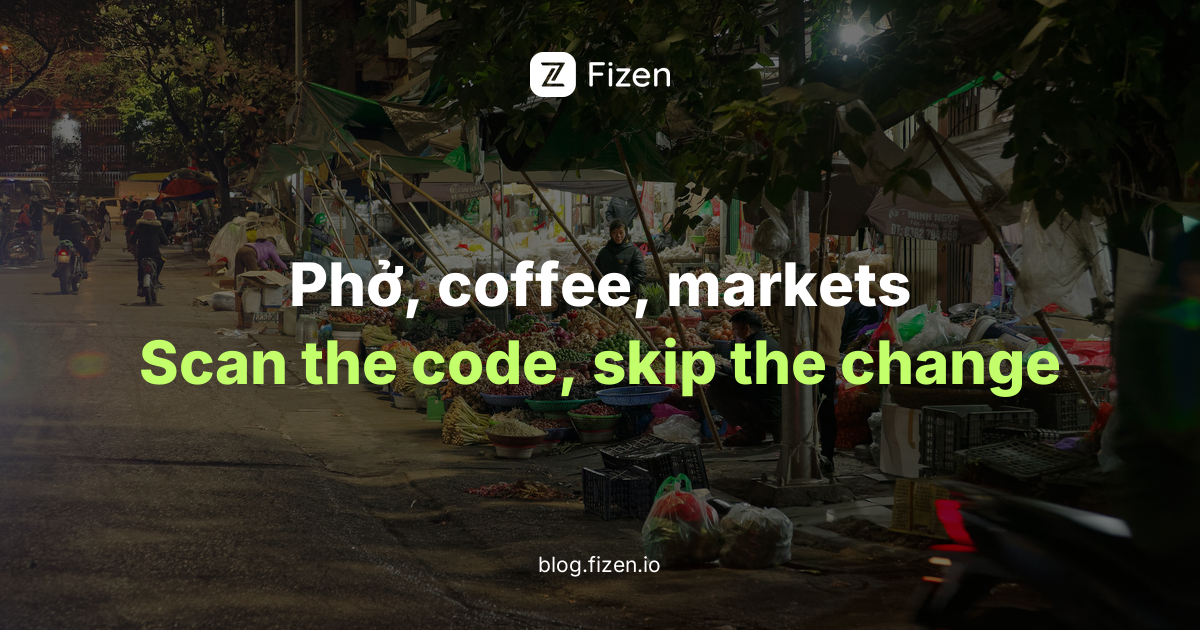
Six in the morning on Hàng Bạc, the broth has been going since before dawn, and the woman ladling phở wants 45,000 dong. Your ATM gave you 500,000 notes. She sighs, sends a child to find change, and the man next to you scans the card stuck to her cart and is gone. Paying in Hanoi is mostly about that moment, repeated ten times a day.
Can you really pay Hanoi street food by QR?
Increasingly, yes. A printed VietQR card costs a vendor nothing and needs no terminal, and Hanoi sellers have taken to it: VOV reported in December 2025 on a Hanoi vegetable seller of 15 years who now takes payment from a QR code taped to her stall, and NAPAS said VietQR transactions rose 85% in value in the first ten months of 2025. Hanoi shop owners quoted by DTiNews keep printed codes at the till and confirm the account name with customers before they pay.
It is not universal. Vietnam's tourism guide, updated in October 2026, still advises that most street vendors and small restaurants deal in cash and that you carry small notes. Both are right: you will meet carts with a code and carts without one on the same street, so carry some small notes and look for the code.
What does a day of eating in Hanoi cost in 2026?
| What | Typical price (dong) | How it is paid |
|---|---|---|
| Phở bò, Old Quarter stall | 40,000 to 50,000 | Pay as you leave, at the cart |
| Bánh mì, basic | 20,000 to 30,000 | Pay when it is handed over |
| Bún chả set | 45,000 to 65,000 | Pay at the front on the way out |
| Cà phê trứng (egg coffee) | 30,000 to 55,000 | Often at the counter when you order |
| Cà phê đen đá (iced black coffee) | 15,000 to 25,000 | At the counter or as you leave |
| Bia hơi, per glass | 7,000 to 15,000 | Run a tab, pay once at the end |
Prices from Jackfruit Adventure's Hanoi street food guide, updated April 2026. Location matters more than the dish: Vietnam's tourism guide puts a tourist-zone phở at about 80,000 dong against about 45,000 a few minutes' walk away.
How do you pay at each stop, like a local?
Phở at dawn
Eat first, pay as you stand up. Find the code on the cart or the wall, scan, type the amount you are told, check the name matches the card, confirm and show the screen. Say "ck rồi" (I've transferred) if you want to sound local.
Bún chả at lunch
Busy lunch places add up the plates at the front. Ask "bao nhiêu?" (how much?), then scan the code by the till. If they show a code on a screen with the amount already in it, that is a one-bill code: scan it straight away rather than photographing it for later.
Egg coffee in the afternoon
Cafés up narrow staircases often take payment at the counter when you order. This is where you are most likely to meet a café paid into a foreign owner's account, which matters if you use Fizen QR Pay (see below).
Bia hơi at dusk
Low stools, glasses at 10,000 dong, nobody pays per glass. The table runs a tab and settles at the end, which suits QR perfectly: one scan for the evening, split with your friends afterwards.
The markets
At Đồng Xuân or a neighbourhood wet market, each seller is a separate account. Agree the price, then scan that seller's card, not the neighbour's. Bargaining happens before the scan, never after.
What about getting around without Grab?
Ride apps charge through the app. On the street it is different: cyclo riders around Hoàn Kiếm Lake and xe ôm drivers on corners quote a price first, and they usually expect cash. Agree the price before you get on, and keep a few 20,000 and 50,000 notes in a separate pocket for exactly this.
How do visitors scan Hanoi's QR codes without a Vietnamese bank?
Vietnamese banking apps need a local account. Fizen QR Pay is built for visitors: you scan the stall's VietQR, VNPay, MoMo or ZaloPay code, the app shows the recipient and the amount in dong, and you confirm from your QR Pay balance. The vendor receives dong like any other transfer.
- Visitors and foreigners only. QR Pay is cross-border use only, so people who live in Vietnam cannot use it in Vietnam.
- Funded only with USDT on Solana or BNB Chain. No bank link, no card, no dong deposit. USDT on another network, or another token, cannot be deposited into QR Pay; use Swap and Bridge in the app to move it first.
- Vietnamese account holders' codes only. If that upstairs café is paid into a foreign owner's own account, the payment will not go through. Ask for another code or pay cash.
- Limits. Up to US$800 per payment and US$1,000 per week, no daily limit. Any fee shows before you confirm.
- Custody. The Fizen wallet is self-custody. USDT you move into QR Pay is governed by the Fizen QR Pay Terms, so only move in what you plan to spend.
Scanning needs data on the street. The same app sells travel eSIM data for Vietnam, so you can sort both before you fly.
The result is small and specific: the phở paid without a hunt for change, one scan for the bia hơi table, and no stack of leftover dong at Nội Bài on the way home.
Frequently asked questions
Do Hanoi street food stalls accept QR payments?
Many do, using a printed VietQR code on the cart or wall. Many small places still prefer cash, so carry small notes as well.
How much is phở in Hanoi in 2026?
About 40,000 to 50,000 dong at an Old Quarter stall, according to an April 2026 street food guide. Tourist-zone restaurants can charge around 80,000 dong.
Can tourists pay by QR in Hanoi without a Vietnamese bank account?
Yes, with a payment app built for visitors. Fizen QR Pay lets travellers and foreigners scan Vietnamese QR codes, funded only with USDT on Solana or BNB Chain.
Do cyclo and xe ôm drivers in Hanoi take QR?
Usually they expect cash. Agree the price before the ride and keep small notes ready.
Why did my QR payment fail at a Hanoi café?
Common reasons include a code linked to a foreigner's account, an old one-bill code, or bank maintenance late at night. If the payment says processing, do not pay again.
How do you pay at a bia hơi?
The table runs a tab and pays once at the end. One QR scan or one cash payment covers the evening.
Scan Hanoi's QR codes as a visitor
Fizen QR Pay lets travellers and foreigners pay VietQR, VNPay, MoMo and ZaloPay codes in Vietnam. Fund it with USDT on Solana or BNB Chain and confirm the amount in dong before you pay.
Terms and conditions
- Information only. This article describes how payments work in Hanoi and how Fizen QR Pay fits in. Prices are indicative and change. It is not financial, legal, tax or investment advice, and the QR Pay Terms and the in-app information prevail over this summary.
- For readers in the United States. This is information only, not an offer or sale, and not advice. Fizen products and services are not offered to US Persons.
- QR Pay availability. QR Pay is for cross-border use by travellers and foreigners in Vietnam and the Philippines only, and is not available to residents of those countries in their own country. It is funded only with USDT on Solana or BNB Chain; USDT on another network, or another token, cannot be deposited. KYC, KYT, AML and sanctions checks apply. Use of QR Pay is governed by the Fizen QR Pay Terms.
Sources
- Jackfruit Adventure, Hanoi street food cost (updated 13 April 2026)
- Vietnam Tourism, how much to budget for food per day in Vietnam (updated 3 October 2026)
- VOV, Vietnamese street vendors go cashless as QR payments surge 85% (13 December 2025)
- DTiNews, shop owners warned about scam QR code payments (4 October 2023)
- Fizen QR Pay Terms, effective 5 June 2026
Hanoi prices from guides updated April and October 2026, checked on 25 October 2026. QR Pay rules checked against the Fizen QR Pay Terms and product information on 25 October 2026.