Best eSIM for Hanoi (2026): Viettel 4G, Real Prices and Where the Signal Drops
Standing on a kerb in the Old Quarter with a driver calling and no data is a very specific kind of bad. Here is which network a Hanoi eSIM roams on, what it costs per GB, and when a local Viettel SIM is the better buy.
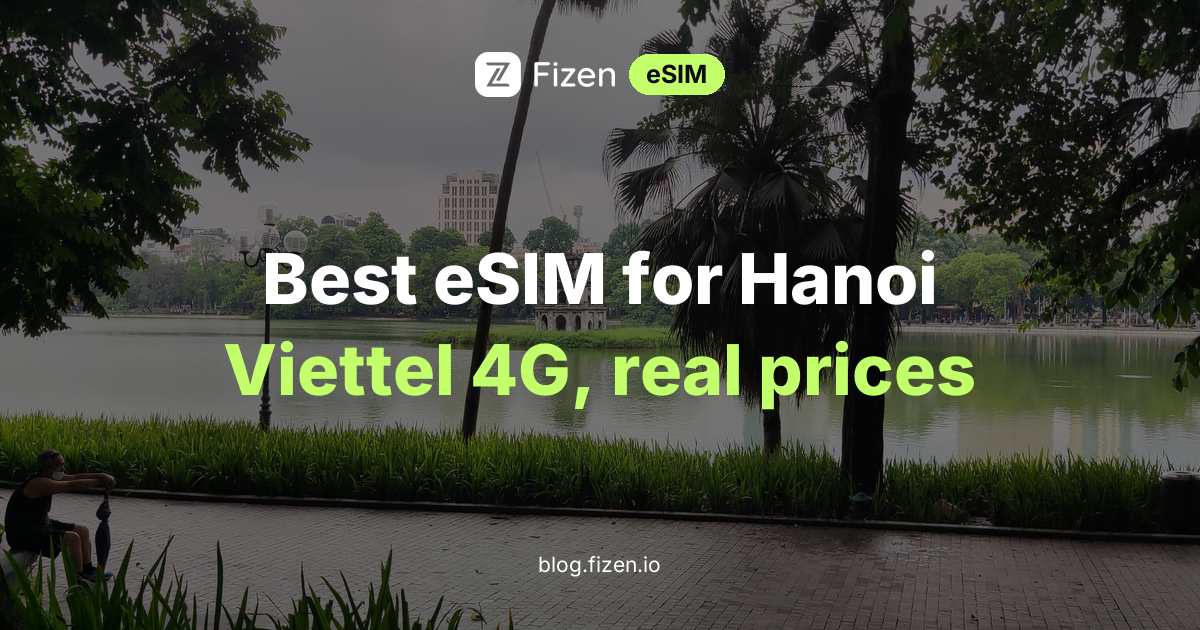
Quick answer: For a first-time visitor basing in Hanoi for ten to fourteen days with trips to Ha Long Bay and Sapa, the Fizen eSIM roams on Viettel Mobile on 4G. Vietnam is sold only inside the South-Eastern Asia plan, which covers 18 countries.
Key takeaways
- Written for one trip: a first-time visitor using Hanoi as a base for ten to fourteen days, with a Ha Long Bay night and a Sapa run, living on ride apps and maps.
- Vietnam is not sold on its own. It comes inside the South-Eastern Asia plan covering 18 countries, on Viettel Mobile, 4G. That is a bonus if your trip continues to Laos, Cambodia or Thailand, and irrelevant if it does not.
- 4G is not a compromise in Vietnam. Ministry figures published in July 2025 put 4G at 99.8% of the population and 5G at only 26%, on roughly 11,000 5G base stations. A 5G plan would be marketing, not coverage.
- Dated prices, per day and per GB: the plan this guide recommends, 20 GB for 15 days, was US$39.00 on 23 September 2026 (US$2.60 a day, US$1.95 per GB). 10 GB for 15 days was US$24.55 (US$1.64 a day, US$2.46 per GB).
The Hanoi version of the connectivity problem is not scenic. It is you outside a hotel in the Old Quarter at nine at night, a driver ringing a phone that cannot open the ride app, a one-way lane full of motorbikes behind you, and the cafe Wi-Fi you were counting on being two doors down and password protected.
Does a Hanoi eSIM roam on Viettel, and is 4G enough in northern Vietnam?
It roams on Viettel Mobile, on 4G. There is no 5G on this plan, and in Vietnam that is a smaller loss than it sounds. Figures published by Vietnam's Ministry of Information and Communications in July 2025 put the established 4G network at 99.8% of the population, while 5G reached about 26% of the population on roughly 11,000 5G base stations, which is around 7.7% of the number of 4G stations. Commercial 5G only launched in October 2024.
In other words, in Vietnam today 4G is the network that is actually there when you step off a bus in a provincial town. Viettel is also the carrier with the deepest rural footprint, which is the right one to be roaming on for a trip that leaves the city.
Why is Vietnam sold inside a Southeast Asia plan?
There is no Vietnam-only plan in the catalogue. Vietnam sits inside the South-Eastern Asia plan, which covers 18 countries on Viettel Mobile. You buy one eSIM and it keeps working when you cross into Laos, Cambodia or Thailand.
| Your trip | Does the regional plan help? | What to do |
|---|---|---|
| Hanoi and northern Vietnam only, two weeks | No, you simply do not use the other 17 countries | Size the plan for Vietnam and ignore the regional part |
| Hanoi, then Luang Prabang or Siem Reap | Yes, one eSIM covers the whole route | Buy the longer validity rather than a second eSIM per country |
| Hanoi, then Bangkok, then back | Yes | Count every day of the whole loop, not just the Vietnam nights |
Count validity from landing to your flight home. Most travel eSIMs cannot be topped up, so running out usually means buying and installing another one.
What does a Vietnam eSIM cost right now, per day and per GB?
All figures are from the Fizen catalogue on 23 September 2026 and move over time. Every plan here roams on Viettel Mobile on 4G, inside the South-Eastern Asia regional plan, and slows to 128 kbps once the high-speed data is used.
| Plan | Days | Total | Per day | Per GB |
|---|---|---|---|---|
| 1 GB | 3 | US$9.94 | US$3.31 | US$9.94 |
| 5 GB | 7 | US$16.68 | US$2.38 | US$3.34 |
| 5 GB | 30 | US$18.36 | US$0.61 | US$3.67 |
| 10 GB | 7 | US$23.52 | US$3.36 | US$2.35 |
| 10 GB | 15 | US$24.55 | US$1.64 | US$2.46 |
| 10 GB | 30 | US$25.60 | US$0.85 | US$2.56 |
| 20 GB | 15 | US$39.00 | US$2.60 | US$1.95 |
| 50 GB | 30 | US$79.74 | US$2.66 | US$1.59 |
How much data does a Hanoi fortnight actually use?
| A day based in Hanoi | Rough data | Note |
|---|---|---|
| Maps open most of the day, Old Quarter and beyond | 150 to 250 MB | Much less if the city map is downloaded offline |
| Ride apps, four to six trips, tracking the driver | 80 to 150 MB | Small, but this is the one that has to work on the kerb |
| Messaging, sending photos, email | 250 to 400 MB | Photos are most of it |
| Looking up restaurants, menus, tour bookings | 100 to 200 MB | Heavier than it feels, thanks to images |
| One 30-minute 720p video call home | About 0.55 GB | The biggest single line of the day |
| Scrolling video while stuck in traffic | 1 GB per hour and up | The reason plans run out on day three |
Where does the signal actually drop in northern Vietnam?
- Ha Long Bay. Signal is normal at Tuan Chau and the cruise ports, and gets patchy once a boat is out among the karst islands and inside the caves. Send the photos when you are back at the pier.
- The road to Sapa and the Ha Giang loop. Mountain passes lose signal between towers, and that is terrain, not carrier choice. Download the offline map and agree your meeting points out loud before you set off.
- Hanoi to Ha Long and Hanoi to Ninh Binh by road. Mostly fine, with short gaps. Not a reason to buy a bigger plan.
- Cafes and hotels. Vietnam Tourism's own connectivity guide, read on 23 September 2026, describes free Wi-Fi as widespread in Vietnamese cities with typical cafe speeds of 20 to 50 Mbps, while rural accommodation runs on shared connections that degrade in the evening. Treat rural hotel Wi-Fi as a bonus, not a plan.
Terms and conditions
- Information only. Fizen publishes this article to inform, not to sell. Nothing here is an offer, solicitation or sale of any product or service, and it is not financial, investment, legal or tax advice.
- For readers in the United States. This article provides information only. It is not an offer, solicitation or sale of any product or service, and it is not financial, investment, legal or tax advice. Fizen is not offered to US Persons.
- Not affiliated. Fizen is not affiliated with, endorsed by or a partner of Viettel, VNPT, MobiFone, Noi Bai International Airport, Hanoi Metro, Grab, Apple or any other third party named here.
- Prices and rules change. Plan prices are those shown in the Fizen catalogue on 23 September 2026 and change without notice. Local SIM prices are those published in Vietnam Tourism's own connectivity guide, read on 23 September 2026, and vary by carrier and outlet. Registration rules change too. Check the official source before you rely on anything here.
- Coverage is not a promise. Population coverage figures are the Vietnamese ministry figures published in July 2025 and describe where people live, not every square kilometre. Real speed depends on terrain, buildings and how busy the local cell is.
- Data only. A travel eSIM provides mobile data. It does not give you a Vietnamese phone number, voice calls or SMS. Keep your home SIM active for bank codes. Your phone must support eSIM and must not be locked to a carrier.
- Full terms. Master Terms of Use, Privacy Policy and Disclaimer on the Fizen site.
Sources
- Vietnam Tourism: Wifi and internet in Vietnam, SIM cards, eSIMs and staying connected
- Ministry portal: Viet Nam's 5G network covers 26% of population
- Hanoi Metro: ticket types
- SGGP English: authorities outline procedures for verifying mobile subscriber information
- Vietnam Briefing: Decree 163 guidelines for the 2024 Telecommunications Law
- Zoom Support: bandwidth requirements
- Apple Support: Use eSIM when you travel
Updated 23 September 2026.