
Authorized, Declined, Reversed: What Your Card Status Really Means (2026)
The five card payment states explained in plain words, and what to do when declines become a pattern.

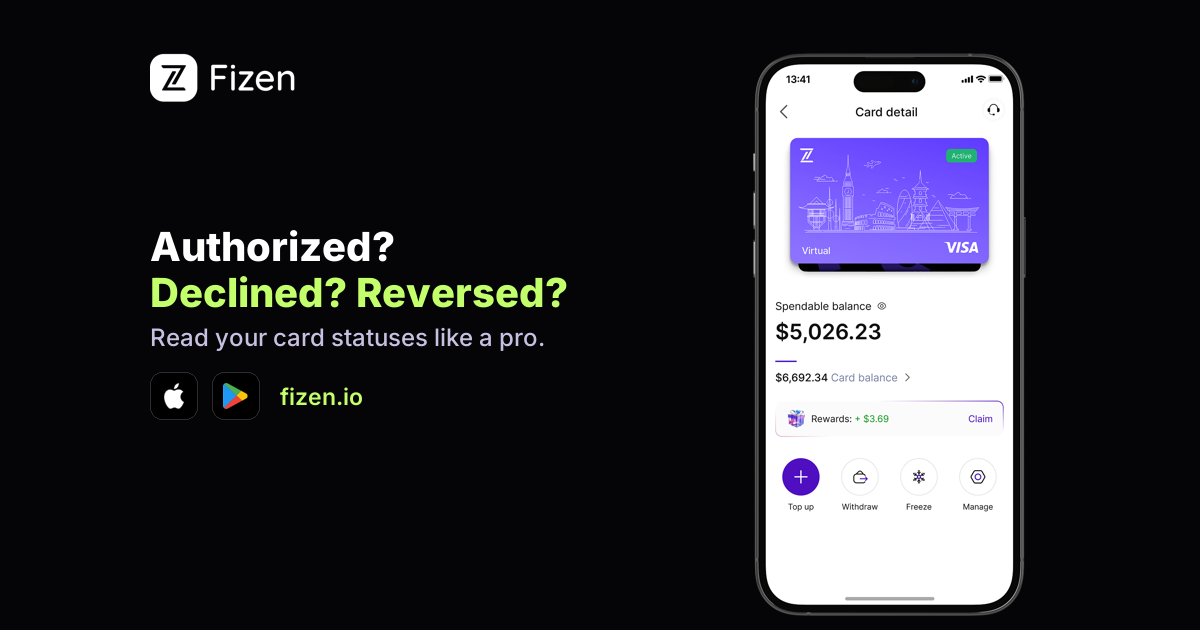
You tap your card, the app pings, and the word on the screen is doing a lot of work: authorized, pending, declined, reversed, refunded. They sound interchangeable and they are not. Understanding the five states saves you from panicking about money that never actually left.
The five card states, in plain words
- Authorized: the merchant asked, your issuer said yes, and the amount is held. No money has moved yet.
- Pending: the hold sits there while the merchant finalizes, usually one to a few days.
- Settled: the merchant collected. This is the real charge.
- Declined: the issuer said no before anything was held. Nothing left your balance, even if the message looks scary.
- Reversed or refunded: a hold released without settling, or money returned after settlement. Releases are fast; refunds take days because they travel the whole rail backwards.
🎁 Reader bonus: Code c12M → up to 10% cashback + FiPoints on every spend. T&Cs apply.
Claim your card →Why hotels and gas stations look like double charges
Hotels, fuel pumps, and car rentals authorize an estimate first, then settle the real amount later. For a while both the hold and the charge can be visible, which looks like a double charge and is not. The hold evaporates on its own.
What a decline actually tells you
A decline is your issuer's decision, not the merchant's. Banks block foreign merchants, subscription BINs, or anything their risk model dislikes, and the merchant only sees 'declined'. If your card keeps declining on services like ChatGPT, Claude, or foreign checkouts, the practical fix is a card whose issuer processes it as a standard Visa, like a virtual Fizen Card funded with USDT.
Frequently asked questions
Does 'authorized' mean I was charged?
Not yet. Authorization is a hold; money moves at settlement. If the merchant never settles, the hold releases by itself.
Why do I see two charges for one hotel stay?
One is the authorization hold, one is the settlement. The hold disappears within days; you pay once.
My card was declined but the money left. What happened?
It did not settle: what you see is a hold that will release. Declines never move money.
How long does a reversal take?
Released holds usually clear within a few days; full refunds can take five to ten business days depending on the banks involved.
Card statuses stop being scary once you can read them. And if declines are your recurring status, a standard-processing virtual card fixes that in minutes.
Fizen Virtual Visa Card
The best card for SaaS, ChatGPT, Claude, Netflix, Spotify, Amazon, Google, Meta, Tiktok Ads. Spend USDT like cash globally.
Fizen Card processes as a standard Visa and is accepted wherever Visa is supported. Whether any individual charge is approved still depends on the merchant and their payment processor at the time of payment. Fizen Card is issued under applicable regulations. Users should verify availability in their jurisdiction. This article is for informational purposes only and does not constitute financial advice. More details about Fizen Card, please refer to Fizen Card Docs and Terms of Use.
Related guides
Terms and conditions
- Information only. Fizen publishes this article to inform, not to sell. Nothing here is an offer or solicitation, and it is not financial, investment, legal or tax advice. Prices, rules and availability change; check official sources.
- For readers in the United States. This article provides information only. It is not an offer, solicitation or sale of any product or service, and it is not financial, investment, legal or tax advice. Fizen is not offered to US Persons.
- Full terms. Master Terms of Use, Privacy Policy and Disclaimer on the Fizen site.