Best eSIM for Ireland 2026: Dublin, the Wild Atlantic Way and Northern Ireland
Picking up a rental car in Dublin and heading west with no data is fine until the first unsigned junction in Connemara. Here is how an Ireland eSIM compares, where coverage thins, and the Northern Ireland roaming catch.
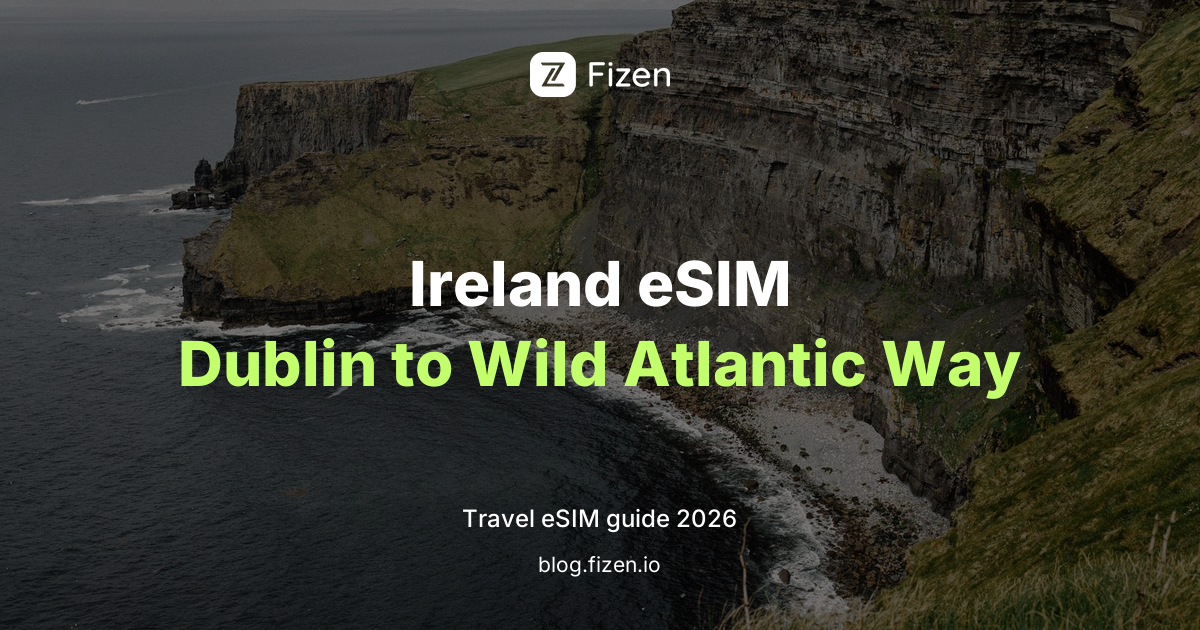
Quick answer: The best eSIM for Ireland is a data-only travel eSIM you install at home and switch on when you land in Dublin or Shannon. Eir, Three and Vodafone cover cities and main roads well, with gaps in remote parts of the Wild Atlantic Way. Northern Ireland is in the UK, so check your plan covers the UK too if you visit Belfast or the Causeway Coast. Plan about 5 to 10GB a week.
Key takeaways
- The Republic of Ireland has three networks, Eir, Three and Vodafone; other brands run on one of them.
- EU residents can usually roam at home prices in the Republic, but Roam Like at Home does not apply in Northern Ireland, which is part of the UK.
- Near the border your phone can switch networks between the Republic and Northern Ireland, so a plan covering both is simpler for cross-border trips.
- Coverage is good in Dublin, Cork, Galway and on main roads, but can drop in remote valleys, peninsulas and islands along the Wild Atlantic Way.
Somewhere west of Clifden, the satnav on my phone froze on a junction with three unsigned roads and a sheep. My roaming allowance had run out a day earlier, I had not noticed, and the map I thought was downloaded turned out to be for Galway city only. I picked the road with the fewest potholes. It was wrong.
Why do you need mobile data in Ireland?
Dublin is easy on foot, but most visitors also rent a car or take tours out west, and that is where your phone earns its keep.
- Dublin transport. Buses, Luas trams and DART trains are easier with live times from the TFI journey-planning apps, and the Leap Visitor Card is a popular option for short stays. Check current terms on the official Leap Card and TFI sites.
- Road trips. Narrow rural roads, few signs and changing weather make navigation and live traffic genuinely useful on the Wild Atlantic Way and the Ring of Kerry.
- Tours and ferries. Boat trips to the Aran Islands or the Skelligs depend on sea conditions and often change at short notice by message.
- Bookings. Popular sights and restaurants sell timed or limited slots online, especially in summer.
- Weather. Irish weather changes fast; a quick radar check can decide whether it is a cliff walk or a pub lunch.
Roaming vs local SIM vs travel eSIM in Ireland: which is best?
| Option | Online when you land? | Cost pattern | The honest catch |
|---|---|---|---|
| Home roaming (EU SIM) | Yes | Usually home prices in the Republic under EU rules, within fair-use limits | EU rules do not cover Northern Ireland, which is in the UK |
| Home roaming (UK SIM) | Yes | Depends on your UK carrier's Europe terms | Some UK carriers include Ireland, others charge daily fees |
| Home roaming (US, Canada, Asia, Australia) | Yes | Daily pass or per-MB rates | Expensive over a week or two |
| Irish prepaid SIM | After you buy one | Local prepaid bundles from Eir, Three, Vodafone or their brands | Shop visit, SIM swap, may not cover Northern Ireland |
| Travel eSIM | Yes, if installed before you fly | Fixed data or daily plans shown at checkout | Data only, no Irish number; check whether the UK is included |
For most visitors from outside Europe, a travel eSIM is the simplest option. If Northern Ireland is on your route, the deciding question is whether your plan covers both Ireland and the UK.
Does EU roaming work in Northern Ireland?
Not by law. Northern Ireland is part of the United Kingdom, and since Brexit the EU's Roam Like at Home rules no longer apply to travel within the UK. Ireland's telecoms regulator, ComReg, notes that some providers have voluntarily kept including the UK, but they are not required to, and that you may face cross-border roaming charges in Northern Ireland depending on your provider.
The border catch. The border between the Republic and Northern Ireland is open and often invisible, and phones near it can connect to whichever network has the strongest signal. ComReg suggests switching off automatic network selection if you want to avoid connecting to a network without Roam Like at Home protection. For travelers, the simpler fix is a plan that covers both sides.
What is mobile coverage like in Ireland and on the Wild Atlantic Way?
The Republic of Ireland has three mobile networks, Eir, Three and Vodafone, and every other brand runs on one of them. All three claim very high population coverage, but real-world performance varies a lot by location, especially in hilly and coastal areas. Travel eSIMs connect to one or more of these networks depending on the plan.
| Area | What to expect |
|---|---|
| Dublin, Cork, Galway, Limerick | Fast 4G, with 5G in many central areas |
| Motorways and main national roads | Generally good |
| Wild Atlantic Way towns (Westport, Dingle, Clifden, Doolin) | Usually fine in town |
| Remote peninsulas, mountain passes, Connemara and Donegal backroads | Patchy; expect dead zones in valleys and on the far side of hills |
| Islands (Aran Islands, Achill) and boat trips | Often usable near villages and harbours; can drop at sea and on remote cliffs |
Before driving the west coast, download offline maps for the whole region, not just the cities, and check your route while you still have signal in town.
How much data do you need for a trip to Ireland?
Maps and messaging are light even on a long road trip. Photo uploads, video calls home and streaming in the evening are what use most data. More detail in how much eSIM data you need.
| Trip length | Light use | Typical use | Heavy use (video, hotspot, work) |
|---|---|---|---|
| Dublin weekend (2 to 3 days) | 1 to 2GB | 3GB | 5GB or more |
| One week (Dublin plus road trip) | 3GB | 5 to 10GB | 15GB or a daily or unlimited plan if offered |
| Two weeks (Wild Atlantic Way and Northern Ireland) | 5GB | 10 to 15GB | 20GB or more |
| A month or longer | 10GB | 20GB | Consider a local SIM or several eSIMs |
If you are sharing a rental car and using one phone as the satnav and hotspot, size up and confirm hotspot is allowed on your plan.
Terms and conditions
- Information only. This guide is general information for travelers. It is not financial, legal, tax or investment advice.
- For readers in the United States. This article provides information only. It is not an offer, solicitation or sale of any product or service, and it is not financial, investment, legal or tax advice. Fizen is not offered to US Persons.
- Plans vary. Prices, data allowances, hotspot support and when validity starts differ by plan and destination. The details shown at checkout take precedence over anything written here.
- Your phone. A travel eSIM needs an eSIM-capable, carrier-unlocked phone. Fizen eSIMs are data-only, with no local number, calls or SMS.
- Rules change. Entry and visa rules, roaming terms, transport fares, network coverage and emergency arrangements are set by official sources and can change. Check the official government, operator or tourism site before you travel.
- No affiliation. Fizen is not affiliated with Eir, Three, Vodafone, ComReg, Transport for Ireland, Leap Card or any other carrier, transport operator, app or venue named in this guide. Names are used for reference only.
- Availability. Fizen is not offered to US Persons. Unused eSIMs can be returned, and eligibility depends on the plan.
- Full terms. Master Terms of Use, Privacy Policy and Disclaimer on the Fizen site.
Sources
- ComReg: roaming advice (UK and Northern Ireland)
- Your Europe: mobile roaming costs (Roam Like at Home coverage)
- ECAS 112.ie: should I dial 112 or 999?
- SmartSaver: which mobile network is best in Ireland
- WorldStandards: plug, socket and voltage by country
Information checked in September 2026. Roaming terms, network coverage, transport fares and plan prices change, so check official sources and the live plan before you travel.