The 2026 World Cup Made Prediction Markets a $5.8B Machine. Here's How Much Was Crypto
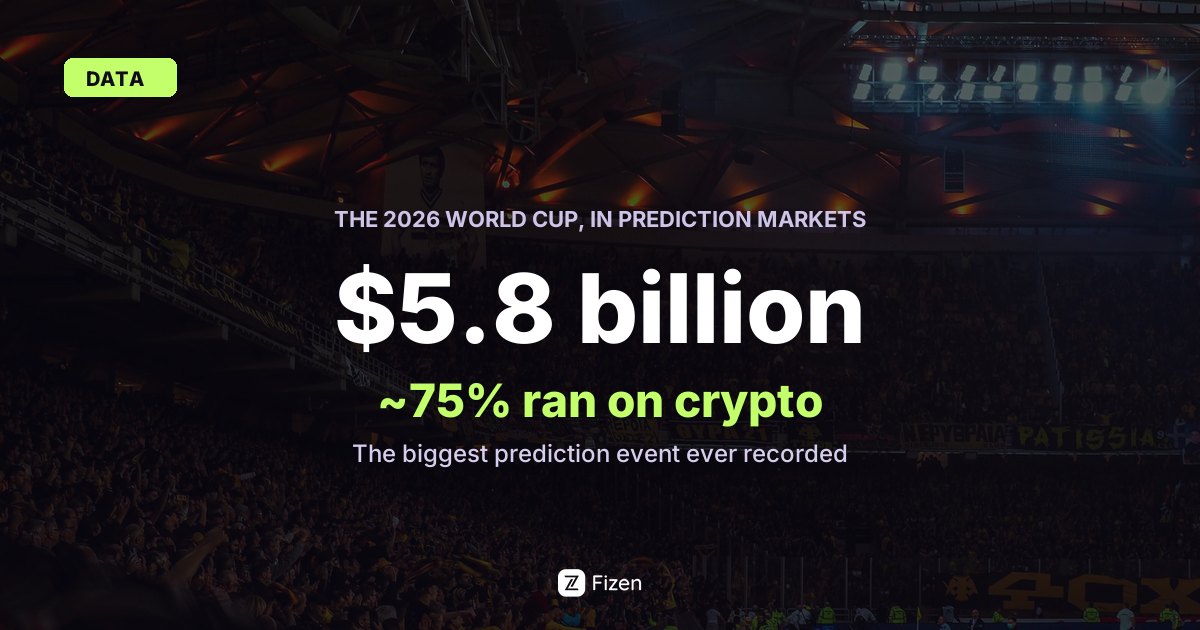
The 2026 World Cup was the biggest prediction event ever, at $5.81B. Here is exactly how much ran on crypto, where it dominated, and why stablecoins won the global market.

Key takeaways
- The 2026 World Cup drove roughly $5.81 billion in prediction-market volume across 52 markets on Polymarket and Kalshi, the biggest prediction event ever.
- Polymarket, which settles entirely in crypto (USDC), hosted about three-quarters of that World Cup volume, with a single 'who lifts the trophy' contract topping $4.21 billion.
- Year-round, though, US-regulated Kalshi leads on total volume (around 59% of Q2 2026), running on fiat, so crypto's dominance is sharpest on global events, not the overall market.
- The takeaway: stablecoins are the settlement rail that let anyone in the world join a prediction market, which is why crypto owned the World Cup.
The 2026 World Cup was not just the biggest football tournament in history, it was the biggest gambling and prediction event ever recorded, and a remarkable amount of it ran on crypto. Here is the data on how big prediction markets got during the World Cup, exactly how much of it was crypto-settled, and why stablecoins gave crypto platforms the edge on a global event.
The headline number: $5.81 billion
Across the 52 primary and secondary World Cup markets on Polymarket and Kalshi, combined trading volume reached about $5.81 billion, per news.bitcoin.com. For scale, crypto.news reports the tournament effectively turned Polymarket into a $5 billion market on its own, and monthly volumes hit records: Polymarket cleared over $10.7 billion in June, its highest ever.
How much of it was crypto?
This is the striking part. Polymarket runs entirely on crypto: users trade with USDC-backed collateral on the Polygon network, and payouts settle in USDC. And on the World Cup, Polymarket dominated. Its single contract tracking who would lift the trophy alone reached about $4.21 billion in volume, per Crypto Briefing. Set against the roughly $5.81 billion across all 52 World Cup markets, that means the large majority of World Cup prediction volume, on the order of three-quarters, flowed through a platform that is 100% crypto-settled.
| Platform | Settles in | World Cup role |
|---|---|---|
| Polymarket | Crypto (USDC on Polygon) | Dominant venue, ~$4.4B+ volume |
| Kalshi | Fiat (US dollars) | Large, but a minority of World Cup volume |
Figures indicative, from public reporting; volumes span primary and secondary markets.
But does crypto dominate prediction markets overall? Honestly, no
Here is the nuance, because the honest picture matters. Across all categories year-round, US-regulated Kalshi actually leads on total volume, holding roughly 59% market share in Q2 2026 while Polymarket's share was about 30%, per FinanceFeeds. Kalshi runs on fiat and captured huge US sports and economics volume. So crypto does not own the whole prediction-market pie. What it owns is the global, open events, the World Cup, politics (where Polymarket holds around 97% of markets), anything the whole world wants to weigh in on.
Why stablecoins gave crypto the edge on a global event
The reason crypto dominated the World Cup specifically comes down to reach. Kalshi is a regulated US exchange, so it is largely a US-only venue. Polymarket, settling in USDC, is borderless: anyone with a stablecoin balance and a wallet can join, from anywhere the platform is available, without a US bank account or broker. A World Cup is a planet-wide event, so the platform the planet can actually use is the one that wins it. That is the quiet story in the numbers: stablecoins are the settlement layer that made prediction markets a global phenomenon, not just an American one.
What it signals
Prediction markets went mainstream in 2026, and crypto rails were a big reason. When a single football contract clears over $4 billion in USDC, stablecoins have stopped being a trading niche and become financial infrastructure, the plumbing under a global market. Whether or not you ever place a prediction, the direction of travel is clear: stablecoins are increasingly what real-world, global money settlement runs on.
Sources
Frequently asked questions
How much did people bet on the 2026 World Cup on prediction markets?
About $5.81 billion in combined volume across 52 markets on Polymarket and Kalshi, making it the biggest prediction event on record.
What percentage of World Cup prediction volume was crypto?
The majority, on the order of three-quarters, ran through Polymarket, which settles entirely in crypto (USDC). Its trophy-winner contract alone topped $4.21 billion.
Does crypto dominate prediction markets overall?
Not year-round. US-regulated Kalshi, which runs on fiat, led total Q2 2026 volume at about 59%. Crypto dominates global and open events like the World Cup and politics.
What crypto do prediction markets use?
Polymarket runs on USDC-backed collateral on the Polygon network, with payouts in USDC. Stablecoins are the core settlement rail.
Why is crypto better for global prediction markets?
Because stablecoin settlement is borderless: anyone with a wallet can join without a US bank or broker, unlike a US-regulated fiat exchange. That global reach won the World Cup.
A single football bet cleared $4 billion in stablecoins. That is not a niche anymore, it is infrastructure.
Fizen: hold the stablecoins these markets run on
Prediction markets settle in stablecoins. Fizen is a self-custody super app to hold your own USDT, spend it by card or QR, send it across 64 countries and more, from one balance you control. Backed by an investment from Tether.
This is data and analysis, not betting or financial advice. Prediction markets are restricted or illegal in many jurisdictions, including parts of the US and elsewhere; follow your local laws. Fizen is a self-custody super app, backed by an investment from Tether.
Terms and conditions
- Information only. Fizen publishes this article to inform, not to sell. Nothing here is an offer or solicitation, and it is not financial, investment, legal or tax advice. Prices, rules and availability change; check official sources.
- For readers in the United States. This article provides information only. It is not an offer, solicitation or sale of any product or service, and it is not financial, investment, legal or tax advice. Fizen is not offered to US Persons.
- Full terms. Master Terms of Use, Privacy Policy and Disclaimer on the Fizen site.