QR Pay in Vietnam: How a UK Traveller Pays by VietQR Without a Local Bank Account
Vietnam runs on QR codes, but the system was built around Vietnamese bank accounts. A UK traveller can now scan VietQR and pay from a USDT balance in the Fizen app. Here is how it works, what it costs you in practice, and when cash is still the better call.
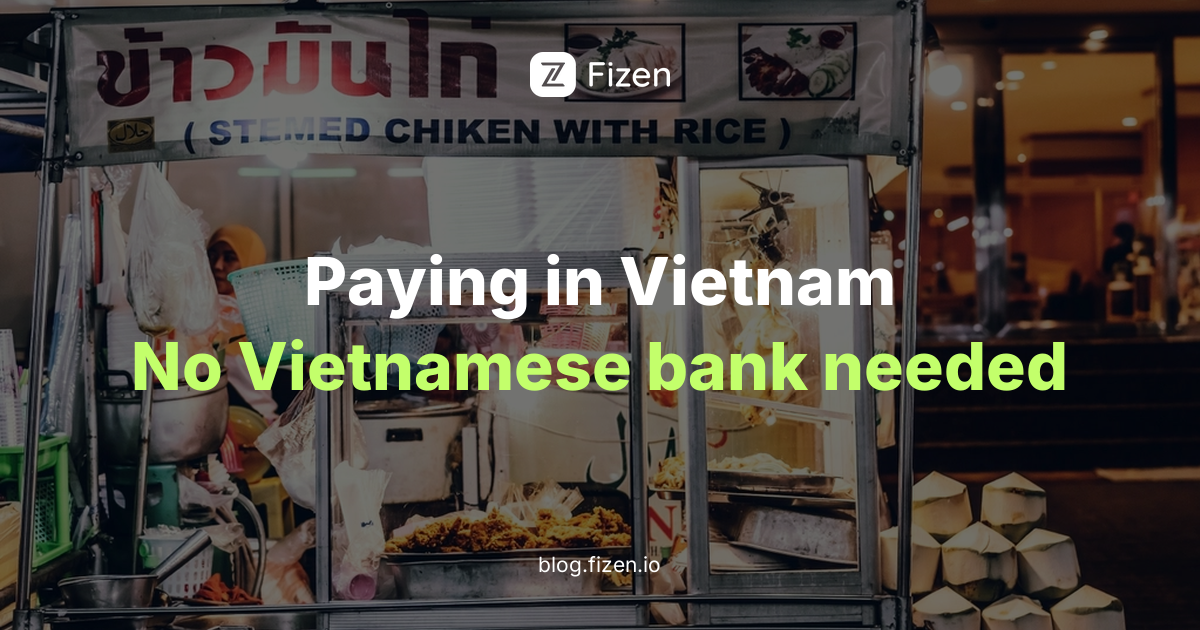
Quick answer: If you are a UK traveller in Vietnam in 2026 and you do not have a Vietnamese bank account, Fizen QR Pay lets you scan a VietQR code and pay from a USDT balance you already hold, with the amount shown in dong before you confirm. It is for visitors only, funded with USDT on Solana or BNB Chain, capped at US$800 per payment and US$1,000 per week.
Key takeaways
- Built for locals, opened for visitors: VietQR is Vietnam's national QR standard from NAPAS, and the domestic wallets behind it usually want a Vietnamese bank account or in-person identity checks, according to Wise's 2026 guide for foreigners.
- What QR Pay does: you scan the code on the counter, the amount appears in dong, and you confirm a payment from a USDT balance moved into QR Pay from the Fizen wallet.
- The limits that matter: US$800 per payment, US$1,000 per week, no daily limit, and it works in Vietnam only, for travellers and foreigners, not for local residents.
- Cash still has a place: small vendors, rural areas and moments when the signal drops still run on dong notes, so carry some even with QR Pay set up.
You are standing at a stall in Hanoi with a banh mi in one hand and your phone in the other, and the QR code on the counter will not take your card. That is the moment people type "qr pay vietnam".
Vietnam runs on QR codes, but the codes were built for Vietnamese bank accounts. Here is what actually works for a visitor, what it costs, and where cash is still the answer.
Can a foreigner pay by scanning the QR codes in Vietnam?
Yes, but not with a Vietnamese banking app. VietQR, the national QR standard run by NAPAS, was built around domestic bank accounts, and most Vietnamese wallets still require in-person identity verification and biometric enrolment before activation (Wise, 2026; Unrush Travel, 2026). For a short-term visitor without a Vietnamese bank account, that route is closed.
What has changed is cross-border QR. By 2026, some services let foreigners register with just a passport and an international phone number, activating in minutes (Unrush Travel, 2026). And NAPAS has connected its QR network to six markets: Thailand, Laos, Cambodia, China, South Korea and Singapore (VnExpress, 5 October 2026). If your home payment app is on that list, you can scan at the counter.
If your app is not on the list, you need a wallet that bridges the gap. That is the gap Fizen QR Pay fills: a USDT balance you already hold, scanned at any VietQR merchant, with the amount shown in dong before you confirm. It is for visitors only, not for Vietnamese residents.
What is VietQR and which QR codes will you actually see at the counter?
VietQR is Vietnam's national QR payment standard, developed by NAPAS with 14 pioneering banks (Wise, 2026). It is accepted by over 2 million merchants across 55 banks and payment institutions, from supermarkets and hotels to street food carts and local markets (NUS March Grad Show, 9 July 2026). One code works with multiple banking apps and e-wallets, including MoMo, ZaloPay, ShopeePay and MobiFone Money (Wise, 2026).
For international visitors, look for the VietQRGlobal mark. It identifies merchants that accept cross-border QR payments, and NAPAS is rolling it out to visitors from Thailand, Laos, Cambodia and most recently China (Wise, 2026). A food-stall owner at Ben Thanh Market said around 70% of her customers pay cashlessly, rising to 80–90% among younger customers (Vietnam News, 28 September 2026).
| Code type | What it looks like | What you do |
|---|---|---|
| Static VietQR | Printed code on a stand or wall | Enter the amount yourself, then confirm |
| Dynamic VietQR | Generated on a POS screen | Amount is pre-filled, just confirm |
| VietQRGlobal | Mark displayed at the counter | Scan with a participating foreign app |
| MoMo / ZaloPay sticker | Separate wallet logo | Only works if you have that wallet |
Which foreign apps already scan Vietnamese QR codes, and which countries do they cover?
NAPAS has connected cross-border QR to six markets, and the list of participating apps depends on where you bank. For Singapore: LiquidPay, Aleta Planet and DCS DeCard (Vietnam News, 28 September 2026). For China: WeChat Pay and Alipay, both scanning VietQRGlobal codes (Vietnam News, 28 September 2026; The Viet Media, 2026). For South Korea: the GLN network (Vietnam.vn, 11 August 2026). For Thailand, Laos and Cambodia: ITMX, LAPNet and ACLEDA respectively (Vietnam.vn, 11 August 2026).
The volumes show this is not theoretical. In the first eight months of 2026, QR transactions by tourists from Thailand, Laos and Cambodia in Vietnam rose eightfold year on year, and their value sixfold, according to NAPAS (VnExpress, 5 October 2026). Chinese visitors using domestic payment apps to scan VietQRGlobal codes tripled transaction volume and quadrupled value compared with April 2026 (Vietnam News, 28 September 2026).
How much does a QR payment cost the shop compared with a card?
The merchant fee for VietQRGlobal, the cross-border QR service that lets foreign visitors pay in Vietnam, is expected to be around 1.5% of the transaction value, compared with 2.4% to 3% for international card payments, according to NAPAS (VnExpress, 5 October 2026). That difference matters for small shops and household businesses, which can serve international visitors but are more sensitive to payment acceptance costs.
For you as the payer, the fee is not charged at the counter. But it explains why more merchants are adopting QR: it is cheaper than a card terminal. For a 100,000 VND payment, the shop pays about 1,500 VND on QR versus 2,400 to 3,000 VND on a foreign card. Over a month of small purchases, that is real money for a street kitchen.
Fizen QR Pay does not add a merchant fee on top; you pay from your USDT balance and the app shows the amount in dong before you confirm. The balance is yours, and you keep your keys. USDT moved into QR Pay is governed by the Fizen QR Pay Terms.
How widely is QR accepted, and where does cash still win?
QR is the default way to pay in Vietnam. One 2026 review puts VietQR acceptance at over 2 million merchants across 55 banks and payment institutions (source 3). The State Bank of Vietnam counts more than 2.5 million businesses accepting cashless payments, of which around 154,000 accept cross-border QR (source 7, VnExpress, 5 October 2026). VNPAY alone has more than 600,000 QR acceptance points (source 9, 11 August 2026).
You will find the code on the counter at coffee shops, convenience stores like WinMart and Circle K, restaurants, and street food stalls (source 2, Wise). A food-stall owner at Ben Thanh Market told Vietnam News that around 70% of her customers pay cashlessly, rising to 80 to 90% among younger buyers (source 6, 28 September 2026).
Cash still wins in three places: rural vendors and provincial markets where signal drops, parking attendants, and the occasional stall that prefers notes (sources 4 and 5). Keep a few small dong notes for those.
What does it cost you to fund a QR wallet as a visitor?
Fees depend on the app. Moreta Pay, one of the foreigner-friendly wallets, charges 1.5% per payment plus a 0.6% FX conversion spread, with a maximum of 50 million VND (about US$1,970) per payment and 160 million VND (about US$6,310) per week (source 4, guide dated 27 October 2026). That means a 100,000 VND banh mi and coffee run costs you 1,500 VND in fee plus the spread.
For comparison, NAPAS says the merchant fee for cross-border QR is expected to be around 1.5% of the transaction value, against 2.4% to 3% for international card payments (source 7). Those are merchant costs, not yours, but they explain why small shops push QR.
| Cost item | Moreta Pay (source 4) | Your UK card (typical) |
|---|---|---|
| Transaction fee | 1.5% per payment | Foreign transaction fee, often 2.5% to 3% |
| FX spread | 0.6% | Bank rate plus markup |
| ATM withdrawal | Not applicable | ATM fee plus operator fee |
| Leftover cash | Stays in wallet | Change back at airport, worse rate |
Frequently asked questions
Can I use VietQR as a UK tourist without a Vietnamese bank account?
Not directly through a Vietnamese banking app, which usually needs local identity checks. Fizen QR Pay lets a visitor scan a VietQR code and pay from a USDT balance instead, with the amount shown in dong first.
What are the limits on Fizen QR Pay in Vietnam?
US$800 per payment and US$1,000 per week, with no daily limit. The balance is funded only with USDT on Solana or BNB Chain moved from the Fizen wallet into QR Pay.
Do I need to complete KYC to use QR Pay?
Yes, KYC applies. QR Pay is available to travellers and foreigners in Vietnam, not to local residents of those countries.
Where can I pay with a VietQR code in Vietnam?
VietQR is accepted from large retail chains to small food vendors, according to Wise's 2026 guide. Look for the VietQR mark on the printed code at the counter.
What happens if I have leftover dong at the end of the trip?
You can keep it for the next visit or change it back, but the point of paying by QR from a USDT balance is that you do not have to carry more dong than you need in the first place.
Set up QR Pay before you land in Vietnam
Scan VietQR and pay with USDT from the Fizen app. Your money. Your freedom. No borders.
Terms and conditions
- Information only. This article is general information about payment methods in Vietnam and is not financial, legal or tax advice.
- For readers in the United States. This is information only, not an offer or sale of any product, and not advice. Fizen is not offered to US Persons.
- QR Pay scope. QR Pay is available to travellers and foreigners in Vietnam and the Philippines only, is funded only with USDT on Solana or BNB Chain, and is governed by the Fizen QR Pay Terms. KYC applies.
- Self custody. The Fizen wallet is self custody, so nobody can restore a lost recovery phrase. USDT moved into QR Pay is governed by the Fizen QR Pay Terms.
Sources
- Wise, VietQR for Foreigners: The Complete Guide (2026)
- Vietnam News, QR payments make Việt Nam more convenient for international visitors, 28 September 2026
- VnExpress International, QR transactions in Vietnam by Thai, Lao, Cambodian tourists up eightfold, 5 October 2026
- Vietnam.vn, Implementing cross-border QR payment between Vietnam and China, 2 December 2025
- Vietnam.vn, International tourists visiting Vietnam do not need to exchange currency, 11 August 2026
- The Viet Media, WeChat Pay Now Works in Vietnam via VietQR Codes, 2026
Facts checked on 11 November 2026.