Brazil Travel Money Scams (2026): What to Watch, What to Ignore
Most visits to Brazil pass without incident. The few that go wrong tend to go wrong in the same handful of ways, and nearly all of them are avoidable with habits locals already have.
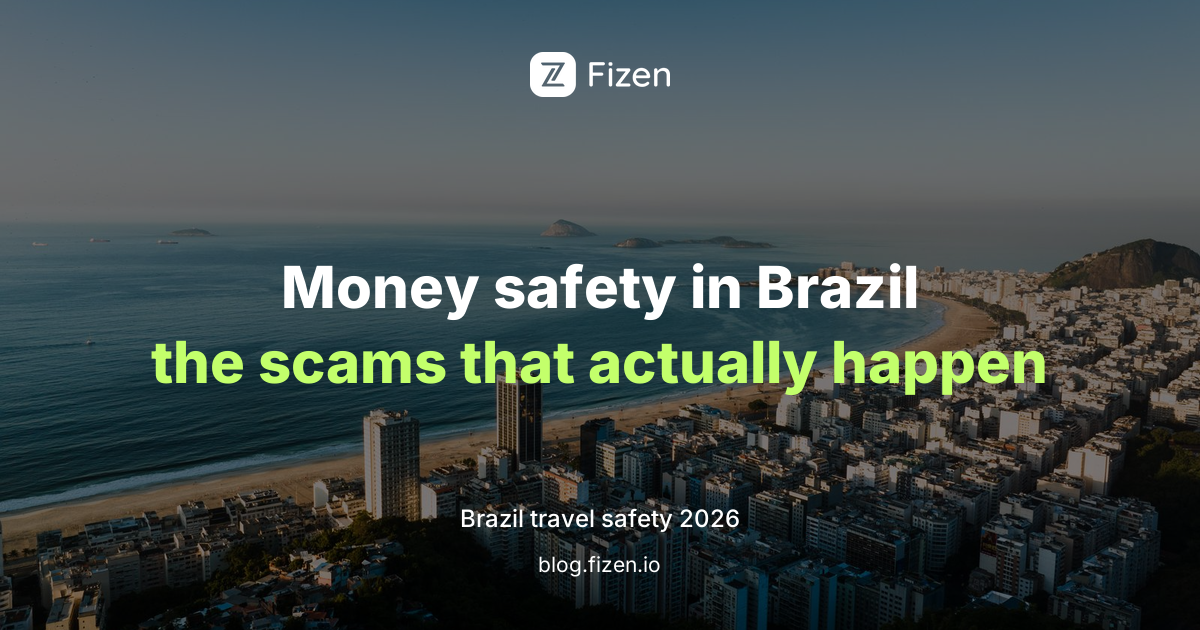
Quick answer: The money problems visitors actually hit in Brazil are card skimming at street ATMs, terminals switched to your home currency at a bad rate, fake QR codes pasted over real ones, unmetered taxi rides agreed on the street, and phone theft. The habits that prevent almost all of it: withdraw inside bank branches, always pay in reais, check the recipient name before approving any payment, book rides in the app, and keep your phone out of sight on the pavement.
Key takeaways
- Nothing here is unique to Brazil. These are the same precautions Brazilians take, and locals will not think you are being paranoid.
- Use ATMs inside bank branches, airports or shopping centres, and walk away from any machine that looks tampered with or has people hovering.
- Decline the terminal's offer to charge you in your home currency. It is not a scam in the criminal sense, but it is the most reliable way to lose money.
- Fake QR codes pasted over real ones are a live problem in Brazil. Read the recipient name on your screen before you approve anything.
- Book taxis in the app rather than on the street, and check the plate and driver before getting in.
- Carry a backup: a second card from a different issuer, a little cash kept separately, and a phone line that works without airport Wi-Fi.
Fizen QR Pay in Brazil: we are building it
Today Fizen works in Brazil as a self-custody USDT wallet and as an eSIM store for your trips. Paying a QR code from a USDT balance is live in Vietnam and the Philippines, for travellers. We are working on bringing QR Pay to Brazil, where the standard is Pix, together with a licensed local partner. It is not available yet and we have no date to announce.
In the meantime: open the app and tap the eSIM tab for the first time and you get $10 of eSIM credit, automatically, no code needed. It covers up to 30% of each plan and is valid for 12 months.
Get the app and the $10eSIM credit, not withdrawable cash. One per person.
Brazil has a reputation that is both overblown and worth respecting. Millions of people visit every year and go home with nothing worse than sunburn. The ones who have a bad story usually have one of about six stories, and almost all of them start with a moment of being distracted, in a hurry, or standing still on a pavement with a phone in their hand.
This is not a scare piece. It is the practical version: the specific ways money goes missing, the habits that prevent them, and what to actually do if something happens. Read it once, adopt three or four habits, and then go enjoy the place.
What are the most common money scams in Brazil?
Sorted by how often visitors actually run into them rather than how dramatic they sound.
| What happens | Where | How you avoid it |
|---|---|---|
| Terminal charges you in your home currency at a poor rate | Restaurants, shops, taxis, ATMs | Always choose reais. Check the receipt for two amounts and a printed rate |
| Card skimming and cloning at a machine | Standalone street ATMs, unattended machines | Withdraw inside bank branches, airports and malls only |
| Fake QR code pasted over the real one | Counters, kiosks, small shops | Read the recipient name on your screen, feel the sticker for an edge |
| Unmetered or inflated taxi fare | Street hails, airport arrivals halls | Book in the app, or use the official airport taxi counter |
| Distraction theft of a phone or bag | Beaches, busy streets, buses | Phone away on the street, bag on your lap, nothing on the beach towel |
| Helpful stranger at the machine | Any ATM | Never accept help. Cancel and leave if someone approaches |
Notice how few of these need a criminal mastermind. Most are opportunistic, which is why boring habits work so well against them.
How do you avoid card skimming and ATM problems?
The UK government's Brazil travel advice is direct: do not use an ATM if you notice anything suspicious, keep sight of your card, and check the amount shown on the terminal before you pay. Add a few practical rules to that.
- Use machines that live inside a bank branch, an airport terminal or a shopping centre, during opening hours, with people around and cameras overhead.
- Look at the card slot and the keypad. A loose reader, a keypad that sits proud of the panel or a sticker over the manufacturer's marking are all reasons to use another machine.
- Cover the keypad with your other hand when you enter the PIN. Cameras are cheap.
- Decline the machine's conversion offer and take reais.
- Put the cash and the card away before you step back from the machine. Do not count notes in the doorway.
- Check your banking app afterwards and keep the receipt until the amount matches.
The travel advice also mentions express kidnapping, where someone is held for a short period and driven to a machine to withdraw money. It is not common for tourists, and the prevention is the same as everything else: do not hail cars off the street, do not walk alone late in quiet areas, and do not carry the card and PIN habits that make a large withdrawal possible.
Are fake QR codes a real risk in Brazil?
Yes, and Brazilian consumer press covers new variations regularly. The physical version is simple: a sticker with a fraudulent code is pasted over the genuine one at a counter or kiosk, and the customer scans it without noticing. The online version tampers with the payment page of a shop so the code shown at checkout belongs to someone else.
The protection is the same one Brazilian banks repeat constantly: before you approve any payment, read the recipient name and the amount on your own screen. Reporting in the Brazilian press on the fake QR code scam makes the same point, along with the advice never to pay from a code that arrived in an email or an unsolicited message.
- Check the name. A café called Padaria Dona Maria should not resolve to an individual's name you have never seen.
- Feel the sticker. A code pasted over another one usually has a lifted edge.
- Ask the staff to generate a code in front of you rather than using the laminated one on the wall.
- Never scan a payment code sent by message, even from a business you have been talking to.
- If something is wrong, stop. Cancel and pay another way. No legitimate business will mind.
As a visitor you are more likely to be the person scanning than the person being paid. If you are not using Brazil's instant payment system at all, which is the normal situation for a tourist, this mostly affects you when a merchant asks you to scan something. Our guide to Pix for foreigners explains why that system usually is not available to short stay visitors in the first place.
How do you avoid being overcharged by taxis in Brazil?
The classic version is the airport arrivals hall: someone approaches you before you reach the official counter, offers a ride, and the price triples somewhere on the motorway. The UK advice explicitly warns about unregulated drivers posing as app drivers at airports, and says not to hail taxis on the street.
- Book in the app. Uber and 99 are the normal way visitors and locals move around. The price is set before you get in.
- Check the plate and the driver's name against the app before opening the door. If they do not match, do not get in.
- Wait inside the terminal. Airports have designated app pickup areas. Do not follow anyone to a car park.
- If you use a metered taxi, insist on the meter. Agreeing a price in advance is normal for long fixed routes, but be clear before the doors close.
- Sit in the back and keep your bag with you, not in the boot, on short city rides.
- Share your trip in the app with someone who knows where you are going.
All of that assumes a phone with a connection. Booking a ride is the single most common reason a visitor needs data in the first ten minutes on the ground, so get your Brazil eSIM before you fly rather than joining the airport Wi-Fi queue with your luggage.
What street habits actually reduce risk in Rio and São Paulo?
Watch what locals do. They are not frightened of their own cities, and they are also not walking down the street holding a phone at arm's length.
- Phone away when you are moving. The UK advice specifically mentions avoiding using a mobile phone in the street, and says thieves target phones. Check your route inside a shop, a cafe or the car.
- Carry less. Leave the passport in the accommodation safe with a photo on your phone, take one card and some cash, and leave the watch at home.
- On the beach, take almost nothing. A beach towel with a phone on it is an invitation. Kiosks often keep an eye on regulars' things, but do not rely on it.
- Buses in the late afternoon and evening are named in official advice as a higher risk window for robbery. Ride apps at night are worth the money.
- If someone demands your things, hand them over. Official advice is not to resist. A phone is replaceable.
- Check your route before you walk it. Navigation apps can send you through areas you should not walk into. The UK advice specifically says to make sure a suggested route does not take you into a favela.
None of this means being tense. It means arriving with the route decided, the phone in the pocket and nothing valuable on display, which is how most people in both cities move around every day.
What should you do if you are robbed in Brazil?
- Do not resist. Hand over what is asked for and let the person leave.
- Get somewhere safe and public, a hotel lobby, a shop, a restaurant, before you do anything else.
- Freeze the cards from your banking app or by calling your bank. This is the moment a backup phone line or a friend's phone matters.
- File a police report. Rio has a tourist police unit in Leblon that is used to handling foreign visitors, and a report, the boletim de ocorrência, is what your travel insurer will ask for.
- Contact your embassy or consulate if your passport is gone. Take the police report with you.
- Use your backup card and backup cash to get through the next 48 hours while replacements are arranged.
This is why redundancy beats every other piece of advice. Two cards from different issuers, kept in different places. A small cash reserve that is not in your wallet. A phone line that works without your home carrier. A photo of your passport in your email. Set that up before you fly and a bad afternoon stays a bad afternoon.
How do you keep a backup payment method and phone line?
Redundancy is cheap and almost nobody does it. Here is the version that takes twenty minutes at home.
- Two cards, two issuers, two pockets. One in the wallet, one in the accommodation safe or a separate bag.
- Cash split. A day's spending in the wallet, an emergency fold somewhere else.
- A second phone line. Keep your home SIM active for bank one time codes and add a travel eSIM as your data line, so losing one does not lose both.
- Offline maps downloaded for the cities you are visiting, so a dead connection is not a dead map.
- Photos of your documents in your email and in a password manager, not only on the phone in your pocket.
- An old phone in the luggage is worth considering for longer trips, with the eSIM ready to move over.
On the connectivity side, a travel eSIM is the simplest way to avoid depending on one fragile thing. Fizen covers 150 plus destinations with plans from $4, data only with no calls or SMS, installed at home over your own Wi-Fi before you fly. You can pay by card, Apple Pay, Google Pay or USDT. Plans come with a trip long warranty and free one for one replacement if an eSIM fails, and support is a real person rather than a form. Land connected. Skip the roaming bill.
Is Brazil safe for tourists in 2026?
The honest answer is that it depends far more on where, when and how than on the country as a whole. Brazil is enormous and wildly varied. A beach town in Santa Catarina, a business district in São Paulo and a late night walk in a quiet part of central Rio are completely different risk pictures, and lumping them together is how bad advice gets written.
- Read your own government's current travel advice before you go, and re read it close to departure. It is updated regularly and is more current than any blog.
- Ask where you are staying. Hotel and pousada staff know which two streets to avoid at night and which ones are fine, and they will tell you straight.
- Adjust by time of day. Areas that are relaxed at noon can be different at midnight, and locals change their own behaviour accordingly.
- Do not treat a guided favela tour as a safe default. Official UK advice is to avoid favelas, including tourist marketed visits.
- Trust the ordinary signals. If a street empties out or people around you change direction, follow them.
Then get on with it. Brazil rewards people who show up prepared and relaxed, and the payments and connectivity side of the trip is the easiest part to get right in advance. If you want the money detail, read our guide to paying in Brazil as a tourist.
Frequently asked questions
Is it safe to use ATMs in Brazil?
Yes, with sensible rules. Use machines inside bank branches, airport terminals or shopping centres during opening hours rather than standalone street machines. Inspect the card slot and keypad, cover your PIN, decline the conversion offer, and put cash away before stepping back. Never accept help from a stranger at a machine.
What is the most common scam against tourists in Brazil?
In money terms it is the card terminal or ATM offering to charge you in your home currency at a marked up rate. It is legal and extremely common, and it costs more visitors more money than any criminal scheme. Always choose to be charged in Brazilian reais.
Should I use a taxi or Uber in Brazil?
Ride apps are the normal choice for visitors, especially at night, because the price is fixed before you get in and the driver and vehicle are recorded. Official travel advice warns against hailing taxis on the street and against people posing as app drivers at airports. Wait inside the terminal and check the plate.
What should I do if my phone is stolen in Brazil?
Do not chase anyone. Get somewhere safe, then freeze your banking apps and lock the device remotely if you can. File a police report, which your insurer will need. This is the situation a second card and a separate phone line are for, so set both up before you travel.
Is it safe to carry a phone on the beach in Rio?
Take as little as possible to the sand. Official advice notes that beach theft happens, sometimes by groups moving through quickly, and that thieves target phones. Leave valuables where you are staying, take one card and a small amount of cash, and keep what you do bring with you rather than on a towel.
Do I need travel insurance for Brazil?
It is strongly advisable, and any claim for theft will need a police report. Check that your policy covers phones, cameras and laptops, since those are what actually get taken, and read the limits before you rely on it.
How do I check a QR code payment is genuine?
Read the recipient name and the amount on your own screen before approving. The name should match the business. Feel the printed code for a pasted edge, ask staff to generate a fresh code where possible, and never pay from a code sent to you by message or email.
Is Rio more dangerous than São Paulo?
Both are large cities where risk varies enormously by neighbourhood and time of day, and neither generalisation holds up. The useful comparison is not city against city but street against street. Ask where you are staying, read current official advice, and adjust your routine after dark in either place.
A phone line that does not depend on luck
Install a Fizen Brazil eSIM at home before you fly, keep your home SIM for bank codes, and always have a way to book a ride or freeze a card. Data only, plans from $4, pay by card, Apple Pay, Google Pay or USDT. Not offered to US Persons.
Terms and conditions
- Information only. This article is general travel safety information, not legal, financial or security advice. Your own government's travel advice is the authority for your trip.
- For readers in the United States. This article provides information only. It is not an offer, solicitation or sale of any product or service, and it is not financial, investment, legal or tax advice. Fizen is not offered to US Persons.
- Rules and conditions change. Safety guidance, police procedures and travel advisories are issued by official bodies and change without notice. Check the current advice from your foreign ministry before you travel.
- No promise of outcome. Following the habits described here reduces risk but cannot remove it. Nothing in this article promises your safety or the security of your property.
- eSIM plans vary. Data amounts, validity, hotspot support, speeds and prices differ by destination and plan. The terms shown at checkout take precedence over any description in this article.
- Device requirements. Your phone must be eSIM capable and not locked to a carrier. Install on Wi-Fi before you travel.
- No affiliation. Fizen is not affiliated with any bank, ride app, police body, government or publication named here. Names are used for description only.
- Availability. Fizen is not offered to US Persons. Product availability varies by country.
- Full terms. See the Master Terms of Use, Privacy Policy and Disclaimer on the Fizen website.
Sources
- UK Foreign Office travel advice, Brazil: safety and security
- Correio Braziliense, fake QR code Pix scam and how to protect yourself
- Banco Central do Brasil, Resolution BCB No. 1 (Pix Regulation, English)
Information current as of September 2026. Travel advice changes, so check your own government's current guidance before departure.