Internet in Vietnam (2026): Hanoi to Saigon, What Data Costs and Where It Drops
Written for the fortnight that runs Hanoi, Ha Long, Sapa, then Ho Chi Minh City. Which Vietnamese network you land on, what it costs per gigabyte, and the two places the signal genuinely disappears.
Quick answer: For the couple doing two weeks north to south: Hanoi, Ha Long, Sapa, then Ho Chi Minh City. The Vietnam eSIM roams on Viettel Mobile on 4G, inside a South-Eastern Asia plan covering 18 countries, and slows to 128 kbps once the bucket is gone. On 23 September 2026, 10 GB for 15 days was US$24.55, about US$1.64 a day and US$2.46 per GB. That is the plan this trip wants.
Key takeaways
- It roams on Viettel Mobile, on 4G. That is the right network for this route: Vietnam's ministry puts 4G at 99.8% of the population, while 5G reached about 26% on roughly 11,000 base stations as of 16 July 2025.
- Prices on 23 September 2026: 10 GB for 15 days, US$24.55, about US$2.46 per GB. Stretching 10 GB from 15 to 30 days costs about a dollar more, so take the longer window.
- The 1 GB plan is the worst value on the page, at US$9.94 for three days, about US$9.94 per GB. Skip it.
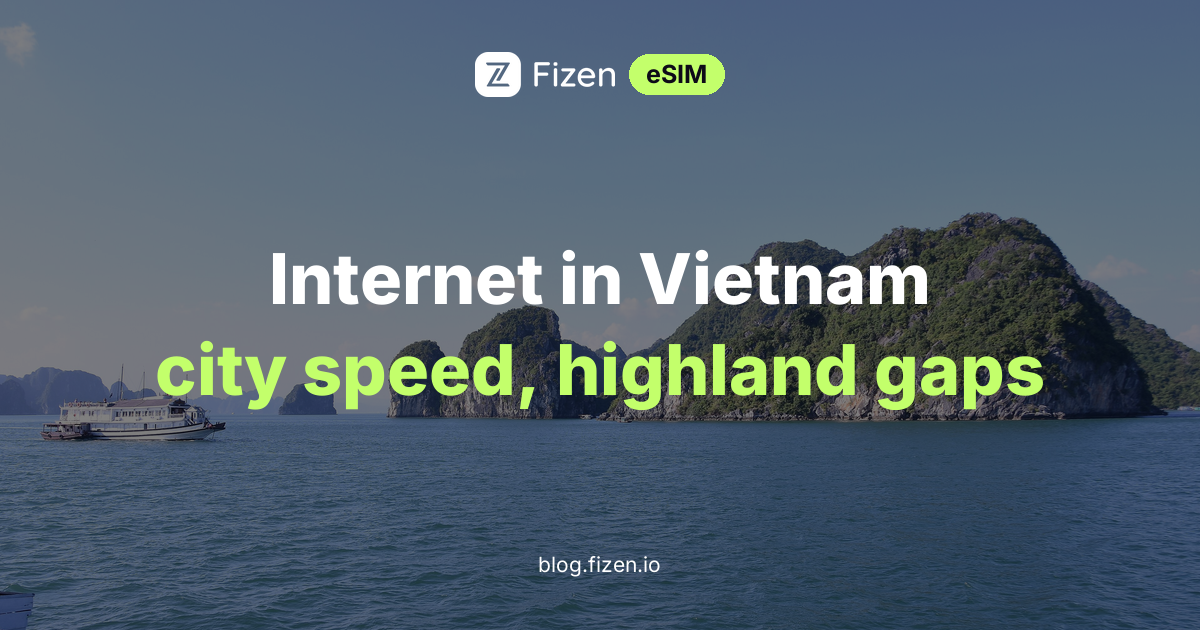
- The signal really does drop in two places: the water in Ha Long Bay, and the deep valleys and passes on the way to Sapa and the northwest loop. Vietnam's tourism authority says Viettel is the strongest there and still expects gaps.
Which network you get, and what it really costs
In Vietnam the Fizen eSIM roams on Viettel Mobile (4G). Vietnam is sold inside the South-Eastern Asia plan, which covers 18 countries. At 128 kbps you can still send messages and load map tiles, but not hold a video call.
| Plan | Days | Price | Per day | Per GB | After the high-speed data |
|---|---|---|---|---|---|
| 1 GB | 3 | US$9.94 | US$3.31 | US$9.94 | slows to 128 kbps |
| 5 GB | 7 | US$16.68 | US$2.38 | US$3.34 | slows to 128 kbps |
| 5 GB | 15 | US$17.35 | US$1.16 | US$3.47 | slows to 128 kbps |
| 5 GB | 30 | US$18.36 | US$0.61 | US$3.67 | slows to 128 kbps |
| 10 GB | 7 | US$23.52 | US$3.36 | US$2.35 | slows to 128 kbps |
| 10 GB | 15 | US$24.55 | US$1.64 | US$2.46 | slows to 128 kbps |
| 10 GB | 30 | US$25.60 | US$0.85 | US$2.56 | slows to 128 kbps |
| 20 GB | 15 | US$39.00 | US$2.60 | US$1.95 | slows to 128 kbps |
| 20 GB | 30 | US$40.07 | US$1.34 | US$2.00 | slows to 128 kbps |
| 50 GB | 30 | US$79.74 | US$2.66 | US$1.59 | slows to 128 kbps |
Prices and carrier read from the Fizen catalogue on 23 September 2026. Data only, no calls or SMS.
Prices are before the welcome credit. A new user who opens the eSIM tab in the Fizen app for the first time gets US$10 of eSIM credit automatically, with no code, valid for 12 months. The app shows how much of it comes off your order. Paying by card on the web works too, but the credit only applies in the app.
This guide is written for one trip in particular: two weeks, north to south. Hanoi first, a night on the water in Ha Long, the train or the road up to Sapa, then a flight south to Ho Chi Minh City. If that is roughly your itinerary, the numbers below are sized for you.
Which network does a Vietnam eSIM roam on, and is 4G enough?
It roams on Viettel Mobile, on 4G. There is no 5G on this plan, and for this route that matters far less than it sounds.
Vietnam is sold inside the South-Eastern Asia plan, 18 countries, and the line slows to 128 kbps once the high-speed data is used. That throttle is not nothing: it keeps messaging and map tiles alive, and it will not carry a video call.
| What you are doing | Bandwidth it needs | On 4G Viettel | At 128 kbps |
|---|---|---|---|
| Maps, Grab, messaging, email | Under 0.5 Mbps | Fine | Slow, but it works |
| Audio-only call home | 60 to 80 kbps (Zoom) | Fine | Works, just |
| 720p video call home | 1.2 Mbps up and down (Zoom) | Fine | No |
| Scrolling short video on a sleeper bus | 1 Mbps and up | Fine | No |
| Laptop on hotspot, email and documents | Under 1 Mbps in practice | Fine | Painful |
What does mobile data in Vietnam cost per day and per gigabyte?
All figures read from the Fizen catalogue on 23 September 2026, and they move. Every plan here roams on Viettel Mobile on 4G, inside the South-Eastern Asia regional plan, and slows to 128 kbps after the high-speed data.
| Plan | Days | Total | Per day | Per GB |
|---|---|---|---|---|
| 1 GB | 3 | US$9.94 | US$3.31 | US$9.94 |
| 5 GB | 7 | US$16.68 | US$2.38 | US$3.34 |
| 5 GB | 30 | US$18.36 | US$0.61 | US$3.67 |
| 10 GB | 15 | US$24.55 | US$1.64 | US$2.46 |
| 10 GB | 30 | US$25.60 | US$0.85 | US$2.56 |
| 20 GB | 15 | US$39.00 | US$2.60 | US$1.95 |
| 50 GB | 30 | US$79.74 | US$2.66 | US$1.59 |
One trap worth naming: most travel eSIMs cannot be topped up. Running out in Hue on day nine means buying and installing a second eSIM, not adding data to the first.
How much data does a two-week Vietnam trip actually use?
| A day on this route | Rough data | Note |
|---|---|---|
| Maps open most of the day | 0.15 to 0.25 GB | Much less with the city downloaded offline |
| Grab, four to six rides, tracking the driver | 0.08 to 0.15 GB | Small, but this is the one that has to work at the kerb |
| Messaging, photos home, email | 0.25 to 0.4 GB | The photos are most of it |
| Restaurants, menus, booking the next leg | 0.1 to 0.2 GB | Heavier than it feels, because of images |
| One 30-minute 720p video call home | About 0.55 GB | The biggest single line of a quiet day |
| An hour of short video on a sleeper bus | 1 GB and up (estimate) | The reason plans die on day three |
| Typical day, calls on hotel Wi-Fi | About 0.7 to 1.1 GB | |
| Travel day with video to kill the hours | About 2 GB |
Where does the signal actually drop in Vietnam?

Not in the cities. Hanoi, Da Nang, Hoi An and Ho Chi Minh City are dense and fast, and Vietnam's tourism authority notes that a typical Hanoi cafe connection runs at 20 to 50 Mbps. Three places on this route are different:
The practical version: download offline maps for every stop before you fly, and screenshot the things you would be stuck without. That one habit removes most of the ways this trip goes wrong.
Is a local Viettel SIM better than an eSIM?
| Travel eSIM | Local SIM in Vietnam | |
|---|---|---|
| Where you get it | Online before you fly, installed on home Wi-Fi | Airport kiosk at Noi Bai or Tan Son Nhat, or a carrier store in town |
| Typical price | 10 GB for 15 days, US$24.55 on 23 Sep 2026 | About 250,000 to 300,000 VND at the airport, or 150,000 to 200,000 VND in a city store, for a 30-day, 30 GB package, per Vietnam's tourism authority |
| Paperwork | None in Vietnam | Passport registration, a legal requirement, not shop policy |
| Vietnamese phone number | No, data only | Yes |
| Online on arrival | Yes, if installed before the flight | After the queue and the registration |
| Works in the other 17 countries of the regional plan | Yes | No |
Terms and conditions
- Information only. Fizen publishes this article to inform, not to sell. Nothing here is an offer, solicitation or sale of any product or service, and it is not financial, investment, legal or tax advice.
- For readers in the United States. This article provides information only. It is not an offer, solicitation or sale of any product or service, and it is not financial, investment, legal or tax advice. Fizen is not offered to US Persons.
- Independent. Fizen is not affiliated with, endorsed by or a partner of Viettel, Vinaphone, Mobifone, the Vietnam National Authority of Tourism, Grab or Zoom. Coverage figures are the published claims of carriers and government bodies and change.
- Rules change, so check before you travel. SIM registration, entry and visa rules are set by the Vietnamese authorities and change. Check official sources before relying on anything here.
- Data only. A travel eSIM carries data. It does not give you a Vietnamese phone number and it does not send or receive SMS, so keep your home SIM active for bank one-time codes.
- Availability. Fizen's QR Pay in Vietnam is for foreign travellers and is not offered to Vietnamese residents in Vietnam.
- Self-custody. Fizen is a self-custody app. You hold your own keys and your own USDT, and nobody, including Fizen, can recover a lost seed phrase.
- Prices and estimates. Plan prices, validity, data size and throttle speed are the ones shown at checkout on the date given. Data-use figures are approximations derived from published bandwidth numbers and your real use will differ. Your phone must support eSIM and be carrier-unlocked, and most travel eSIMs cannot be topped up.
- Full terms. Master Terms of Use, Privacy Policy and Disclaimer on the Fizen site.
Sources
- Vietnam National Authority of Tourism: Wifi and internet in Vietnam, SIM cards, eSIMs and staying connected
- Ministry portal: Viet Nam's 5G network covers 26% of population (16 July 2025)
- Vietnam Briefing: Decree 163/2024 guidelines for the 2024 Telecommunications Law
- Zoom Support: bandwidth requirements
- Apple Support: use eSIM when you travel
- Apple Support: set up an eSIM on iPhone
- Tether: strategic investment in Fizen
Updated 23 September 2026. Plan prices, coverage figures and registration rules change; check before you buy.