
Vietnam Digital Nomad Visa 2026: What Just Launched, and What Nomads Actually Use
Vietnam's visa system changed on 1 July 2026, and if you work in tech it changed in your favour. Here is what launched, who it is for, and the setup independent nomads still use.
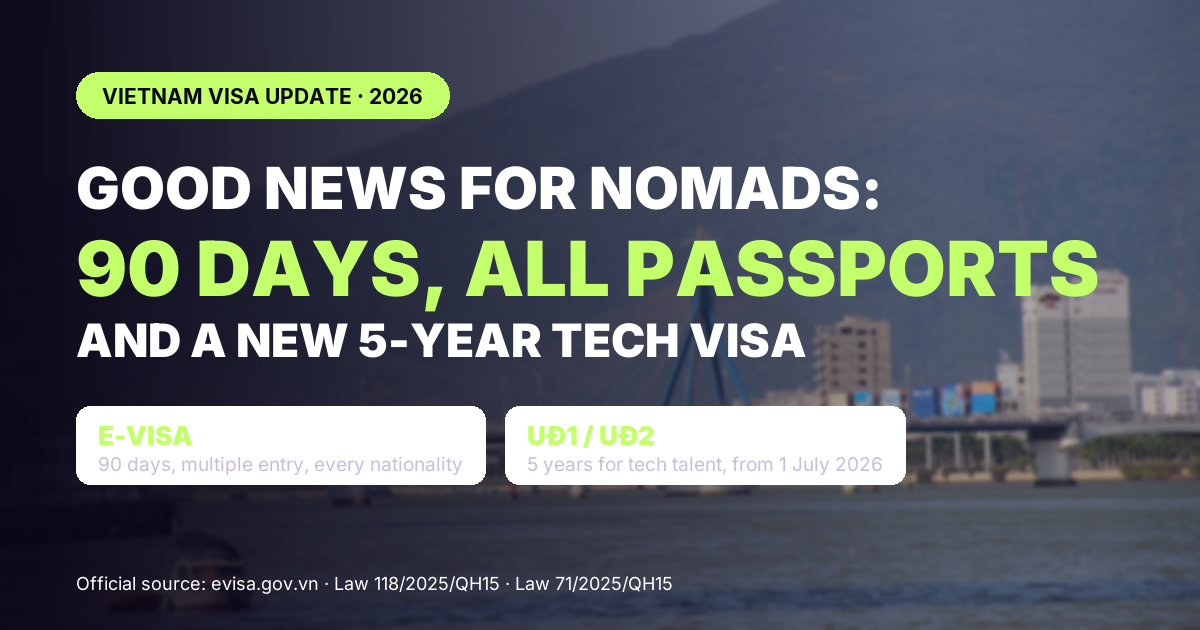
Key takeaways
- Vietnam's visa system changed on 1 July 2026: two new categories, UĐ1 for high-quality digital technology personnel and UĐ2 for their spouse and children under 18, both valid up to five years.
- Alongside it, the Law on Digital Technology Industry gives five-year renewable temporary residence cards to high-quality foreign digital technology personnel, with matching cards for family and a five-year personal income tax exemption for digital technology experts.
- If you work in tech and have an employer or institution in Vietnam, this is now one of the strongest long-stay packages in Southeast Asia, and the family provision is rarer than the five years.
- If you are an unsponsored freelancer, the working setup is unchanged: the 90-day e-visa, open to every nationality and available with multiple entry, plus visa exemption of 14 to 45 days depending on your passport.
Vietnam's visa system changed on 1 July 2026, and if you work in tech it changed in your favour. Two new categories now exist: UĐ1 for high-quality digital technology personnel, and UĐ2 for their spouse and children under 18. Both run for up to five years.
What actually launched
The legal basis is Law 118/2025/QH15, which amends provisions across ten laws on security and order, including the Law on Entry, Exit, Transit and Residence of Foreigners. It took effect on 1 July 2026 (Thư viện pháp luật, Công an Nghệ An).
| What you get | Detail | Source |
|---|---|---|
| UĐ1 visa | High-quality digital technology personnel, up to 5 years | Law 118/2025/QH15, from 1 July 2026 |
| UĐ2 visa | Spouse and children under 18, up to 5 years | Law 118/2025/QH15, from 1 July 2026 |
| Temporary residence card | Up to 5 years, renewable | Law 71/2025/QH15 |
| Family residence cards | Matching validity | Law 71/2025/QH15 |
| Income tax exemption | 5 years for digital technology experts | Law 71/2025/QH15 |
If you are a nomad, which half applies to you
You have a company behind you
Then this is genuinely the best news Vietnam has produced for tech workers, and the family clause is the part to notice. Five-year visas for skilled workers exist in plenty of countries. Five-year visas that bring a spouse and children on matching terms are rare, and they are the difference between a posting and a life. Combined with the tax exemption, Vietnam has just become a serious competitor to Singapore and Malaysia for anyone deciding where to base a technical team.
Practically: this route runs through your employer or sponsoring institution, so the conversation to have is with them, not with a visa agency.
You are independent, with clients abroad
Then nothing has changed yet, and the honest playbook is the one nomads have used in Vietnam for years.
- The 90-day e-visa is the workhorse. Available to citizens of every country, applied for online, and issuable with multiple entry, which is what makes short trips out of the country practical.
- Visa exemption gives 14 to 45 days depending on your passport, useful for a first look rather than a base.
- The cycle, meaning an e-visa, a border exit and a fresh application, is what most long-stayers actually do. It works. It is also a pattern immigration officers can see in your passport, so treat re-entry as a decision someone makes rather than a right you hold.
Vietnam against the rest of Southeast Asia
For an unsponsored nomad choosing a base in 2026, this is the comparison that matters. We have written each of these up separately, so the table links rather than repeats.
| Country | The route | Built for unsponsored remote workers? |
|---|---|---|
| Thailand | DTV, five years, multiple entry | Yes, explicitly |
| Malaysia | DE Rantau Nomad Pass | Yes |
| Indonesia | Remote worker visa, Bali in practice | Yes |
| Japan | Six-month nomad visa, high income bar | Yes, with conditions |
| Vietnam | 90-day e-visa, or UĐ1 with a sponsor | Not yet |
Terms and conditions
- Not legal advice. This article summarises Vietnamese legislation as published and as of 26 August 2026. Immigration and tax law changes, is applied differently by different offices, and depends on your nationality, employer and circumstances. Nothing here is legal, immigration or tax advice. Verify on evisa.gov.vn and take qualified Vietnamese advice before acting.
- For readers in the United States. This article provides information only. It is not an offer, solicitation or sale of any product or service, and it is not financial, investment, legal or tax advice. Fizen is not offered to US Persons.
- Sources. Primary references are Law 118/2025/QH15 (entry, exit, transit and residence of foreigners, effective 1 July 2026) and Law 71/2025/QH15 (digital technology industry, in force 1 January 2026), with explanatory notes from the Ministry of Public Security and the Government Gazette linked above.
- Implementation. Several provisions depend on implementing decrees and circulars. Where this article describes benefits such as the tax exemption or residence card duration, confirm the current implementing position before relying on it.
- Availability. Fizen is not offered to US Persons. Product availability varies by country and can change without notice. QR Pay is built for foreigners and travellers spending in the supported markets.
- Self-custody. You hold your own keys. No one, Fizen included, can restore your wallet if you lose your recovery phrase.
- eSIM. Your phone must be eSIM capable and carrier unlocked. eSIM is data only, so keep your normal SIM for calls and bank one-time passcodes. Plan details, validity and hotspot support vary; check Package details before buying.
- Full terms. Master Terms of Use, Privacy Policy and Disclaimer.
Related reading
- The UĐ1 and UĐ2 visas in detail: what the law actually says
- Thailand's DTV: five years, and suddenly necessary
- Malaysia's DE Rantau Nomad Pass
- Indonesia (Bali) remote worker visa
- Japan's digital nomad visa
Position as of 26 August 2026. Official source: evisa.gov.vn. Legislation: Công báo Chính phủ and Thư viện pháp luật.