Living in the Philippines on USDT: How Expats Pay Rent, Utilities, and Daily Bills (2026)
Six months or six years, living in the Philippines without a local bank account? Here's how to handle rent, utilities and monthly bills with USDT and QRPh.

How paying by QR Ph works
- Scan the merchant's or biller's QR Ph code, the same one locals use.
- They are paid in Philippine pesos. Nothing changes on their side, and they never touch crypto.
- Your Fizen balance is debited in USDT at the market rate.
No card, no local bank account needed. Just scan and pay.
Living in the Philippines on USDT: How Expats Pay Rent, Utilities, and Daily Bills (2026)
Living in the Philippines as an expat used to mean one of two things: get a 9G work visa and a local bank account (slow and document-heavy), or run your whole life on cash and constant ATM trips. There is now a third path.
Fund daily life straight from USDT. With QRPh, the national QR standard accepted at hundreds of thousands of merchants, plus a USDT-funded app and Visa card, you can cover rent, utilities, groceries and subscriptions without a Philippine bank account. This guide breaks it down by expense category.
What expats actually spend in the Philippines
A rough monthly budget for a comfortable single expat (2026 prices):
- Rent: ₱25,000, 60,000 ($450, 1,050) for a 1-bedroom condo in Makati, BGC or Cebu IT Park; less in the provinces
- Electricity (Meralco, with aircon): ₱3,000, 8,000 ($55, 145)
- Water (Maynilad / Manila Water) plus fiber internet (PLDT, Globe, Converge): ₱1,500, 2,500 ($27, 45) combined
- Food (mix of carinderia, restaurants and cooking at home): ₱15,000, 30,000 ($270, 540)
- Transport (Grab, jeepney, occasional car hire): ₱3,000, 8,000 ($55, 145)
- International health insurance: ₱4,000, 9,000 ($70, 160)
- Gym, hobbies and nightlife: ₱3,000, 8,000 ($55, 145)
- Online subscriptions (Notion, ChatGPT, Spotify, VPN…): ₱2,000, 5,000 ($35, 90)
Total: roughly $1,000, 2,200/month for a comfortable single lifestyle in Metro Manila. Cebu, Davao and the provinces run lower. All of it can be paid from a USDT balance with the right setup.
Rent, the biggest line item
Rent is 35, 50% of most expat budgets. How you pay depends on your landlord.
Path 1: Landlord with a Philippine bank account (most common)
Use Fizen QR Pay to send PHP straight to their account. Every Philippine bank and e-wallet generates a QRPh code, scan it, enter the amount, confirm. This replaces the old workflow: convert USDT to PHP on an exchange (lose 1, 3%), withdraw cash from an ATM (₱250 per pull), then hand it over in person. Direct QRPh: scan, confirm, done.
Path 2: Landlord who accepts USDT directly
Increasingly common in expat-heavy areas (BGC, Makati, Cebu IT Park). Some landlords give a small discount for USDT because it saves them conversion hassle. If you negotiate a long lease with a tech-savvy landlord, ask.
Path 3: Cash-only landlord
Less common in expat-targeted condos, but it happens. Withdraw PHP from an ATM with your Fizen Visa card (₱250 fee, up to about ₱20,000 per withdrawal at most banks) and pay in person.
Path 4: Property management company
Higher-end condos often use a management company that issues formal invoices and accepts QRPh or card. Pay the invoice QR with Fizen QR Pay, or use the card on their online portal.
Utilities, the recurring small bills
Electricity, water and internet are billed monthly. Two ways to pay:
Through your landlord (most common)
Most condo landlords bundle utilities into one monthly figure with rent, so you pay once via QRPh. Serviced apartments usually work this way.
Direct to the provider
On a separate account, every major provider takes QRPh:
- Meralco (electricity): pay the bill QR, the Meralco app, or any QRPh app
- Maynilad / Manila Water (water): QR printed on the bill
- PLDT, Globe and Converge (fiber internet): QR or in-app, fully digital
Fiber plans run ₱1,200, 2,000/month for 100 Mbps and up, essential if you work online.
Daily expenses, the QRPh rhythm
This is where QRPh shines. Once you settle into a routine, you rarely touch cash:
- Coffee shops, restaurants and milk-tea stalls, QRPh almost everywhere
- Groceries: SM Supermarket, Puregold, Robinsons and Landers all take QRPh
- Grab, set Fizen as your default payment, or scan the driver's QR
- Convenience stores: 7-Eleven, Alfamart, Ministop
- Sari-sari stores and palengke (wet markets): mixed, many accept QRPh via a personal bank QR, but keep small cash for the smallest stalls
- Jeepneys and tricycles: still mostly cash
Subscriptions, where the card earns its keep
Online subscriptions are all Visa-billed, and a home-country card often gets declined abroad or hit with foreign-transaction fees. A USDT-funded Fizen Visa card pays them in USD with no hidden FX markup. A typical expat stack:
- Notion or Coda ($10, 20/mo)
- ChatGPT Plus, Claude Pro ($20, 40/mo)
- Cursor or GitHub Copilot for developers ($20, 40/mo)
- AWS, Hetzner or DigitalOcean hosting ($20, 200/mo)
- VPN ($5, 12/mo, useful for home-country streaming and bank sites)
- Cloud storage, Spotify, YouTube Premium, Netflix ($20, 50/mo)
For freelancers the SaaS stack is often $200, 500/month. Centralizing it on one USDT-funded card simplifies accounting and avoids the foreign-transaction fees a home-country card adds to every charge.
Health insurance and gym
Most international insurers (Cigna Global, SafetyWing, IMG, Bupa Global) bill monthly to Visa, so the Fizen card covers them. PhilHealth is the public option, but most expats carry private international cover and use hospitals like St. Luke's, Makati Medical Center or The Medical City. Gym chains (Anytime Fitness, Gold's Gym) bill by card or QRPh; smaller studios take QRPh or cash.
Government and visa fees
Some bills still need cash at the office, budget for these:
- Tourist-visa extensions and the visa waiver at the Bureau of Immigration (cash; roughly ₱3,000, 10,000 depending on length)
- ACR I-Card, required once you pass 59 days on a tourist stay
- 9G work visa or SRRV (retirement visa) processing for long-term residents
Keep a cash reserve for a busy visa cycle, and use the Fizen Visa card at an ATM to top it up.
The long-term savings
Versus the old expat workflow (P2P-convert USDT to PHP, hold PHP in a local bank, spend PHP):
- P2P spread saved: ~1, 3% per conversion
- Local-bank maintenance and per-transaction fees avoided
- Market-rate conversion at the point of payment, no hidden FX markup
- Foreign-transaction fees on a home-country card avoided (~3% per swipe)
- Wise or remittance transfer fees avoided
- Hours per month saved not juggling exchanges and accounts
For a $1,200/month lifestyle that is roughly $30, 70 a month, about $400, 800 a year. Higher spenders save more.
What about taxes?
Keep records of major transactions. The headline points:
- Stay 183+ days in a calendar year and you may become a Philippine tax resident
- The BIR is the tax authority; crypto gains are taxable in principle
- Spending USDT (converting to PHP for a purchase) is, in theory, a taxable disposition
- Enforcement on small daily transactions is currently light, but the framework exists
If you stay long-term, consult a Philippine tax advisor. This article is informational and not tax advice.
Banking alternatives for expats
Even on a USDT-first setup, some expats want a local account for flexibility. Foreigner-friendlier options include HSBC, Citi, UnionBank, BDO, BPI and Metrobank, most require an ACR I-Card and proof of address, and the process takes time. Many expats still keep Fizen for spending: the USDT-funded card handles subscriptions and travel, and QRPh covers daily life.
Day-one setup for new expats
Checklist for landing in the Philippines:
- Fizen Super App: KYC done with your passport, USDT balance funded with 2, 3 months of expenses
- Fizen Visa card: activated, added to Apple/Google Pay, used for subscriptions
- Grab: Fizen set as the default payment method
- Cash reserve: ₱5,000, 10,000 for first-month edge cases
- Local data: eSIM or SIM from Smart, Globe or DITO
- eTravel registration completed within 72 hours before arrival
- Optional: a Philippine bank account if you will stay long-term and hold an ACR I-Card
Frequently asked questions
Can I receive freelance income directly in USDT?
Yes. Many remote workers are paid in USDT (via Deel, direct transfer, or an exchange) and fund their Fizen balance with it, no off-ramp needed before spending.
How do I send money home?
Internal Fizen P2P if the recipient is also on Fizen; otherwise off-ramp USDT to a home bank via an exchange. Often cheaper than Western Union's 5, 8% all-in cost.
Should I save in PHP or USDT?
Most expats hold savings in USDT (or other crypto) and convert to PHP only for spending.
Is there a retirement route?
Yes, the SRRV (Special Resident Retiree's Visa) is popular with retirees and grants long-term residency. The USDT setup works the same once you are here.
What if regulations change?
The BSP has steadily built digital-payment and virtual-asset rules; in 2026 stablecoin payments over QRPh went live with local partners. Keep your funds in assets you control and stay informed.
Ready to set up?
Get the Fizen Super App and start paying by QR Ph here, no local bank account needed.
More from Fizen
- Pay with crypto in the Philippines: the foreigner's guide to QRPh + USDT
- Pay in the Philippines without a bank account
- Fizen Visa card for online payments
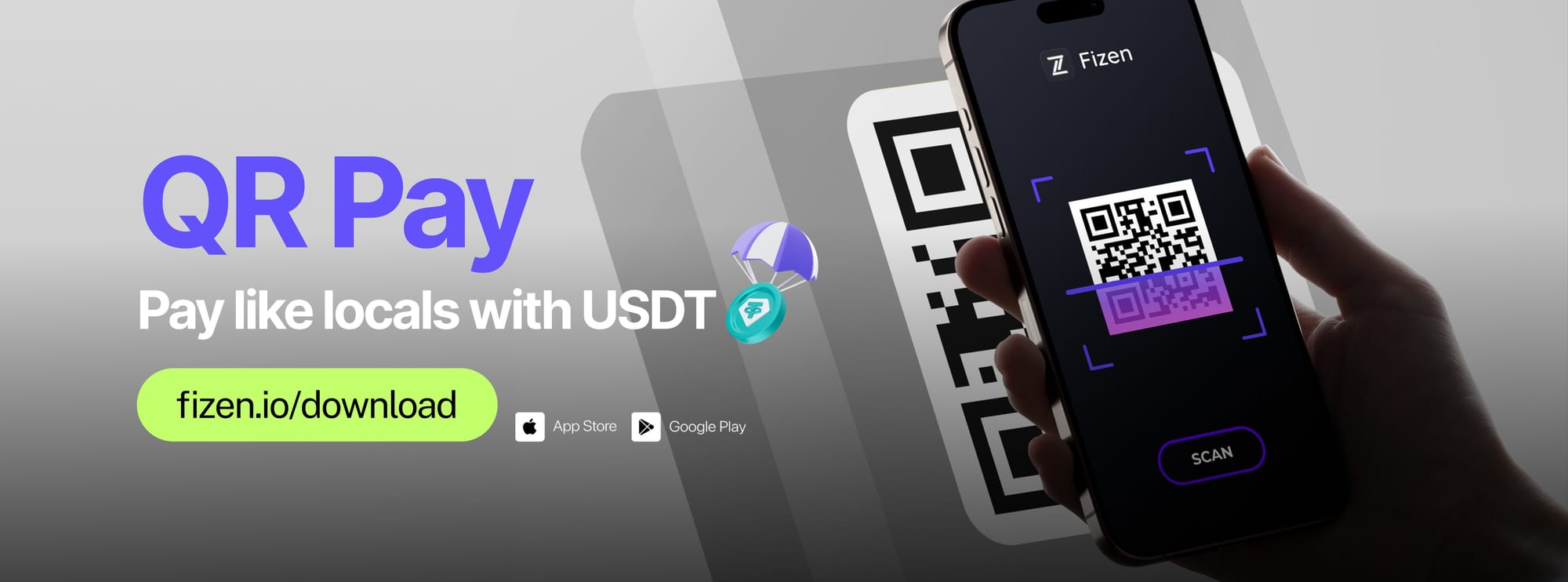
Fizen is backed by Tether, the largest digital-asset company and issuer of USDT. The Fizen Super App is available globally. QR Pay currently supports Vietnam & the Philippines. This article is for informational purposes only and does not constitute financial advice. More details: Fizen QR Pay Docs and Terms of Use.