Fizen Card vs RedotPay: Fees, Cashback, and Limits Compared (2026)
Fizen: 100 virtual cards, $10 first card, Tether-backed. RedotPay: 1 card, $5 virtual, $100 physical. Here's the full comparison.
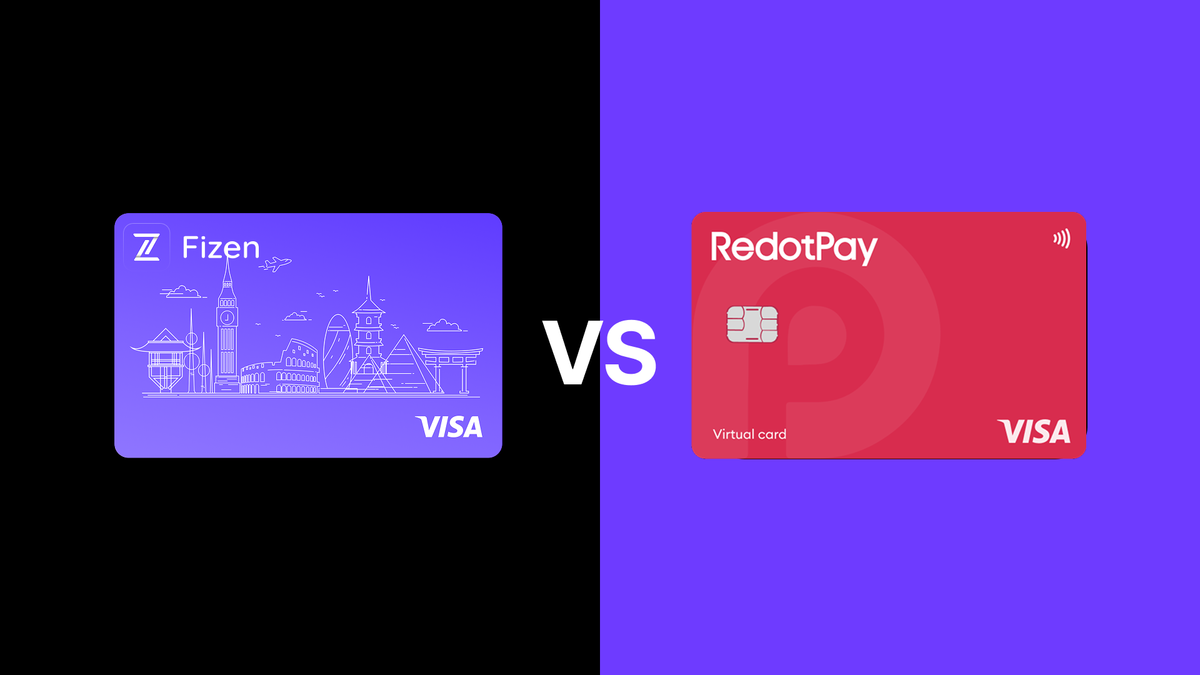
RedotPay is one of the most-searched crypto cards in Asia — probably the one you just Googled. Fizen is the Tether-backed alternative. Both issue Visa cards, both work with USDT. But you're comparing because the fees and card costs matter. Let's cut through the brand recognition and look at the actual numbers.
Side-by-Side Comparison
| Feature | Fizen Card | RedotPay |
|---|---|---|
| Card network | Visa | Visa |
| Virtual card fee | $10 (first card) | ~$5 |
| Physical card | Not yet available | $100 |
| Top-up | USDT/USDC Solana (multi-chain coming soon) | USDT multi-chain |
| Apple Pay / Google Pay | Yes | Apple Pay only |
| Transaction fees | Transparent, published | 1–3% depending on scenario |
| FX conversion | 0% (USD to USD) | 0–1% |
| Multi-card | Up to 100 virtual cards | 1 per account |
| Invested by | Tether | Independent (Hong Kong) |
| Ad platform support | TikTok, Meta, Google confirmed | Reported working |
| Affiliate program | Yes (40% on first card) | Yes (up to 40%) |
| Target user | Media buyers + USDT holders | General crypto spenders |
Where Fizen Wins
Up to 100 virtual cards. Fizen supports up to 100 virtual Visa cards per KYC account. Run 50 ad accounts? Create 50 separate cards. RedotPay is designed as one card per user — not built for media buyers managing multiple accounts.
$10 first card, transparent pricing. Fizen: $10 first virtual card, additional volume discounts available. Clear, predictable, better at scale. RedotPay: ~$5 virtual, $100 if you want physical. (Need setup guides? TikTok Ads | Meta Ads | Google Ads)
Tether investor. Fizen is strategically invested in by Tether — the company that issues USDT with $140B+ in reserves. When your card is funded by USDT and invested in by the people who make USDT, there's a trust layer that no independent Hong Kong startup can match.
0% top-up fee. Send USDT/USDC on Solana with zero deposit fees. RedotPay's transaction fees (1–3%) add up fast at scale.
Apple Pay + Google Pay. Fizen supports both Apple Pay and Google Pay. RedotPay only supports Apple Pay. If you're on Android or want the widest wallet compatibility, Fizen covers both ecosystems.
Where RedotPay Has a (Shrinking) Edge
More YouTube reviews. RedotPay has more YouTube reviews and crypto forum discussions in the Hong Kong/Asia market. But let's be clear: Fizen has been around since 2022 — a year before RedotPay launched in late 2023. Fizen has a global user base across eSIM, QR payments throughout Southeast Asia, and Visa cards. More reviews ≠ better product. It just means more marketing.
Multi-chain USDT support (for now). RedotPay supports USDT across more blockchain networks (Ethereum, Tron, Polygon, etc.). Fizen currently focuses on Solana — but multi-chain support is coming soon. This gap is temporary.
Lower virtual card entry. RedotPay's virtual card starts at ~$5, which is lower than Fizen's $10. If you just want to test a crypto card with a small amount, RedotPay's entry cost is $5 lower. But that $5 difference disappears in the first month of transaction fees.
The Real Math: 6-Month Cost
Assume: spending $5,000/month for 6 months ($30,000 total). Fizen uses 4 virtual cards (1 per ad account). RedotPay limited to 1 card.
| Cost over 6 months | Fizen | RedotPay |
|---|---|---|
| Card creation | $10 first + volume pricing (4 cards) | ~$5 (1 card only) |
| Top-up fee | $0 (0% on $30K) | Included in tx fees |
| Transaction/conversion fees | ~$150 (0.5% × $30K) | $300–900 (1–3% × $30K) |
| Multi-card capability | 4 cards, isolated billing | 1 card, single point of failure |
| Apple Pay | Yes | Yes |
| Total 6-month cost | ~$160 | $305–905 |
| Savings with Fizen | $145–745 saved over 6 months | |
At $5K/month, Fizen saves you $145–745 over 6 months. At $10K/month, that gap doubles to $290–1,490. At $30K/month, you're saving $870–4,470 in half a year — money that belongs in your ad budget.
The Honest Trade-Off
Where RedotPay has an edge: RedotPay has more YouTube reviews and crypto community discussions in the Hong Kong market. They also support more blockchain networks today — though Fizen (founded 2022, a year earlier than RedotPay) is rolling out multi-chain support soon.
But familiarity doesn't lower your fees. RedotPay's 1-card-per-account limit, 1–3% transaction fees, and $100 physical card fee make it a consumer card — not a tool for media buyers who need to scale. And both Fizen and RedotPay support Apple Pay, so there's no convenience gap there.
Fizen gives you up to 100 virtual cards, 0% top-up fee, Apple Pay + Google Pay, transparent flat pricing, and Tether backing. Whether you run 1 ad account or 50, Fizen is built to grow with you. RedotPay is built for one person spending at coffee shops.
Bottom Line
RedotPay built brand awareness first. Fizen built better economics. Over 6 months at $5K/month, Fizen saves you $145–745. At $10K/month, you're saving $290–1,490. That's not a rounding error — that's ad budget you're leaving on the table.
Fizen has been operating since 2022 with a global user base across eSIM, QR payments, and Visa cards. It matches RedotPay on Apple Pay, will match on multi-chain soon, and already beats it on everything that matters for ongoing operations: 100 virtual cards, 0% top-up, 0.5% conversion, $0 decline fees, and Tether backing. RedotPay launched a year later and still charges 1–3% on every transaction. See how Fizen compares to all 10 crypto cards here.
Related reads:
→ Fizen vs Buvei — Virtual-only vs. full Visa infrastructure
→ Fizen vs Bybit Card — EU-only exchange card vs. global Fizen
→ How to pay for TikTok Ads with USDT
→ Best USDT cards for Facebook/Meta Ads
→ How to pay for Google Ads with crypto
→ 10 Best Crypto Cards for Media Buyers 2026
Fizen Virtual Visa Card
The best card for Google, Meta, Tiktok Ads. Spend USDT like cash
Fizen is invested by Tether. USDT Visa cards with transparent fees and no $100 surprise.
Need help? Reach us at support@fizen.io or connect with our support in-app or on X (Twitter) · Telegram